AI Solutions Deployed on Microsoft Azure
Supplied to Thousands of Hospitals and Medical Institutions Worldwide
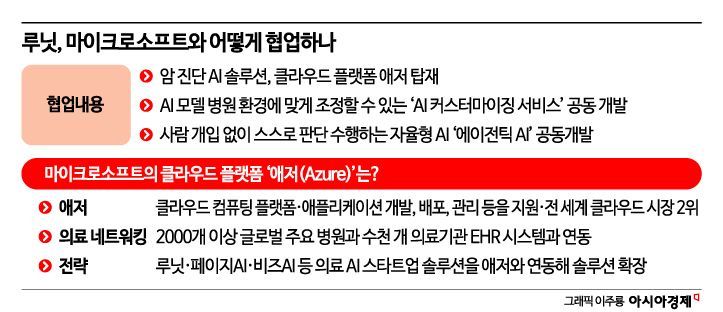
According to industry sources on July 4, Lunit recently decided to develop and supply its cancer diagnosis solutions to the global market based on MS’s cloud platform, Azure. Since medical data collected by hospitals and medical institutions varies, Lunit will also develop an “AI customization” service that provides tailored AI solutions. Additionally, the company will develop an agentic AI-based solution that automates the entire process from imaging appointments to interpretation and result delivery. By utilizing “Agentic AI,” a form of autonomous AI technology that makes decisions and performs tasks independently without human intervention, Lunit and MS plan to collaborate on developing solutions for automating medical workflows.
MS Azure has established itself as a global healthcare platform, much like a smartphone app store. In particular, it is integrated with the electronic health record (EHR) systems of over 2,000 hospitals and thousands of medical institutions worldwide, including those in the United States. This provides a foundation for Lunit’s solutions to be rapidly distributed to medical institutions around the world. The collaboration with MS is expected to be an opportunity for Lunit to accelerate its global expansion significantly.
Azure’s vast network also increases the likelihood of rapid monetization for Lunit. By providing its solutions on Azure, Lunit can expand its revenue through subscription-based and usage-based billing models. The ability to immediately access the networks of existing medical institutions and secure paying customers makes this collaboration more than just a technical partnership?it is considered a critical step in establishing a monetization structure.
This collaboration also represents an intermediate stage in Lunit’s pursuit of building “foundation AI.” Lunit’s long-term strategy is to enhance efficiency in medical settings by providing hospital-specific diagnostic AI and fully automated solutions, while continuously accumulating data and refining models to ultimately expand into foundation AI. By collaborating with global big tech cloud platforms, Lunit aims to expand its influence within the ecosystem and strengthen its revenue base.
Following its partnership with MS, Lunit is also pursuing additional collaborations with other global big tech companies. Nvidia is strengthening its AI-based medical imaging analysis and diagnostic solutions, while Google is actively developing AI solutions utilizing healthcare data. The reason big tech companies are all entering the medical AI market is because AI’s impact on the industry?including drug development, clinical trials, and treatment?is increasing. The global medical AI market was valued at $19.2 billion (about 26 trillion won) in 2023, but the industry projects that it will expand to around $600 billion (about 818 trillion won) within the next decade.
The potential for Korean medical AI startups to collaborate with global big tech companies is also drawing attention. Vuno, which owns the cardiac arrest prediction AI DeepCARS, is awaiting approval from the U.S. Food and Drug Administration (FDA). Three Billion, which provides AI for rare disease genome analysis, and Galux, which is developing AI for protein antibody design, are also considered to have significant potential for collaboration with global big tech.
An industry official stated, “The Lunit case is an important example that demonstrates both the competitiveness of Korean medical AI in the global market and its monetization potential. Domestic startups are increasingly likely to seek overseas expansion through collaborations with global platforms.”
© The Asia Business Daily(www.asiae.co.kr). All rights reserved.
![Clutching a Stolen Dior Bag, Saying "I Hate Being Poor but Real"... The Grotesque Con of a "Human Knockoff" [Slate]](https://cwcontent.asiae.co.kr/asiaresize/183/2026021902243444107_1771435474.jpg)















