DSR for Jeonse Loans and Tighter LTV in Regulated Areas Remain Options
Property Tax Hikes Considered Only as a Last Resort
Supply-Side Measures Essential for Market Stabilization
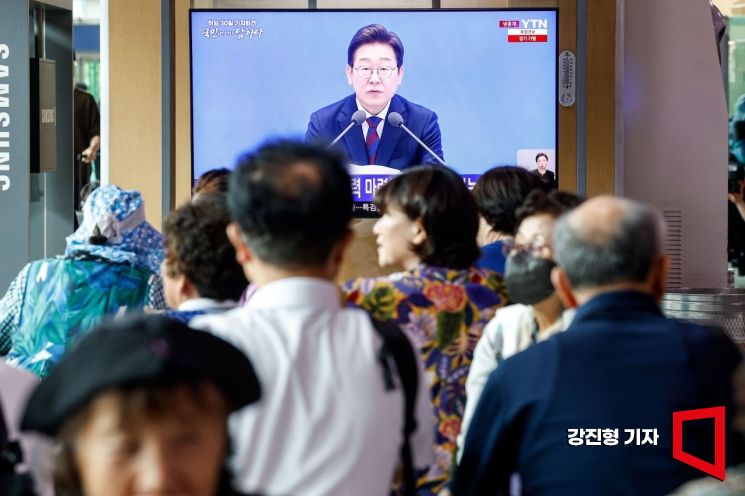 On the 3rd, citizens are watching Lee Jae Myung's 30-day presidential inauguration press conference at the Seoul Station concourse in Jung-gu, Seoul. 2025.7.3. Photo by Kang Jinhyung
President Lee Jae Myung indicated that the real estate loan regulations announced by the government on June 27 were merely a "preview," suggesting that stronger measures could be introduced depending on market conditions. In the market, there is speculation that the government could implement measures such as applying the Debt Service Ratio (DSR) to jeonse loans, tightening the Loan-to-Value (LTV) ratio in regulated areas, or further limiting the maximum amount of mortgage loans. However, some point out that regulatory measures alone have limitations in curbing the overheated real estate sentiment in the Seoul metropolitan area, emphasizing the need for swift supply-side measures.
DSR for Jeonse Loans, Tighter LTV in Regulated Areas Remain Options
According to financial authorities such as the Financial Services Commission and the Financial Supervisory Service on July 4, the government maintains that it can introduce additional measures at any time if the overheated real estate market does not stabilize.
The most prominent option is to apply the DSR to jeonse loans or policy loans. The DSR is a regulation that limits the ratio of a borrower's total annual debt repayment (principal and interest) to their annual income to no more than 40% (for banks). Until now, jeonse loans and policy loans were exempt from the DSR to support housing stability for ordinary citizens. However, there has been criticism that this exemption has recently contributed to rising home prices in Seoul. In a policy briefing to the National Planning Committee last month, the Financial Services Commission stated that if housing price instability continues, the DSR could be expanded to include jeonse loans.
There is also consideration of further tightening the LTV ratio in regulated areas. Currently, the LTV for first-time homebuyers is up to 50% in regulated areas (Gangnam, Seocho, Songpa, and Yongsan districts in Seoul) and up to 70% in non-regulated areas. The government is considering lowering the LTV ratio further to reduce the maximum loan amount. Under the June 27 regulations, the mortgage loan limit was set at 600 million won, but there is a possibility of lowering this limit even further. If the mortgage loan limit is reduced to around 200 to 300 million won, it will become much more difficult to purchase an apartment in Seoul using loans.
Regulations at the National Planning Committee level are also possible. The committee is reviewing capital regulations for banks. The idea is to require banks with a high volume of mortgage lending to hold more capital buffers, thereby reducing their capacity to supply loans. There is also discussion of increasing the risk weight for mortgage loans, which would reduce household lending by banks.
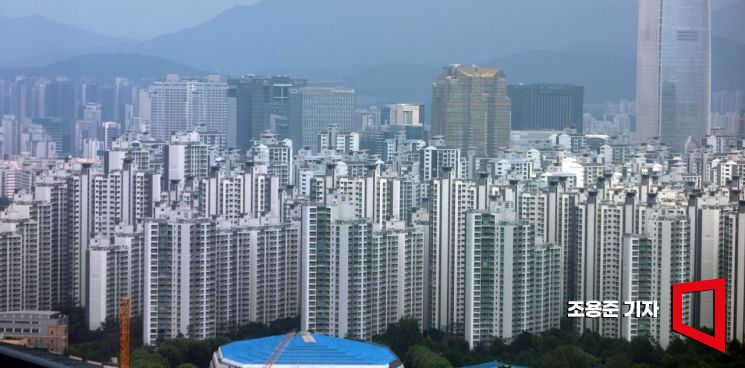
Property Tax Hikes Considered a Last Resort
Another powerful option is a tax increase. This would involve raising property holding taxes, such as the comprehensive real estate tax, to curb overheating in the real estate market. However, since President Lee has repeatedly stated before his inauguration that he would not use taxes to control housing prices, it is expected that this option will only be used as a last resort. Jin Sungjoon, the Democratic Party's Policy Committee Chair, also said in a recent radio interview, "It is desirable to prioritize financial measures, supply-side measures, and, if necessary, administrative tools, while tax measures should be considered only as a last resort."
Additionally, there is a possibility of expanding the designation of speculative zones and adjustment target areas, which currently apply only to the three Gangnam districts and Yongsan district, to other areas experiencing significant increases in housing prices.
However, there are continued concerns that regulatory measures alone are clearly limited in controlling housing prices. It is argued that fundamental problems can only be addressed if supply-side measures are implemented alongside regulations. Expanding new town supply is cited as the fastest solution.
President Lee also stated in a press conference the previous day that he would accelerate the pace of housing supply. President Lee said, "There are still many new towns that have already been planned," and added, "Although the scale is significant, supply has not yet materialized. We intend to proceed with the existing plans, but at a much faster pace." There are expectations that the government will speed up already planned projects such as the reconstruction of first-phase new towns and the development of third-phase new towns, and increase density through measures such as raising the floor area ratio.
© The Asia Business Daily(www.asiae.co.kr). All rights reserved.
![Clutching a Stolen Dior Bag, Saying "I Hate Being Poor but Real"... The Grotesque Con of a "Human Knockoff" [Slate]](https://cwcontent.asiae.co.kr/asiaresize/183/2026021902243444107_1771435474.jpg)
















