U.S. House Passes Bill with 218 Votes in Favor, 214 Against
Trump to Hold Signing Ceremony at 5 p.m. on July 4
Trump Strengthens Policy Momentum... Fiscal Deficit Remains a Concern
The tax cut package led by U.S. President Donald Trump passed its final hurdle in Congress on July 3 (local time) as it was approved by the House of Representatives. With this, President Trump has succeeded in legislating a large-scale tax cut bill that includes his core policy agenda, thereby securing a significant political victory and further strengthening his momentum in governance. However, concerns have been raised that the bill is expected to increase the federal deficit by $3.3 trillion (approximately 4,500 trillion won) over the next ten years, which could have significant aftershocks in the financial markets.
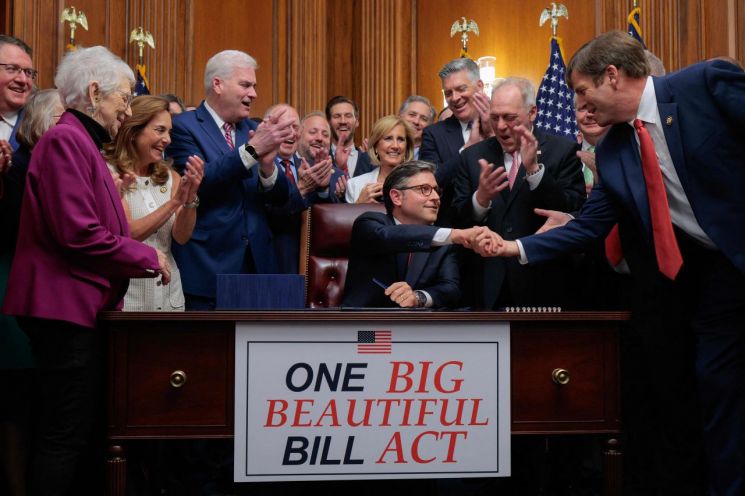
The House held a plenary session that day and put the tax cut bill, which had previously passed the Senate, to a vote, approving it with 218 in favor and 214 against.
Although two out of 220 Republican lawmakers voted against the bill, persistent internal persuasion by President Trump and the Republican leadership minimized defections. All 212 Democratic lawmakers opposed the bill. During this process, Democratic House Minority Leader Hakeem Jeffries (New York) delayed the final vote by delivering a marathon speech against the bill for as long as 8 hours and 45 minutes, exercising his authority as opposition leader. On this day, Minority Leader Jeffries also broke the previous record for the longest speech?8 hours and 32 minutes?set by then-Republican Minority Leader Kevin McCarthy in 2022.
The bill first passed the House, then moved to the Senate, where it was amended and passed, and finally returned to the House for re-approval, completing the legislative process. As President Trump previously announced, the bill will be officially enacted once he completes the signing ceremony on July 4, Independence Day. White House spokesperson Karoline Leavitt stated that President Trump would hold the signing ceremony at 5 p.m. Eastern Time on the 4th.
The bill includes provisions to extend major tax cuts that President Trump introduced during his first term. These include reductions in personal income tax rates and the top corporate tax rate, as well as expansions of the standard income deduction and child tax credit. It also contains populist measures such as tax exemptions for tips and overtime pay, and deductions for auto loan interest.
Politically, the bill features a number of "Biden erasure" policies. These include increased border security funding to curb illegal immigration, as well as measures to eliminate or phase out clean energy tax credits and tax credits for electric vehicle purchases.
With the bill's final passage in Congress, President Trump has, just about six months into his term, succeeded in legislating a comprehensive bill that encapsulates his major campaign pledges and policy agenda, giving a significant boost to his administration.
However, there is considerable concern that the bill will significantly expand the federal deficit, leading to serious aftereffects. The Congressional Budget Office (CBO) projects that the bill will increase the federal deficit by $3.3 trillion by 2034. This is because the total tax cuts amount to $4.5 trillion, while government spending reductions are limited to $1.2 trillion. As the deficit expands, U.S. Treasury bond issuance is expected to increase, and this could cause a sharp rise in Treasury yields, potentially delivering a significant shock to the financial markets.
Another concern is that the tax cut benefits are concentrated among high-income earners, while cuts to the Medicaid (health insurance for low-income individuals) budget are expected to result in about 11 million people losing health coverage over the next ten years.
President Trump, for his part, maintains that the tax cuts will stimulate consumption and expand corporate investment, leading to economic growth and a "trickle-down effect" that will benefit the middle class and below. He also plans to offset revenue losses through increased tariff income and other measures.
© The Asia Business Daily(www.asiae.co.kr). All rights reserved.

















