Statement Issued Immediately After Passage in National Assembly
Economic Organizations: "Regret Over Plenary Passage"
"Discussion Needed on Management Defense Measures"
After the National Assembly passed the amendment to the Commercial Act, which is the first livelihood bill of the Lee Jaemyung administration, economic organizations collectively expressed their concerns.
On July 3, immediately after the bill passed the plenary session, eight major economic organizations issued a statement saying, "The business community regrets the passage of the Commercial Act amendment by the National Assembly." The eight organizations include the Korea Economic Association, Korea Chamber of Commerce and Industry, Korea Employers Federation, Korea International Trade Association, Korea Federation of SMEs, Korea Federation of Middle Market Enterprises, Korea Listed Companies Association, and the Kosdaq Association.
The amendment expands the fiduciary duty of corporate directors to include both the company and its shareholders, and limits the combined voting rights of the largest shareholder and related parties to 3% (the 3% rule) when appointing audit committee members. It also mandates electronic general shareholders' meetings for listed companies and converts outside directors into independent directors.
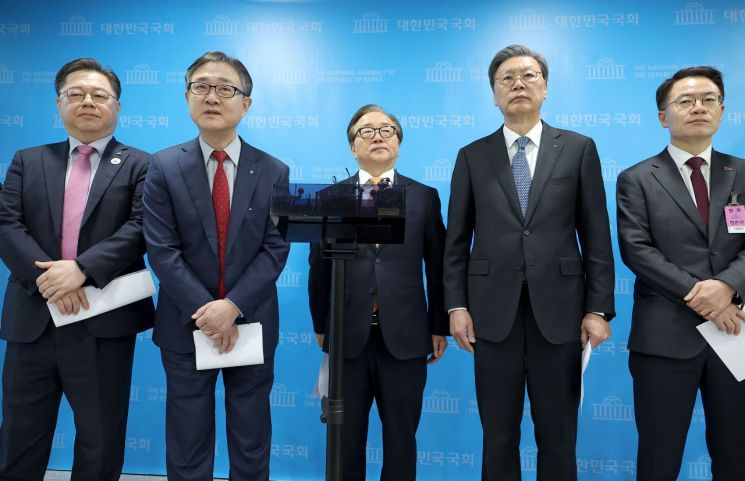 Park Iljun, Executive Vice President of the Korea Chamber of Commerce and Industry, Lee Donggeun, Executive Vice President of the Korea Employers Federation, Kim Changbeom, Vice President of the Korea Economic Association, and other executives from eight economic organizations held a press conference on March 19 at the National Assembly Communication Office, urging the acting president to exercise the right to request reconsideration of the amended Commercial Act passed by the plenary session. Yonhap News.
The business community has strongly opposed the amendment to the Commercial Act, which has been promoted by the Democratic Party of Korea. They pointed out that if the amendment is implemented, minority shareholders or activist funds could file excessive lawsuits against companies.
They stated, "While we agree with the intent of the amendment to vitalize the capital market and create fair market conditions, we have significant concerns because no measures have been prepared for directors to defend themselves in lawsuits, and the strengthening of the 3% rule increases the likelihood that speculative forces could appoint audit committee members."
They also added, "Since the National Assembly has expressed its intention to supplement the system through ongoing communication with the business community if necessary, we hope that discussions will proceed quickly on the codification of the business judgment rule, improvement of the breach of trust crime, and the introduction of measures to defend management rights."
© The Asia Business Daily(www.asiae.co.kr). All rights reserved.
![Clutching a Stolen Dior Bag, Saying "I Hate Being Poor but Real"... The Grotesque Con of a "Human Knockoff" [Slate]](https://cwcontent.asiae.co.kr/asiaresize/183/2026021902243444107_1771435474.jpg)















