President Lee Hints at "Preview" in July 3 Press Conference
Emphasizes "Curbing Demand and Expanding Supply, Many Policies in Place"
At a press conference on July 3, President Lee Jae Myung responded that the "loan regulations announced by the Financial Services Commission on June 27 are just a preview," fueling growing interest in additional measures the government is expected to introduce. President Lee had rarely commented on the direction of real estate policy, both during his presidential campaign and after his election. However, he has now outlined a general direction focused on "curbing demand and expanding supply." While some predict that the recent loan regulations may slow the rise in Seoul housing prices, various regulatory measures are being discussed in the market.
On this day, President Lee pointed out that speculative demand is high in the current real estate market, a view that aligns with the previous Moon Jae In administration. However, the methods to address this issue differ. President Lee stated, "Although it may not go as planned, I believe it would be much better to shift investment from real estate to the financial market, and I intend to make that happen."
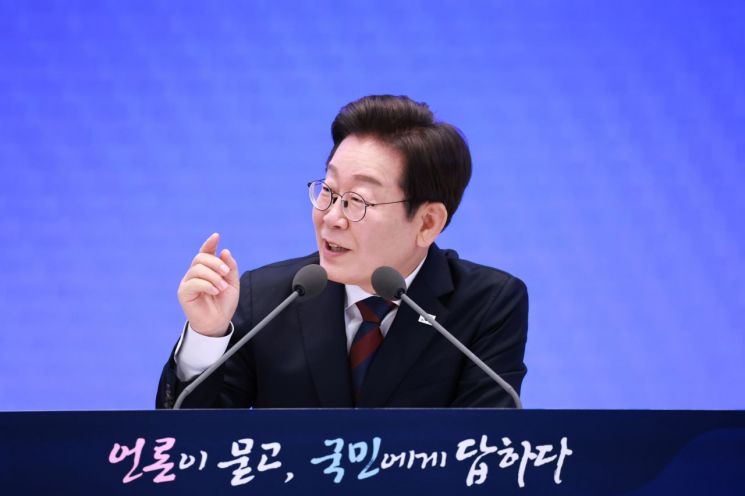 President Lee Jae Myung is speaking at the press conference "30 Days of the President, Media Asks and Answers the People" held at the Blue House State Guest House on July 3, 2025. Photo by Yonhap News
During the Moon Jae In administration, a real estate policy tightening loan regulations and expanding regulated zones was introduced within a month of the president taking office. This was even before Kim Hyun Mee, who was nominated as the first Minister of Land, Infrastructure and Transport under Moon Jae In, assumed her post. Upon taking office, Minister Kim emphasized, "An apartment is a home, not a means of making money, and there should be no more cases where the housing market is disrupted to the extent that ordinary people and genuine buyers are unable to own homes for the sake of profit." She described the real estate policy at the time as "the first message to those people." Observers interpreted this as a declaration of war against speculative forces.
Potential demand-suppression measures President Lee may introduce include not only loan regulations but also the designation of regulated areas such as speculative zones and land transaction permit zones (Toheoguyeok). In Seoul and other parts of the capital region, where many redevelopment projects are underway, the full implementation of the reconstruction excess profit recovery system (reconstruction levy) and the increase in the official price realization rate are being considered. Both policies were promoted during the Moon Jae In administration but were suspended under the previous Yoon Suk Yeol government.
The reconstruction levy aligns with the current administration’s stance of preventing a small number of people from monopolizing excessive development profits. Raising the official price realization rate was originally intended to gradually narrow the gap between the official housing price used for various tax calculations and the actual market price, but this plan has stalled. If the official price realization rate increases, property holding taxes such as the comprehensive real estate tax will rise even without changes to the existing tax system. These measures can be implemented at any time, depending on the government’s willingness to act.
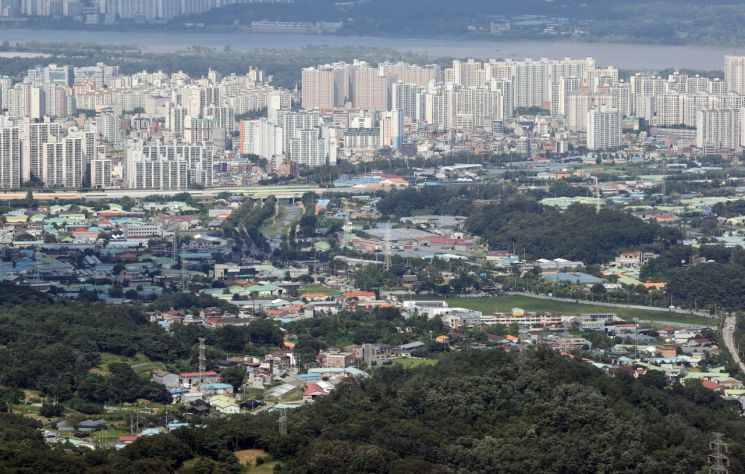
Reforming the tax system is likely to be left as a last resort. President Lee himself has declared, "I will not try to control housing prices through taxes," and he is well aware that the backlash could outweigh the benefits. The fact that the land ownership tax, which was proposed during the 20th presidential election, was omitted from this election's platform seems to reflect the same reasoning. However, there remains some room for discussion within the ruling party about reconsidering property holding taxes or transaction taxes.
Regarding housing supply, President Lee announced that he would not designate additional new towns but would instead accelerate the pace of existing projects. Given his extensive administrative experience with new towns at both the municipal (Seongnam City) and provincial (Gyeonggi Province) levels, he is well aware that the impact of new towns on housing supply is often delayed.
Instead, he mentioned reusing existing sites or making use of current land, rather than relying solely on new development sites. Direct participation by the government or public institutions in areas where projects have stalled due to low profitability is considered a realistic approach. Regarding the Daejang-dong development project, which has been mired in legal disputes, President Lee has consistently argued that it was a "public interest project model in which the government (Seongnam City) participated, generated profits, and returned them to citizens." His plan to utilize idle land owned by public institutions or corporations to increase housing supply is also one of his campaign pledges.
© The Asia Business Daily(www.asiae.co.kr). All rights reserved.
![Clutching a Stolen Dior Bag, Saying "I Hate Being Poor but Real"... The Grotesque Con of a "Human Knockoff" [Slate]](https://cwcontent.asiae.co.kr/asiaresize/183/2026021902243444107_1771435474.jpg)
















