Lee Jae Myung: "Absorptive unification would require enormous sacrifices and conflicts"
Suggests a mutually beneficial approach and supports renaming the Ministry of Unification
Criticizes the previous administration's suspension of inter-Korean communication as "truly foolish"
Expresses uncertainty over concluding tariff negotiations by July 8
U.S. Secretary of State Marco Rubio cancels visit to South Korea; concerns over postponement of summit
On July 3, President Lee Jae Myung stated, "(Absorptive unification) would entail enormous sacrifices and conflicts," adding, "If possible, let us acknowledge (North Korea's) existence and pursue a path that is mutually beneficial."
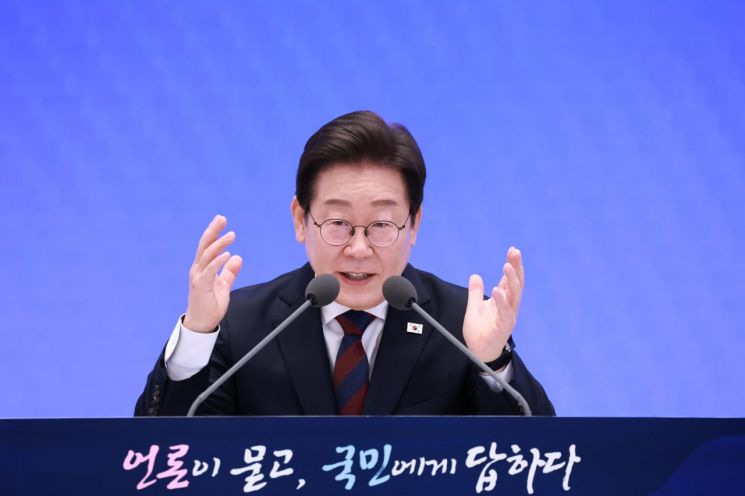 President Lee Jae Myung is speaking at the press conference titled "30 Days of the President, Media Asks and Answers the People" held at the Blue House State Guest House on July 3, 2025. Photo by Yonhap News
During a press conference marking his 30th day in office, President Lee made these remarks in response to a question about his vision for North Korea policy. He said, "Our Constitution states that we aim for peaceful unification." He went on to say, "If our goal is not the annihilation of (North Korea), then within the bounds of our safety, we should pursue a path that benefits both sides, which means dialogue, communication, cooperation, and coexistence." He added, "If South and North Korea gradually recover their sense of commonality, unification will be possible even centuries from now."
In line with this approach, President Lee also expressed agreement with discussions about the need to change the name of the Ministry of Unification. He said, "I have communicated various ideas to the (National) Security Office and the National Intelligence Service," and added, "I will speak about what specific actions have been taken when the results are available."
Regarding the complete suspension of inter-Korean communication under the previous Yoon Suk Yeol administration, President Lee strongly criticized it, saying, "Diplomacy continues even during wartime. That was truly foolish." He continued, "Currently, (inter-Korean relations) are hostile and deeply mistrustful, so I do not expect this to be easy." Nevertheless, he repeatedly emphasized, "Based on close cooperation and consultation with the United States, I will work to improve relations with North Korea."
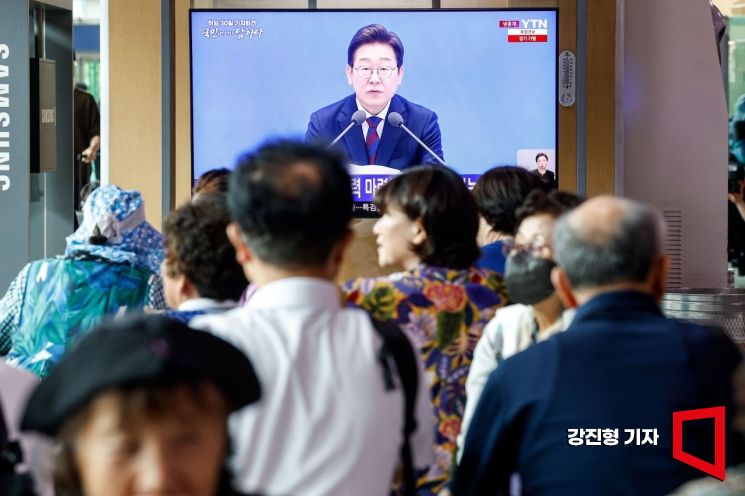 On July 3, 2025, citizens are watching Lee Jae Myung's 30-day presidential inauguration press conference in the waiting room of Seoul Station, Jung-gu, Seoul. Photo by Kang Jinhyung
Meanwhile, regarding the tariff negotiations, which are among the most pressing issues between South Korea and the United States, President Lee said, "It is certainly not an easy matter," and admitted, "It is difficult to say with certainty whether we can conclude (the negotiations) by July 8, which is the deadline for the mutual tariff suspension." President Lee added, "We need to achieve a mutually beneficial outcome that helps both sides, but so far, neither side has clearly defined exactly what it wants. I will do my utmost."
In this context, the planned visit to South Korea by U.S. Secretary of State and National Security Advisor Marco Rubio, which had been discussed for July 8, was canceled just five days before the expected date. A Ministry of Foreign Affairs official stated, "South Korea and the United States have kept the possibility of Secretary Rubio's visit open and have been in discussions, but due to internal circumstances in the U.S., a visit in the near future seems unlikely. The two countries will continue to consult on high-level exchanges."
As a result, there are concerns that the South Korea-U.S. summit, which was initially expected to take place at the end of July or the beginning of August, may also be postponed. Ultimately, key issues between the two countries, such as mutual tariffs, need to be resolved at the summit level. A senior official at the presidential office said, "Even if Secretary Rubio had come (to South Korea), we would have been limited in what we could discuss," adding, "Matters such as tariffs and defense cost-sharing are topics for discussion within broader frameworks."
© The Asia Business Daily(www.asiae.co.kr). All rights reserved.


















