Improvement of Work Suspension Lifting Procedures
and Definition of Confined Spaces
If a company fulfills the "registration of new chemical substances" requirement under the Act on the Registration and Evaluation of Chemicals (K-REACH) when manufacturing or importing new chemical substances, it is exempt from submitting the "hazard and risk assessment report for new chemical substances" required under the Occupational Safety and Health Act (OSHA). However, the registration threshold under K-REACH is 1 ton or more per year, whereas the OSHA threshold is 100 kilograms or more per year.
As a result, if the annual amount of new chemical substances manufactured or imported is less than 1 ton, companies are exempt from registering the new chemical substance under K-REACH, but are still required to submit a separate hazard and risk assessment report for new chemical substances under OSHA, which has been cited as an inconvenience.
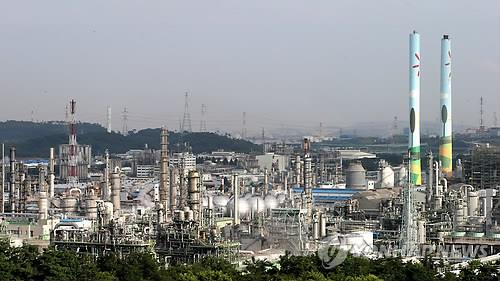 Ulsan Petrochemical Complex panorama.
The Korea Employers Federation announced on July 3 that it had identified 147 regulatory improvement tasks related to safety, health, chemicals, and the environment that do not reflect on-site realities, and submitted them to the government. Of these, 40 are new proposals, while 107 are repeated suggestions previously submitted to the government since last year that have not yet received a response.
Key proposals include: ▲Improvement of the procedure for lifting work suspensions ▲Clarification of the scope of risk assessments for subcontracted work ▲Improvement of the definition of confined spaces ▲Expansion of exemptions from certain installation and management standards for rest facilities ▲Improvement of overlapping regulations regarding hazard and risk assessment reports for new chemical substances ▲Improvement of overlapping regulations on personal protective equipment standards for chemicals, taking into account the characteristics of specific tasks.
The Federation stated, "Under the current Occupational Safety and Health Act, the procedure for lifting a work suspension is complicated, as it must go through a review committee, which prolongs the suspension period and infringes on the employer's management rights." The Federation proposed eliminating the 'review committee' procedure and removing the requirement for a 'majority' in the process of hearing workers' opinions.
The Federation also pointed out, "The current definition of confined spaces is ambiguous, resulting in even safe passageways equipped with ventilation systems being classified as confined spaces, which imposes excessive obligations." It suggested that areas where the absence of risk is proven by continuous operation of ventilation systems should be excluded from the definition of confined spaces.
Lim Wootaek, head of safety and health at the Federation, emphasized, "Overlapping regulations of similar systems are increasing confusion and burdens in the industry," and added, "Active regulatory improvements must be made through communication and coordination among government ministries."
© The Asia Business Daily(www.asiae.co.kr). All rights reserved.
















