New Molecular Mechanism of DNA Repair Revealed Using Single-Molecule Imaging
Findings Offer Insights for Prevention and Treatment Strategies for Xeroderma Pigmentosum and Skin Cancer... Published in Nucleic Acids Research
Twisted DNA strands caused by intense ultraviolet rays are a source of skin aging and cancer.
Fortunately, our bodies have a pathway that can rapidly identify and repair only the damaged sites among the three billion DNA base pairs, and the mechanism behind this process has now been newly revealed.
A team led by Professor Lee Jaeil from the Department of Life Sciences at UNIST has discovered that, in the DNA repair pathway known as 'NER', the two proteins responsible for detecting damaged sites function as a 'cooperative complex' rather than the previously known 'sequential handover' relationship.
 Research team, Professor Lee Jaeil (left) and Researcher Ahn Soyoung. Provided by UNIST
NER is a repair pathway that removes a type of damage structure called CPD, which is caused by ultraviolet light. Since DNA is made up of about three billion base pairs, the speed at which damaged sites are detected determines the efficiency of the repair.
The XPC protein, which detects structural changes, is activated to find the damaged sites. However, because CPD damage does not cause significant distortion, XPC alone has difficulty recognizing it. In this case, a protein called UV-DDB assists in damage recognition.
Previously, it was understood that UV-DDB first binds to the damaged site and then sequentially transfers it to XPC.
In contrast, this study found that the two proteins form a complex (UX-complex), jointly search the DNA, and that XPC enhances both the binding strength and search efficiency of UV-DDB.
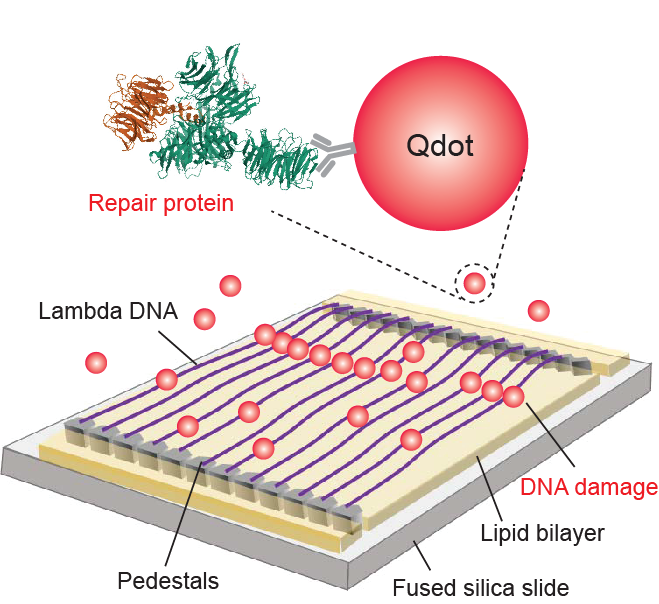
This conclusion was supported by experiments using a single-molecule imaging technique called DNA curtain. In this method, protein molecules are flowed over DNA strands aligned on a glass surface, and their movements are tracked with a fluorescence microscope. The experiments showed that when the two proteins form a complex, UV-DDB adheres more strongly to the DNA strand and slides along it, enabling more effective detection of damaged sites.
First author, Researcher Ahn Soyoung, explained, "This is the first case in which we have directly observed the molecular movements that accurately locate damaged sites."
Professor Lee Jaeil stated, "We have demonstrated that the two proteins recognizing ultraviolet damage cooperate to detect damage more rapidly and promote the NER process," adding, "This is a significant result that could rewrite the principles of NER described in molecular biology textbooks, and it will contribute not only to understanding skin damage and aging caused by ultraviolet rays, but also to developing prevention and treatment strategies for xeroderma pigmentosum and skin cancer."
Xeroderma Pigmentosum is a disorder caused by defects in the gene that produces the XPC protein, and those affected have a risk of skin cancer that is hundreds to thousands of times higher than that of the general population.
This research was supported by the National Research Foundation of Korea's Mid-Career Researcher Program and the Bio-Medical Technology Development Program. The results were published online on June 18 in the world-renowned journal 'Nucleic Acid Research (IF: 16.6)'.
© The Asia Business Daily(www.asiae.co.kr). All rights reserved.
![Clutching a Stolen Dior Bag, Saying "I Hate Being Poor but Real"... The Grotesque Con of a "Human Knockoff" [Slate]](https://cwcontent.asiae.co.kr/asiaresize/183/2026021902243444107_1771435474.jpg)















