Including 3,500 Institutions Adopting Volpara Products
Lunit, a medical artificial intelligence (AI) company, announced on July 3 that the number of medical institutions worldwide that have adopted its AI imaging diagnostic solutions surpassed 10,000 as of the end of last month.
This figure combines 6,500 medical institutions that have implemented Lunit products with 3,500 institutions that have adopted solutions from Volpara Health (Volpara), which became a Lunit subsidiary in May last year.
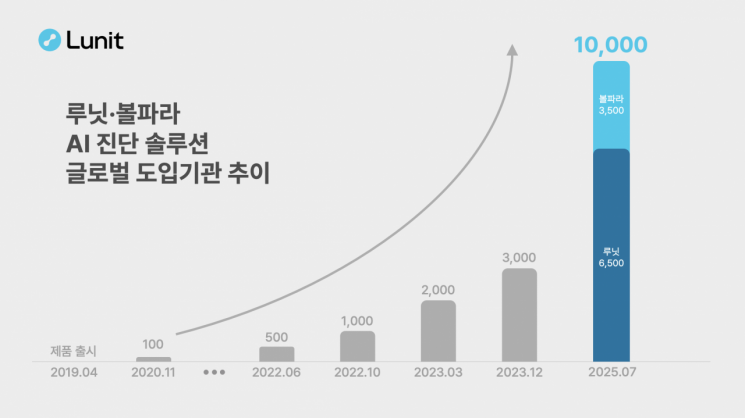
Lunit launched its chest X-ray AI imaging analysis solution, "Lunit INSIGHT CXR," and its mammography AI imaging analysis solution, "Lunit INSIGHT MMG," in 2019. The company surpassed 100 institutions by the end of 2020, 1,000 by the end of 2022, and 3,000 by the end of 2023. Now, with its products supplied to 6,500 institutions, Lunit has achieved more than double growth in approximately 18 months.
Volpara also saw rapid growth, with the number of institutions adopting its solutions rising sharply from just over 2,000 at the time of acquisition to 3,500 currently. More than 90% of all adopting medical institutions are overseas customers, with the largest numbers in the United States, followed by Asia and Oceania, Europe, Central and South America, the Middle East, and Africa. Lunit is currently actively pursuing post-merger integration (PMI) with Volpara and plans to accelerate market penetration by integrating the two companies' product portfolios in the global market, including the United States, starting in the second half of this year.
Previously, Lunit announced partnerships with global big tech companies, including Microsoft (MS), to jointly develop diagnostic medical AI solutions. This collaboration involves deploying the AI solutions developed by both companies on Microsoft's cloud platform, Azure, for distribution in overseas markets. As a result, the supply of new products is expected to increase significantly.
Seo Beomseok, CEO of Lunit, stated, "While Lunit has previously pioneered the market through hardware-focused collaborations with global medical device companies such as GE Healthcare, Philips, and Fujifilm, we are now expanding and reshaping the market with a software-centric approach through partnerships with global big tech companies like Microsoft. The number of medical institutions using Lunit products is expected to increase even more significantly going forward."
© The Asia Business Daily(www.asiae.co.kr). All rights reserved.
![Clutching a Stolen Dior Bag, Saying "I Hate Being Poor but Real"... The Grotesque Con of a "Human Knockoff" [Slate]](https://cwcontent.asiae.co.kr/asiaresize/183/2026021902243444107_1771435474.jpg)















