Foreign Direct Investment in the First Half of 2025 Drops Nearly 15%
U.S. Tariff Measures and Domestic Political Instability Cited as Main Factors
Foreign direct investment (FDI) in the first half of this year dropped by nearly 15%. The decline in investment was attributed to the tariff measures implemented by the United States following the inauguration of President Donald Trump, as well as domestic political instability such as the declaration of emergency martial law and the impeachment of the president.
According to the Ministry of Trade, Industry and Energy on July 3, 2025, the amount of reported FDI in the first half of 2025 was $13.1 billion, down 14.6% compared to the same period last year.
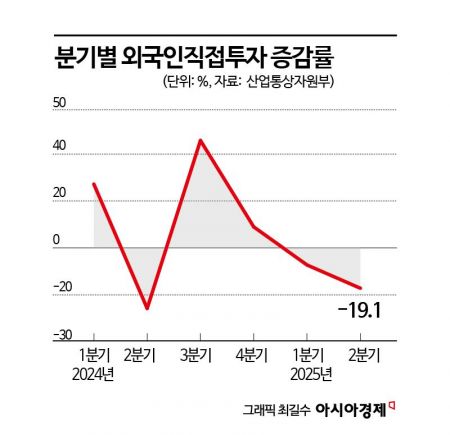
The amount of reported FDI has declined for two consecutive quarters since the first quarter of this year, with the decrease accelerating from 9.2% in the first quarter to 19.1% in the second quarter.
An official from the Ministry of Trade, Industry and Energy explained, "Ongoing delays in new investments by global companies have been observed due to U.S. tariff policies and domestic political instability following the emergency martial law incident in December last year. As a result, reported foreign investment intentions have decreased compared to the same period last year."
By investment type, greenfield investment?intended for new or expanded factories?was reported at $10.97 billion, a 4.5% decrease year-on-year. Mergers and acquisitions (M&A) investment amounted to $2.13 billion, a 44.6% decrease.
By country, the European Union (EU) reported $2.24 billion in investment in the first half of this year, a 14.5% increase compared to the same period last year, following the results of an offshore wind power project bid in December last year. The United States also saw a 20.2% increase, mainly in the service sector, reaching $3.13 billion. In contrast, Japan ($2.16 billion, down 25.4%) and China ($1.82 billion, down 39.0%) saw declines.
Foreign direct investment in the manufacturing sector dropped sharply. Manufacturing FDI was $5.33 billion, down 34.5% year-on-year, while the service sector saw an increase of 10.6% to $7.09 billion. The decline in manufacturing was mainly in capital-intensive industries such as electrical and electronics ($1.4 billion, down 61.6%) and machinery equipment and medical precision ($260 million, down 77.0%), due to the concentration of global investment in the U.S. following U.S. tariff policies and a contraction in domestic facility investment (down 2.1% in the first quarter). In contrast, service sector investment increased, with reported investments in distribution ($1.32 billion, up 73.3%) and information and communications ($1.09 billion, up 9.4%) rising as companies sought to enter the Korean market.
An official from the Ministry of Trade, Industry and Energy stated, "The FDI figures for the first half of this year demonstrate that U.S. tariff measures and domestic political instability are having a negative impact on attracting foreign investment to Korea. Given the persistent uncertainty in the global economy, it is difficult to predict the annual FDI situation based solely on first-half results. However, with the launch of the new administration and the easing of uncertainty surrounding U.S. tariffs, we expect performance to improve in the second half, showing a 'low in the first half, high in the second half' trend."
© The Asia Business Daily(www.asiae.co.kr). All rights reserved.
![Clutching a Stolen Dior Bag, Saying "I Hate Being Poor but Real"... The Grotesque Con of a "Human Knockoff" [Slate]](https://cwcontent.asiae.co.kr/asiaresize/183/2026021902243444107_1771435474.jpg)















