New Delhi Bans Fuel Sales to Old Vehicles
Gasoline Cars Over 15 Years, Diesel Over 10 Years Targeted
PM2.5 Levels 18 Times Higher Than WHO Guideline
In New Delhi, the capital of India and often cited as the world's most polluted city, a new measure banning the sale of fuel to old vehicles has been implemented. According to Yonhap News, citing AFP on July 1 (local time), as of that day, gasoline vehicles that have been in use for more than 15 years and diesel vehicles older than 10 years are no longer allowed to refuel in New Delhi.
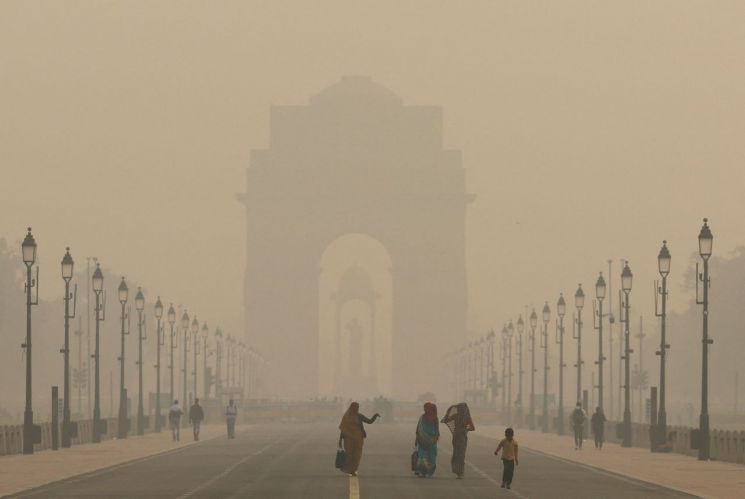
This measure is interpreted as an attempt to effectively phase out old vehicles from New Delhi. On the day of implementation, police officers and city officials were stationed at gas stations throughout the city, and license plate recognition cameras and loudspeakers were installed. A traffic police officer assigned to one gas station told AFP that they had been instructed to immediately contact scrap dealers if an old vehicle arrived. The measure is scheduled to be expanded to neighboring satellite cities near New Delhi in November, covering a total population of 32 million people in the affected areas.
Air pollution in India is at a critical level. The internationally respected medical journal The Lancet analyzed that in 2019, air pollution in India caused 1.67 million deaths and resulted in an economic loss of $36.8 billion (about 40.5 trillion won at the time). The report stated that air pollution led to an increase in diseases such as lung cancer, heart disease, stroke, diabetes, neonatal disorders, and respiratory illnesses.
According to the "2024 World Air Quality Report" released in March by Swiss air quality analysis company IQAir, New Delhi had the worst air quality among all world capitals last year. The annual average concentration of fine particulate matter (PM2.5) in New Delhi last year was 91.6 micrograms per cubic meter (㎍/㎥), which is 18 times higher than the World Health Organization (WHO) recommended standard of 5 ㎍/㎥. In November last year, the PM2.5 concentration at one point reached 980 ㎍/㎥, which is 65 times the daily maximum standard (15 ㎍/㎥).
According to Yonhap News, the Supreme Court of India had already ruled in 2018 to ban gasoline vehicles older than 15 years and diesel vehicles older than 10 years from operating on New Delhi roads. Nevertheless, there are currently 6 million old vehicles still in operation. In addition to old vehicles, emissions from coal-fired power plants and factories, as well as the burning of fields and garbage in rural areas, are making air pollution even worse.
India's air quality is generally moderate from January to September but deteriorates severely from October to December. During this period, smoke from the burning of farmland by slash-and-burn farmers in Punjab and Haryana in northern India is carried by the wind, and during Diwali, the largest Hindu festival held from late October to mid-November, large quantities of fireworks are set off. The combination of lower temperatures and weaker winds keeps the air pollution at critical levels. The Indian government has tried various measures to reduce fine dust, such as operating water mist spray vehicles, but these efforts have not produced noticeable results.
© The Asia Business Daily(www.asiae.co.kr). All rights reserved.
![Clutching a Stolen Dior Bag, Saying "I Hate Being Poor but Real"... The Grotesque Con of a "Human Knockoff" [Slate]](https://cwcontent.asiae.co.kr/asiaresize/183/2026021902243444107_1771435474.jpg)















