The Korea Forest Service Employees' Union (hereinafter referred to as the Forest Union) has expressed strong concerns regarding some calls for the fire department to take on the role of the control tower for large-scale wildfires. The union argues that transferring wildfire response command authority (from the Korea Forest Service to the National Fire Agency) is based on misunderstandings and distrust of the field, and that if such a transfer were to occur, it could have a serious impact on the rights and interests of public sector workers as well as the overall national wildfire response system.
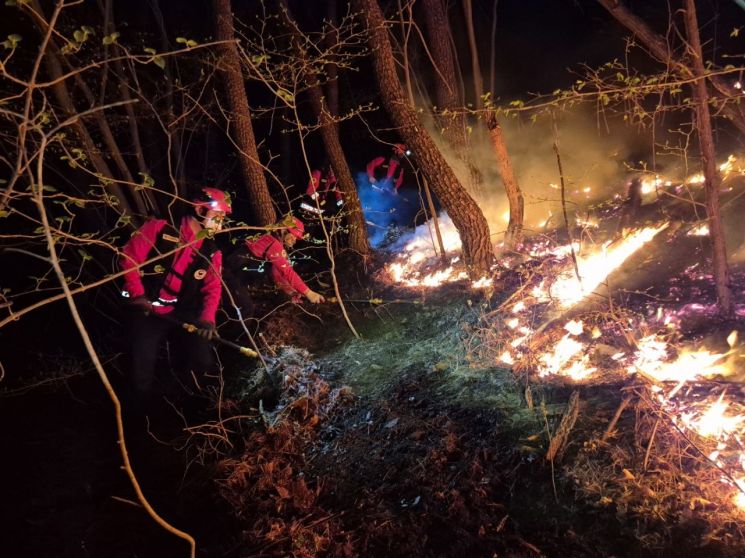 This year, the Korea Forest Service wildfire suppression team is conducting wildfire suppression activities at the wildfire site in Uiseong, Gyeongbuk. Provided by Korea Forest Service
On July 3, the Forest Union released a statement outlining this position. In the statement, the Forest Union emphasized that wildfires are fundamentally different from ordinary fires, and that transferring command authority is not a fundamental solution to wildfire response.
The Forest Union defined wildfires as "high-risk disasters in which various factors such as forest ecosystems, topography and climate, local residents, and cultural heritage interact in complex ways." The union pointed out that, considering the unique characteristics of wildfires, an integrated management approach is needed that encompasses forest management, prevention, preparedness (monitoring), suppression, recovery, and restoration, rather than a simple concept of fire extinguishing.
The union also argued that "this kind of integrated management system is currently being operated based on the experience, data, and organizational infrastructure that the Korea Forest Service has accumulated over several decades, and it would be difficult for another agency to replace or replicate this in a short period of time."
There was agreement that improvements to the current wildfire response system are necessary. However, the union expressed concern that transferring command authority, as some have proposed, could cause confusion and a vacuum of responsibility in the field.
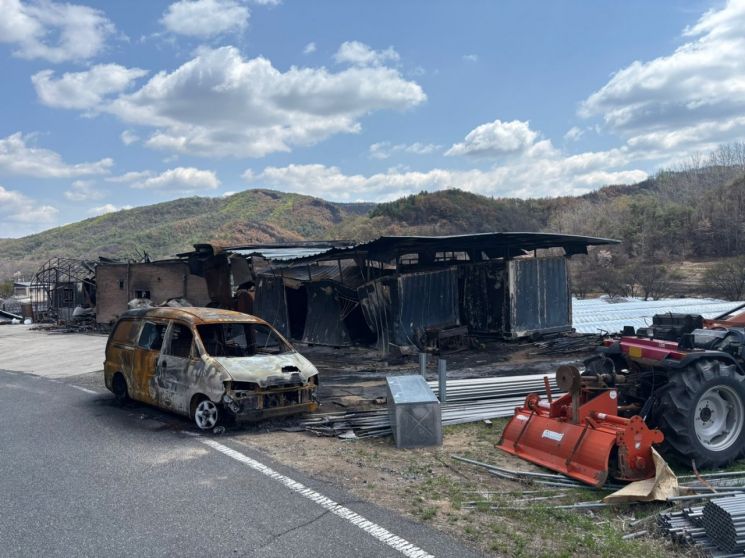 Buildings and vehicles completely burned down as the flames spread toward residential areas during the wildfire in Uiseong, Gyeongbuk. Photo by Jeong Ilwoong
The union also reminded the public that calls for transferring command authority, which have recently resurfaced, have been repeatedly discussed in the past, but have always concluded that "the Korea Forest Service should remain at the center of wildfire response."
The Forest Union stated, "Since 1996, discussions on reorganizing the wildfire command system have been repeated seven times whenever there were large-scale wildfires or government organizational reforms," but emphasized, "In all discussions, the conclusion was that it is appropriate to maintain command authority centered on the Korea Forest Service."
The union explained that this conclusion was not simply based on the interests of the Korea Forest Service as an organization, but was reached by comprehensively considering the expertise required for wildfire response, administrative efficiency, budgetary connectivity, and accountability.
Nevertheless, the union expressed concern that, despite the same conclusion being reached in all seven previous discussions, unilateral calls for transferring command authority are once again being raised without scientific or policy-based grounds or empirical analysis.
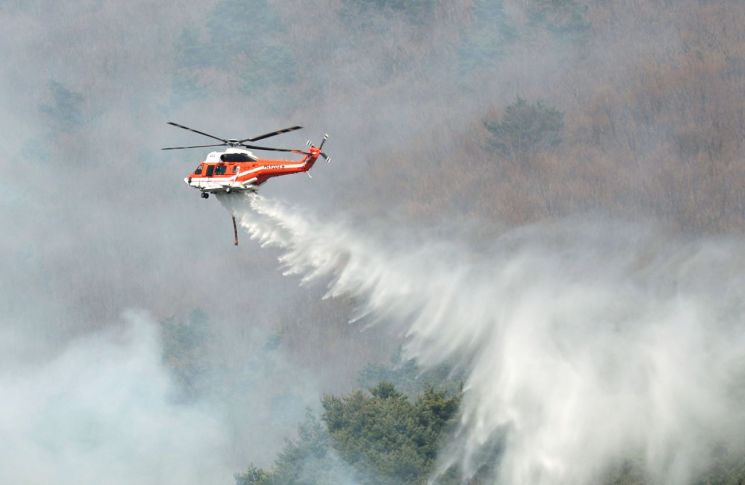 A Korea Forest Service wildfire suppression helicopter is extinguishing a forest fire. Photo by Yonhap News
The union also raised suspicions that the ongoing discussions about transferring command authority are not simply about changing the command system, but could be seen as a structural attempt by the National Fire Agency to absorb the organization and assets of the Korea Forest Service's Forest Aviation Headquarters.
The union further pointed out that such attempts could ultimately be interpreted as a planned organizational restructuring aimed at expanding the National Fire Agency and securing more opportunities for promotion within its ranks. The union warned that if command authority were actually transferred in this direction, the Korea Forest Service's expertise in disaster response and its integrated wildfire management system would be seriously undermined, ultimately threatening the lives and safety of the public.
The union concluded by stating, "The Forest Union is not simply focused on maintaining command authority, but believes that a stronger and more effective national wildfire response system must be established." The union emphasized that collaboration among relevant agencies (such as the Korea Forest Service, National Fire Agency, and local governments) is essential for wildfire response, and that the Korea Forest Service, as the organization that has accumulated long-term experience and know-how in wildfire management, should remain at the center of this system.
Meanwhile, on July 1, a National Assembly debate on "Measures to Improve the Wildfire Disaster System" was held at the National Assembly Members' Office Building in Yeouido, Seoul. At the event, many current and former firefighters argued that the National Fire Agency should be unified as the control tower for large-scale wildfire disaster response.
At the debate, fire officials cited the inefficiency of the current response system, which is divided among the Korea Forest Service, National Fire Agency, and local governments, as well as the structural limitations of this system in minimizing damage should another large-scale wildfire occur in the future, as grounds for the need to transfer command authority.
© The Asia Business Daily(www.asiae.co.kr). All rights reserved.
![Clutching a Stolen Dior Bag, Saying "I Hate Being Poor but Real"... The Grotesque Con of a "Human Knockoff" [Slate]](https://cwcontent.asiae.co.kr/asiaresize/183/2026021902243444107_1771435474.jpg)

















