ADP Private Employment Drops by 33,000 in June
First Decline Since March 2023
Tesla Delivers 384,000 Units in Q2... Down 14% Year-on-Year
Focus on Additional Trade Agreements and House Debate on Tax Cut Bill
U.S. Treasury Yields Rise... 10-Year Up 4bp, 30-Year Up 6bp
On July 2 (local time), the three major U.S. stock indexes showed mixed movement in early trading, remaining largely flat. Concerns over a weakening labor market and a possible economic recession have resurfaced as private sector employment unexpectedly declined last month for the first time in over two years. Investors are taking a wait-and-see approach as they await further trade agreements from the Donald Trump administration and monitor the progress of the House tax cut bill.
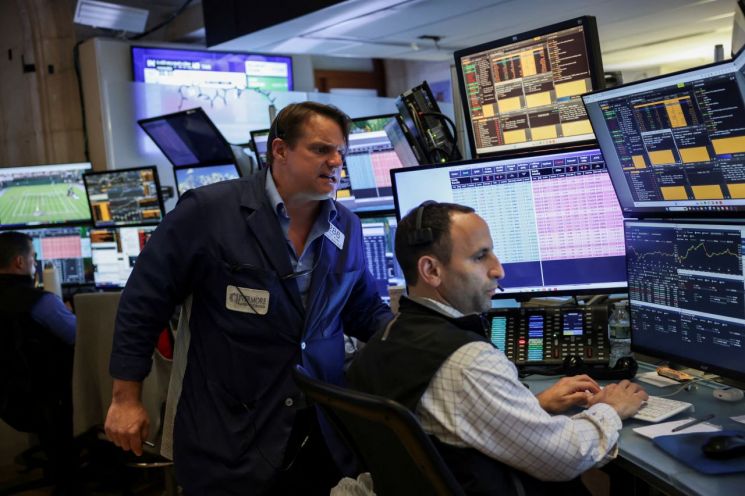
As of 10:17 a.m. on the New York Stock Exchange, the blue-chip Dow Jones Industrial Average (Dow) was down 122.63 points (0.28%) at 44,372.31 compared to the previous trading day. The S&P 500, which focuses on large-cap stocks, was up 5.98 points (0.1%) at 6,203.99, while the tech-heavy Nasdaq was up 98.03 points (0.49%) at 20,300.92.
Last month's private employment data showed a much sharper decline than expected. According to U.S. private labor market research firm ADP, private sector payrolls in June fell by 33,000 jobs. This marks the first decrease in private employment in two years and three months, since March 2023. The figure also fell far short of market expectations (an increase of 99,000 jobs) and the May figure (an increase of 29,000 jobs).
Nela Richardson, chief economist at ADP, explained, "Layoffs remain rare, but last month’s job losses resulted from companies hesitating to hire and choosing not to replace employees who left." She added, "However, the slowdown in hiring has not yet affected wage growth rates."
This data has raised concerns that the labor market, which had remained relatively resilient despite aggressive tariff policies, could weaken more rapidly than expected. Following the release of the ADP private employment data, the market has slightly increased its expectations for a rate cut in July. According to CME FedWatch, the federal funds futures market is currently pricing in a 25.3% chance that the Federal Reserve will lower the benchmark rate by 0.25 percentage points at the July 29-30 Federal Open Market Committee (FOMC) meeting, up from 20.7% the previous day.
Ross Mayfield, investment strategist at Baird, said, "I've always thought that the Fed would need to see negative employment figures to focus more on the labor market than on inflation," adding, "I hope this data is enough to capture the Fed's attention."
However, Federal Reserve Chair Jerome Powell has maintained a cautious and observant stance regarding further monetary easing. Attending the European Central Bank (ECB) forum the previous day, he responded to a question about the likelihood of a July rate cut by saying, "It's really hard to say," and emphasized, "It depends on how the data unfolds."
Investors are also closely watching the Trump administration's additional trade deals and the status of the congressional tax cut bill. The so-called "One Big Beautiful Bill," which passed the Senate the previous day, is now awaiting a vote in the House. Some Republican members in the House have expressed opposition, as the Senate version would increase the fiscal deficit more than the bill previously passed by the House. If the tax cut bill passes the House and becomes law after much debate, there is a possibility that concerns over a widening fiscal deficit could lead to a decline in U.S. Treasury prices and a rise in yields.
The possibility of the U.S. reaching additional trade agreements is also a key focus. President Trump has reiterated that he will not extend the reciprocal tariff suspension, which is set to expire at 12:01 a.m. on July 9. In particular, he has increased pressure on Japan, where trade negotiations have stalled, warning that reciprocal tariffs could be raised to as high as 35%.
U.S. Treasury yields are rising, especially on longer-term bonds. The benchmark 10-year U.S. Treasury yield, which serves as a global bond market benchmark, is up 4 basis points (1bp = 0.01 percentage points) from the previous day at 4.29%. The 30-year U.S. Treasury yield has risen 6 basis points to 4.84%. The 2-year U.S. Treasury yield, which is sensitive to monetary policy, remains around the previous day's level at 3.76%.
By stock, Tesla is up 4.34% despite news of a decline in vehicle deliveries for the second quarter of this year. On this day, Tesla announced that it delivered 384,122 vehicles between April and June, a 14% decrease from the same period last year. Wall Street had projected a decline of up to 20%, so the stock is rising as Tesla avoided the worst-case scenario. Microsoft (MS), which is laying off 9,000 employees?less than 4% of its total workforce?is down less than 0.1%. Nvidia and Apple are up 1.76% and 2.1%, respectively.
© The Asia Business Daily(www.asiae.co.kr). All rights reserved.

















