ADP: Private Sector Employment Down by 33,000 in June
First Decline Since March 2023
"Companies Hesitant to Hire New Workers"
Attention on Department of Labor Employment Report on the 3rd
Last month, private sector employment in the United States saw an unexpectedly sharp decline. This marks the first decrease in private employment in two years and three months. Although the labor market has remained relatively resilient despite President Donald Trump's aggressive tariff policies, there are concerns that employment could weaken faster than expected as companies become more hesitant to hire new workers amid ongoing uncertainty.
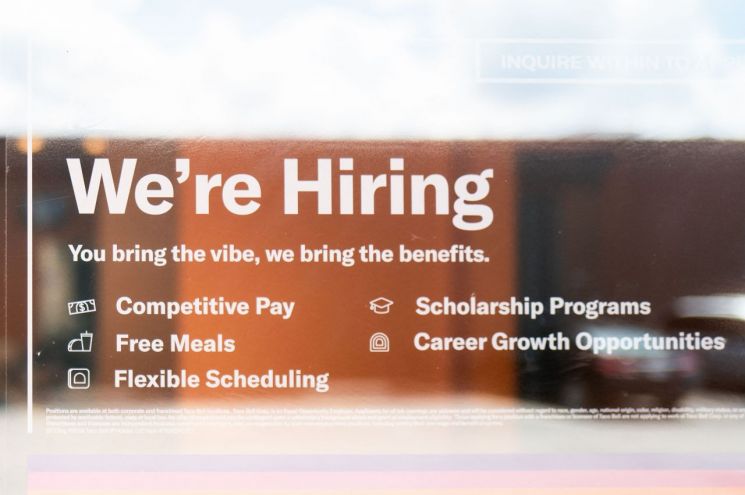
On July 2 (local time), U.S. private labor market research firm ADP released its employment report, which showed that private sector employment in June decreased by 33,000 jobs.
This is the first time since March 2023 that private employment has declined, ending a two-year and three-month streak. The figure is significantly lower than the market forecast of 99,000 jobs, and it also represents a substantial deterioration compared to May, when private sector employment increased by only 29,000 jobs, the lowest level in two years.
ADP also revised its May private sector employment increase downward from 37,000 jobs to 29,000 jobs.
By sector, professional and business services saw a decrease of 56,000 jobs. Employment in education and health services fell by 52,000 jobs, and the financial sector lost 14,000 jobs. In contrast, leisure and hospitality added 32,000 jobs, and manufacturing increased by 15,000 jobs.
However, the decrease in employment did not affect wage growth. For workers who remained at their jobs for one year, the annual wage growth rate was 4.4%. For job changers, the rate was 6.8%. Although these figures were down by 0.1 percentage point and 0.2 percentage point, respectively, compared to the previous month, they remain robust.
Nela Richardson, Chief Economist at ADP, explained, "Layoffs remain rare, but last month's decline in jobs was driven by companies hesitating to hire new workers and being reluctant to replace employees who left." She added, "However, the slowdown in hiring has not yet affected wage growth."
As President Trump's tariff policies have heightened concerns about stagflation (rising prices amid economic stagnation), Wall Street is closely monitoring both inflation data and labor market indicators. There are worries that the labor market could weaken rapidly as consumer spending slows and companies hesitate to hire.
A clearer picture of employment conditions will be available in the June employment report to be released by the U.S. Department of Labor on July 3. Nonfarm payrolls are expected to increase by 120,000 jobs in June, below the May figure of 139,000. The unemployment rate is projected to rise from 4.2% in May to 4.3% in June. The nonfarm payroll data released by the Department of Labor, which includes both private and public sector employment, is considered the most reliable indicator of the overall health of the labor market.
© The Asia Business Daily(www.asiae.co.kr). All rights reserved.
![Clutching a Stolen Dior Bag, Saying "I Hate Being Poor but Real"... The Grotesque Con of a "Human Knockoff" [Slate]](https://cwcontent.asiae.co.kr/asiaresize/183/2026021902243444107_1771435474.jpg)















