A Market with High Customer Loyalty for Products Like Ramen, Beer, and Seasonings
Organizational Stability and Mid- to Long-Term Strategies Are Key
Even in a rapidly changing business environment, the domestic food and beverage industry in Korea is notable for having a large number of long-serving CEOs. Many CEOs have maintained their positions for 8 to 15 years or more, and their long-term leadership is credited with driving both the stability and growth of their companies. The business structure, which relies heavily on steady-selling products, the relatively gradual pace of market change, and a management environment focused on long-term projects all contribute to making seasoned industry experts a key competitive advantage in the food sector.
Leaders Who Have Guided Their Companies for Over a Decade
According to the food industry as of July 4, Hur Inchul, Vice Chairman of Orion Group, has been overseeing the group’s management for ten years since being appointed Vice Chairman of Orion Holdings and Orion in 2014. Born in 1960, Hur graduated from Yonsei University with a degree in business administration and joined Samsung Group. He later moved to Shinsegae Group, where he served as President of the Management Strategy Office and CEO of Emart, before taking up the position of Vice Chairman at Orion Holdings and Orion in 2014. Hur is especially recognized for expanding Orion’s overseas markets to India, the United States, Europe, and other regions. He also enhanced the company’s financial stability and, through internal innovation, elevated Orion to the ranks of global food companies.
He is also well known for his aggressive mergers and acquisitions (M&A) strategies. Even during his time at Shinsegae Group, he was regarded as a “master of M&A” due to his proactive approach to acquisitions. A well-known story is that in 2008, as Head of Shinsegae’s Management Support Office, he led Emart’s acquisition of Walmart Korea and concluded negotiations within just one week. Hur pushed for Orion’s acquisition of Jeju Yongamsu in 2016 and last year pursued the acquisition of the biotech firm LegoChem Biosciences (now Ligachem Biosciences).
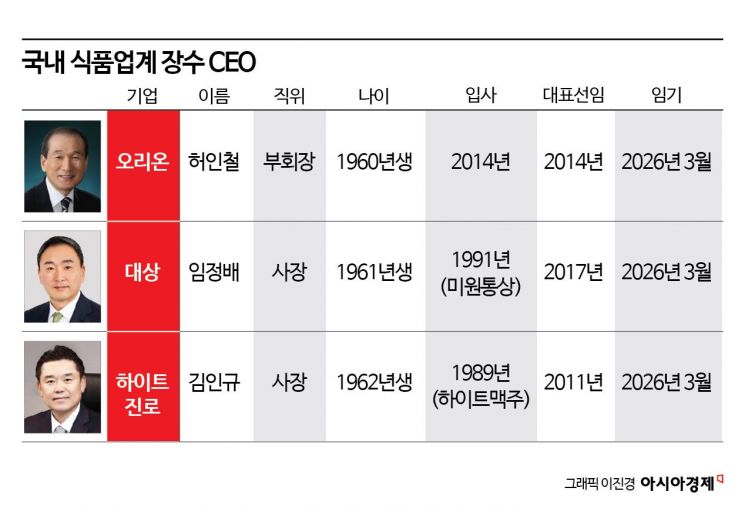
Lim Jungbae, CEO of Daesang, is a leading example of the “salaryman success story,” having risen from entry-level employee to the top executive position. Born in 1961, Lim graduated from Korea University with a degree in food engineering. He joined Miwon Trading (now Daesang) as a junior employee in 1991, marking his 34th year with the company this year. In 2007, Lim became head of Daesang’s finance team, and in 2009, he served as head of planning and management before being appointed CEO of the Food Business Unit in 2017. He became the sole CEO of Daesang in 2020.
Lim is considered a strategic leader within the group, particularly skilled in overseas sales. Since he became CEO, Daesang has continuously established new factories and subsidiaries in Vietnam, China, India, and other countries, solidifying its presence in the global market. Lim is also known for promoting a horizontal organizational culture and for his practice of addressing all employees with honorifics.
Kim Inkyu, CEO of Hite Jinro, was born in 1962 and joined Hite Brewery in 1989. He is also known for his connection to Park Moondeok, Chairman of Hite Jinro, as a fellow alumnus of Baeje High School. As Park’s junior from high school, Kim earned strong trust and was appointed CEO of Hite Jinro when Hite Brewery acquired Jinro in 2011 and the merged company was launched.
Over the past 15 years, Kim has proven his management capabilities by being reappointed four times. Above all, he is credited with leading Hite Jinro into its “second golden age” with the launch of “Terra” and “Jinro Is Back.” In fact, Terra surpassed 800 million bottles sold within just over a year of its release, setting a record for selling 22 bottles per second and achieving the fastest initial sales pace among Hite Jinro’s beer brands.
Emphasis on Continuity and Stability, Preference for Experienced Leaders
The prevalence of long-serving CEOs in the domestic food industry can be attributed to the unique characteristics of the sector’s structure and management environment. Because the main products are staples such as ramen, seasonings, alcoholic beverages, and snacks?items closely tied to everyday life?the product lifecycle is long and consumer loyalty is high. Rather than frequently changing leadership in response to rapid product turnover or shifting trends, as in the retail industry, companies tend to favor internal experts who possess a deep understanding of the existing business and the ability to drive ongoing improvements.
In addition, food companies face many tasks that require time, such as mid- to long-term research and development (R&D), brand building, and investment in overseas factories, making it essential to have leadership capable of executing long-term strategies rather than focusing solely on short-term results. An industry insider commented, “Stability is fundamentally important in the food industry, and there is a general reluctance to take risks associated with sudden leadership changes. As a result, there is a strong tendency to appoint experienced individuals as CEOs.” In fact, Kang Shinguk, President of Ottogi, has held his position for over 21 years, and Lee Sangyoon, President of Nongshim, has served for more than 19 years, earning reputations as legendary long-serving CEOs. Kang is credited with quietly ushering Ottogi into the era of 1 trillion won in sales, while Lee is recognized for leading Nongshim to the top spot in the ramen market amid fierce competition with Samyang Foods.
However, the food industry is now facing new challenges, such as business diversification, global expansion, and ESG management, which are increasing the need for change. An industry official explained, “While the food industry has traditionally been conservative, companies are now re-examining their existing systems as both domestic market limitations and pressures for change intensify.”
© The Asia Business Daily(www.asiae.co.kr). All rights reserved.

















