Tariff Surge Hits South Korea's Export-Driven Economy
Tariffs on Pharmaceuticals and Semiconductors Have Especially Significant Impact on South Korea
US Fed Expected to Cut Rates at Year-End... Further Cuts Projected Next Year
Stablecoins Require Frameworks and Controllable Zones
Household Debt Demands Sustainable, Long-Term Policy Approach
"We are projecting South Korea's economic growth rate to be extremely low at 0.6% this year."
Louis Kuijs, Chief Asia-Pacific Economist at S&P Global Ratings, made this forecast at the S&P invited seminar hosted by the International Financial Center, titled 'Global Trade Contraction, Rising Credit Risks,' held at Bankers Hall in Jung-gu, Seoul on the 2nd. He explained, "South Korea is already experiencing low growth, and now, with external conditions worsening due to the impact of U.S. tariffs, the burden has become even greater." He added that, since the country's GDP shrank in the first quarter of this year, an extremely steep growth trajectory would be required going forward. He stated, "We expect a recovery next year, but our outlook for this year is very conservative."
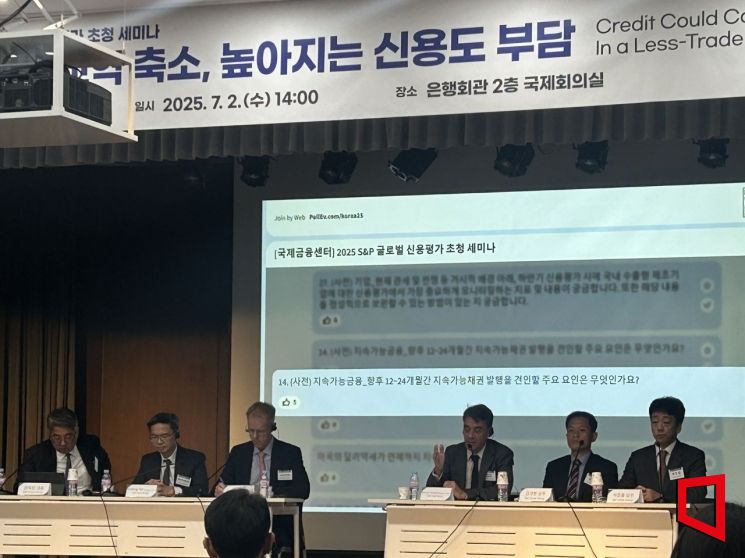 Jaemin Kwon, S&P Global Ratings Korea Representative (left in the photo), and others are answering questions at the S&P invited seminar hosted by the International Financial Center held at the Bankers Hall in Jung-gu, Seoul on the 2nd.
South Korea is a country highly dependent on exports, so it is inevitably more vulnerable to external shocks. He said, "(S&P) assumed that U.S. tariffs would remain at a high level when making our projections," and added, "In particular, we expect that tariffs will also be applied to a significant extent to the pharmaceutical and semiconductor sectors, even though the U.S. has not yet finalized its decisions in these areas." He specifically pointed out that semiconductors could have a significant impact on South Korea. Amid mounting concerns over low growth, inflation is showing signs of stabilization, and he forecast that South Korea's base interest rate will be cut two more times in the second half of the year, by 0.25 percentage points (25bp) each time.
Recently, the U.S. government has been pursuing changes in several areas, including fiscal policy, immigration, and deregulation. S&P believes that these changes will negatively affect U.S. economic growth. Kuijs noted, "This is evident from the widening fiscal deficit due to immigration restrictions and changes in tax policy," and added, "Externally, tariffs are also a factor weighing on economic growth." He assessed that tariffs are negative because they lower the growth rate and increase inflation.
Low growth and high inflation also present a difficult challenge for the U.S. Federal Reserve's monetary policy operations. Kuijs said that not only political pressures but also the economic indicators themselves make the situation far from easy. He stated, "The Fed will not lower rates for the time being due to rising inflation," and predicted that it will only begin to cut rates around the end of the year, when inflationary pressures ease as a result of economic slowdown. Accordingly, S&P expects the Fed to begin cutting rates at the end of this year, with additional cuts to follow next year.
He also predicted that China will see a clear decline in exports due to the impact of U.S. tariffs in the second half of the year and beyond. He stated, "The global slowdown in trade and protectionist measures by other countries are also challenging Chinese exports," and "exports to the U.S. have plummeted every month since April, and this trend is expected to continue." However, he forecast that domestic demand in China will be more robust than expected. S&P projects China's growth rate this year to be around 4.3%. Kuijs added, "Even though the U.S.-China tariff war is currently in a truce, average tariffs of 43% are still being applied to exports to Europe, so the external environment remains difficult," and pointed out that these effects will become especially pronounced in the second half of the year.
He also assessed that Asian currencies, which have recently shown strength, are still undervalued. He said, "Some argue that Asian currencies are overvalued due to recent appreciation, but I do not see it that way," emphasizing that "even after the recent rise, they remain at relatively cheap levels."
Meanwhile, during the Q&A session, perspectives on stablecoins and evaluations of the June 27 household debt management measures were also discussed. The recently hotly debated won-based stablecoin was seen as both an opportunity and a risk. Kim Daehyun, Managing Director at S&P, said, "Opportunities include the creation of new added value and the potential for spin-off businesses, provided stability and utility are proven." However, he also pointed out that "the fact that its stability has not yet been verified, the high possibility of deposit outflows from banks and other financial institutions, and the potential limitation of the effectiveness of the Bank of Korea's monetary policy on a macro level should all be considered as risk factors." He further analyzed that, if stablecoins are to be used in foreign exchange transactions in earnest, the key issue will be how well they can be tracked and monitored. He stressed, "Even though banks are subject to strict regulations, accidents can still occur due to inadequate internal controls," and "it is necessary not only to establish regulations, but also to ensure continuous and thorough monitoring."
Kuijs also commented, "The declining effectiveness of monetary policy creates risks at the government level," and pointed out that "seigniorage revenue from currency issuance could decrease, reducing the effect of incorporating it into the government budget, and regulatory arbitrage could also become a problem." However, he emphasized that, from the perspective of 'if we do not do it, someone else will,' it is important to establish a framework so that stablecoins can be anchored within controllable zones and systems.
He assessed that the government's June 27 loan regulation policy was stronger than expected. Kim said, "Not only the content but also the immediate implementation of the measures prevented problems that could have arisen between the announcement and enforcement, demonstrating the government's strong resolve." However, he diagnosed that it is important to have policies with a mid- to long-term perspective that can be implemented sustainably. He pointed out that, over the long term, policy directions have often changed whenever administrations have changed, which has been a shortcoming in terms of the long-term effectiveness of policies. Kim said, "The issues of household debt and the real estate market are based on the psychology that 'real estate investment never fails.' A fundamental change in investment sentiment itself is needed," and emphasized that "attention should be paid not only to curbing prices in Seoul, but also to alleviating stagnation in regional areas."
© The Asia Business Daily(www.asiae.co.kr). All rights reserved.
![Clutching a Stolen Dior Bag, Saying "I Hate Being Poor but Real"... The Grotesque Con of a "Human Knockoff" [Slate]](https://cwcontent.asiae.co.kr/asiaresize/183/2026021902243444107_1771435474.jpg)















