Factories up 1.3 times, listed companies up 1.4 times, venture-certified and promising small enterprises up 3.3 times
Lee Gangdeok: "I will make Pohang a sustainable city through balanced growth"
Marking the 11th anniversary of his inauguration, Lee Gangdeok, mayor of Pohang, drew attention by presenting statistical achievements from his 11 years leading the 6th, 7th, and 8th popularly elected administrations at a press conference held on the 2nd in the city hall's large conference room.
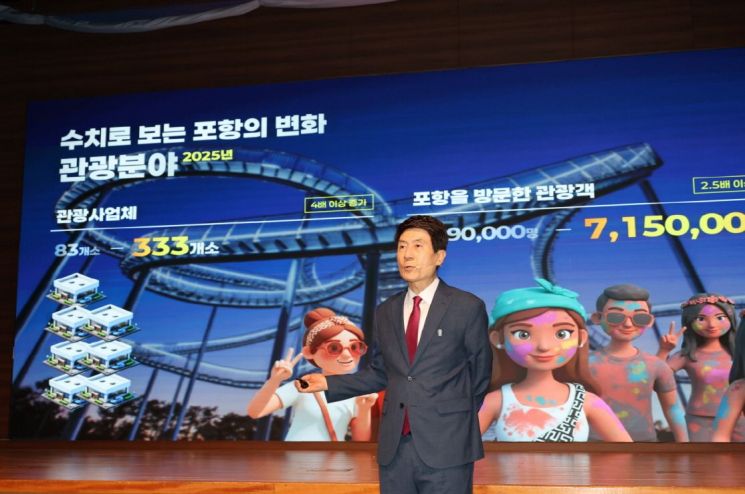 Lee Gangdeok, mayor of Pohang, is explaining the changes in Pohang seen through statistics at a press conference marking the 11th anniversary of his inauguration held on the 2nd in the city hall's large conference room.
The most notable change has been the expansion of the city's financial scale. Pohang's budget, which stood at 1.3343 trillion won when Mayor Lee took office in 2014, has increased to 3.027 trillion won as of the first supplementary budget for 2025, representing a 2.3-fold increase.
In particular, the total amount of national funding secured over the past 11 years reached 18.049 trillion won, serving as a driving force for expanding the foundation of future industries and promoting balanced regional development.
With the expansion of the economic scale, the number of local businesses and jobs has also increased. As of 2025, Pohang has 1,458 factories, a 1.3-fold increase; 19 listed companies, a 1.4-fold increase; and the number of officially registered jobs rose from 20,600 to 33,883, a 1.6-fold increase.
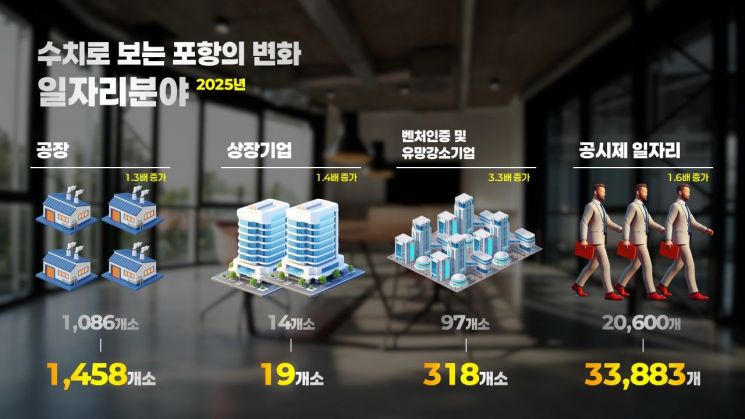
The number of venture-certified companies and promising small but strong enterprises also grew from 97 to 318, a 3.3-fold increase, demonstrating the region's growing innovation capacity.
Changes in tourism and leisure are also noteworthy. In 2024, Pohang attracted 7.15 million tourists, a 2.5-fold increase compared to 2.89 million in 2014.
In line with this, the number of tourism businesses increased from 83 to 333, a fourfold rise, underscoring Pohang's emergence as a hub of marine tourism.
The leisure environment for citizens has also improved. As of 2025, the number of large-scale public cultural facilities, including libraries, increased to 20, a 1.8-fold rise; public sports facilities reached 85, a 1.4-fold increase; and parks and urban forests grew to 238, a 1.8-fold increase. These expansions have established a foundation for citizens to enjoy relaxation and leisure in their daily lives.
These changes in tourism and leisure are significant not only for the external growth centered on the economy and jobs but also for enhancing the quality of life for citizens and creating stable living conditions.
Infrastructure to improve urban safety and citizen convenience has also been steadily expanded. The number of public parking lots now stands at 398, a 3.5-fold increase over 11 years ago; the number of security CCTVs reached 4,990, a fourfold increase; and the number of rainwater pumping facilities rose to 41, a 1.6-fold increase, strengthening the city's ability to respond to urban flooding.
There have also been notable improvements in health and welfare. The number of public childcare facilities increased from 17 to 45, and the number of medical institutions expanded from 532 to 624.
The number of medical personnel grew from 5,923 to 9,277, a 1.6-fold increase, creating an environment where citizens can receive better medical services.
Mayor Lee Gangdeok stated, "By taking on challenges and embracing change together with our 500,000 citizens, we have achieved both quantitative and qualitative growth in various fields." He emphasized, "Going forward, I will do my utmost to make Pohang a sustainable city through balanced growth across the economy, environment, welfare, tourism, and other sectors."
© The Asia Business Daily(www.asiae.co.kr). All rights reserved.
![Clutching a Stolen Dior Bag, Saying "I Hate Being Poor but Real"... The Grotesque Con of a "Human Knockoff" [Slate]](https://cwcontent.asiae.co.kr/asiaresize/183/2026021902243444107_1771435474.jpg)
















