'2025 Offshore Wind Supply Chain Conference and Exhibition' Held
Need to Resolve Investment Uncertainty with Plans Exceeding 10 Years
Proposal to Encourage Joint Ventures and OEMs with Major Overseas Turbine Companies
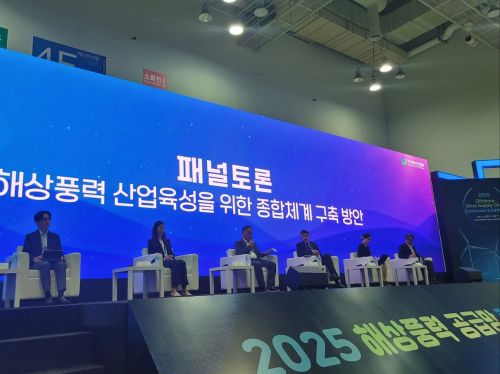 Panelists are discussing at the 'Comprehensive System Establishment Plan for Offshore Wind Industry Promotion' conference, an auxiliary event of the '2025 Offshore Wind Supply Chain Conference' held on the 2nd at BEXCO in Busan. Photo by Heejong Kang
There have been calls for the government to present a long-term supply plan of more than 10 years in order to advance the domestic offshore wind industry. There were also arguments that, for turbines of 10 megawatts (MW) or more?which are difficult to localize immediately?the government should encourage foreign developers to manufacture domestically.
At the '2025 Offshore Wind Supply Chain Conference and Exhibition' hosted by the Korea Wind Energy Industry Association at BEXCO in Busan on the 2nd, Kim Beomseok, professor at Jeju National University’s Department of Wind Engineering, said, "Currently, the Ministry of Trade, Industry and Energy has only announced wind power market bidding volumes up to the first half of 2026," and added, "It is necessary to present at least a roadmap through 2030, in conjunction with the government's Basic Plan for Electricity Supply and Demand."
He emphasized that, in order for offshore wind supply chain companies and power generation operators to decide to invest in the domestic offshore wind market, the government must resolve market uncertainty by presenting a mid- to long-term roadmap. Kim Eunsung, Vice President of Next, also stressed, "The government should present a long-term roadmap of more than 10 years so that supply chain companies can have confidence in the market."
In August last year, the Ministry of Trade, Industry and Energy presented a competitive bidding roadmap that included plans to conduct competitive bidding for a capacity of 7 to 8 gigawatts (GW) by the first half of 2026. However, bidding plans for the period after the second half of 2026 have not yet been announced. According to the 11th Basic Plan for Electricity Supply and Demand, 18.3 GW of wind power must be deployed by 2030, but detailed plans for this have not yet been presented.
Regarding this, Kim Yunseong, CEO of Energy and Space, said at the event, "To instill confidence in domestic supply chain companies to invest, there must be a steady annual bidding volume of more than 2.5 GW." Seong Jingi, Executive Vice President of the Wind Energy Industry Association, pointed out, "This is a time when the government needs to have a detailed and meticulous plan."
There was a consensus that, for large offshore wind turbines that are difficult to localize immediately, it is necessary to foster domestic parts and equipment through collaboration with overseas turbine manufacturers. Turbines account for about 30% of the offshore wind supply chain and are a core supply chain that also affects other supply chains such as substructures and installation vessels.
Professor Kim Beomseok said, "In the case of Japan, which does not have its own turbines, the country is promoting localization of wind power facilities by attracting a factory from GE Vernova of the United States and inducing cooperation with domestic companies and technology," and added, "In Korea, while focusing on Doosan Enerbility and Unison, it is necessary to foster the domestic supply chain for turbines of 10 MW or more through collaboration with overseas manufacturers."
Domestic turbine manufacturers Doosan Enerbility and Unison have commercialized turbines up to the 8 MW class and are developing and testing 10 MW class turbines. In contrast, European and Chinese companies have commercialized 15 MW class turbines and are developing even larger turbines of 20 MW or more. In order to achieve economies of scale in the domestic offshore wind market, installation of 12 to 15 MW class turbines is necessary.
Vice President Kim Eunsung said, "Even if we start development now, it will take six years to develop a 15 MW class large wind turbine," and added, "It is necessary to encourage the establishment of joint ventures or original equipment manufacturing (OEM) arrangements with overseas turbine companies for the large turbines that are currently lacking."
There were also opinions that the role of public power generation companies is important for the localization of the offshore wind supply chain. Lee Seulgi, research fellow at the Korea Institute for Industrial Economics and Trade’s New Growth Engine Research Division, said, "To reduce investment uncertainty for public power generation companies, it is necessary to provide policy support such as improving the management evaluation criteria for public enterprises, exempting preliminary feasibility studies, and expanding financial support when domestic equipment is used."
© The Asia Business Daily(www.asiae.co.kr). All rights reserved.
![Clutching a Stolen Dior Bag, Saying "I Hate Being Poor but Real"... The Grotesque Con of a "Human Knockoff" [Slate]](https://cwcontent.asiae.co.kr/asiaresize/183/2026021902243444107_1771435474.jpg)















