Proposal to Establish an Education Policy Platform: "Integrated Support Center"
"Building a Collaborative Governance System Between Local Governments and Education Offices"
Jaetae Lee, a member of the Jeonnam Provincial Assembly (Democratic Party of Korea, Naju 3), has called for comprehensive policy improvements to secure the institutional foundation and sustainability of the Jeonnam-style Education Development Special Zone.
On July 1, Lee attended the "Forum on Exploring Ways to Establish and Activate Educational Governance in the Era of National Sovereignty" held at Donggang Hall in the Central Library of Dongshin University in Naju. At the forum, he reviewed the current status of the Jeonnam-style Education Development Special Zone and presented policy alternatives, focusing on the case of Naju.
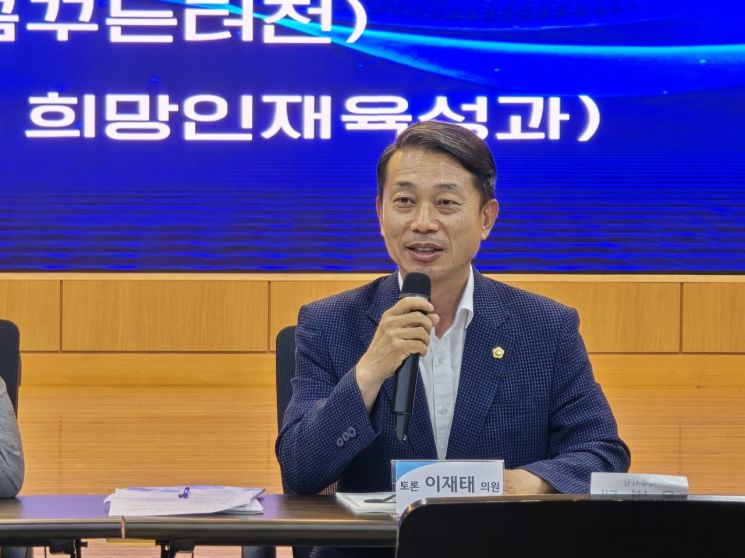
The forum brought together education and regional policy experts, including Daejung Kim, Jeonnam Superintendent of Education; Soonam Jeong, President of the Jeonnam Local Era Research Institute; and Yongsuk Noh, Director of the Jeonnam Village Community Support Center. Participants engaged in diverse discussions on strategies for building educational governance and the feasibility of region-led models.
As a panelist, Lee stated, "The Jeonnam-style Education Development Special Zone is a region-led educational innovation model designed to address the decline in the school-age population and the crisis of local extinction." He continued, "Although Naju is pursuing various initiatives such as energy-specialized career education centered on the innovation city and village-linked experiential education, it faces structural limitations due to institutional and financial instability."
He identified several issues: concerns about project discontinuity due to changes in the terms of local government heads and education offices; marginalization of the original downtown and rural areas due to a focus on the innovation city; instability in the financial structure; and insufficient systems for performance analysis and policy feedback.
As a solution, he proposed the establishment of an "Integrated Education Support Center." Lee emphasized, "There is a need for a hub center that can integrate village education, career education, childcare, and parent counseling functions. This center should serve as a platform to bridge educational gaps in the region and maintain policy continuity."
He also highlighted the need to foster customized high schools linked to local industries. He said, "We must prevent the outflow of local talent and build a career education system connected to actual industries through high schools specialized in energy and AI fields." He added, "It is also necessary to introduce an evaluation system that reflects not only quantitative outcomes but also the perceived satisfaction of parents and students."
In particular, he stressed, "Institutional stability must be secured through the legalization of the Education Development Special Zone, and a framework for national funding support should be established. The state should allocate separate budgets to regions it has designated, creating successful cases through a strategy of selection and concentration."
Lee stated, "The Education Development Special Zone goes beyond school education innovation. It is about creating an integrated educational ecosystem through organic cooperation among local industries, research institutes, universities, and schools. Local governments should take the lead in establishing the implementation system, while education offices should focus on areas of expertise such as curriculum reform and teacher training within the governance framework."
© The Asia Business Daily(www.asiae.co.kr). All rights reserved.

















