Physical AI Gaining Momentum
Potential Value Projected at $50 Trillion
Autonomous Planning, Decision-Making, and Action
"Aiming for Robot Butlers That Encompass Everyday Life"
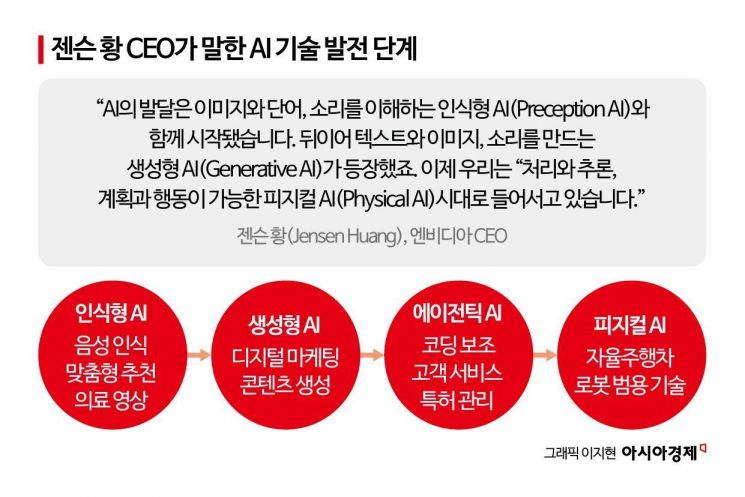
'Physical AI' is emerging as a new strategic keyword in the industrial sector, expanding its application not only to production sites but also to security tasks such as patrols and to agriculture. Physical AI refers to intelligent systems in which AI technology autonomously interacts with various devices such as robots and the Internet of Things (IoT), making decisions and acting independently. Jensen Huang, CEO of Nvidia, predicted that physical AI will revolutionize a wide range of industries, including factories, transportation, and humanoid robots, and that its potential value could reach $50 trillion (about 7,200 trillion won).
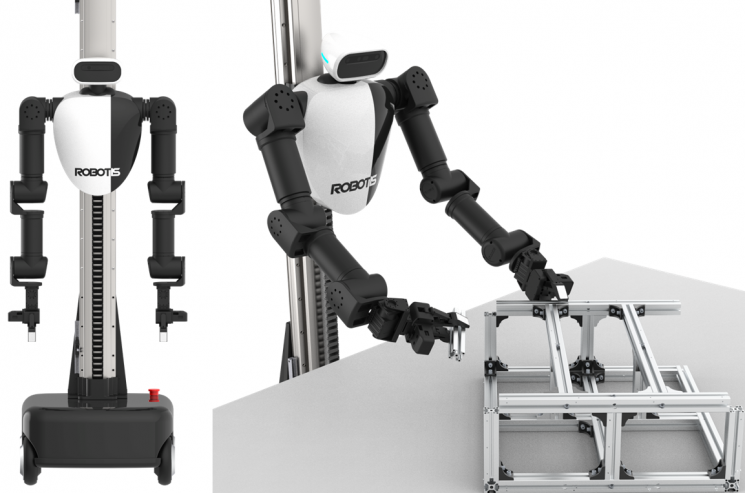 Robotics' work humanoid 'AI Walker.' It moves on wheels and can adjust its height according to the workbench height. Provided by Robotics
'$50 Trillion' Market Opportunity...Companies Rushing In
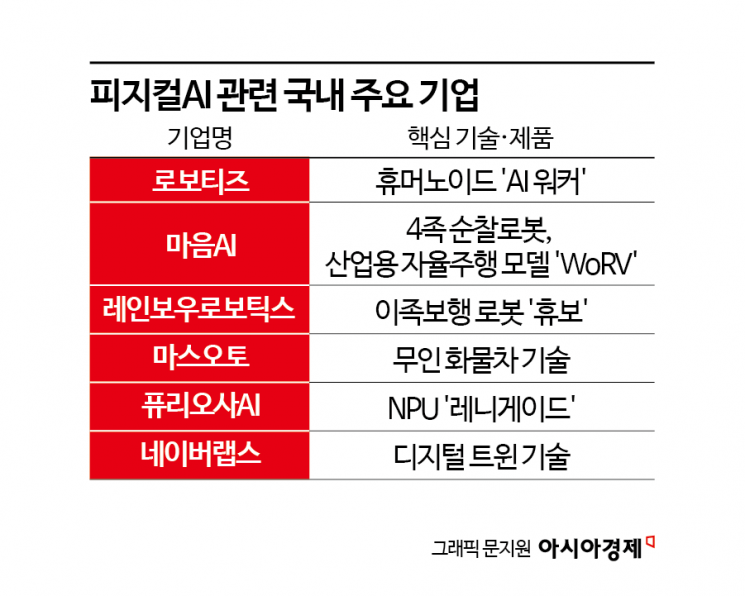
Robotics, a company specializing in robots, succeeded in turning a profit in the first quarter of this year thanks to the physical AI boom. This was due to increased overseas demand for Robotics' main products and key robot components, such as actuators that serve as robot joints. During this period, sales increased by 22.6% compared to the same period last year. Recently, the company unveiled its work-type humanoid 'AI Walker,' which moves on wheels. The first batch has been delivered to LG Electronics, and the company aims to sell about 100 units this year. Robotics is also participating in the 'K-Humanoid Alliance,' formed under the leadership of the Ministry of Trade, Industry and Energy, to develop mass-produced humanoids based on domestic technology.
Mind AI is in discussions with three to four companies in Korea and Southeast Asia to supply its autonomous quadruped patrol robot, which is equipped with its proprietary foundation model. Kim Moonhwan, Vice President of Mind AI, said, "We want our robots to perform security tasks in a variety of locations, from factories to buildings and airports," and added, "Stairs and obstacles are difficult for wheeled robots to navigate, so the need for agile quadruped robots is increasing." Mind AI has also secured a large-scale proof-of-concept (PoC) project covering 6,000 hectares in Southeast Asia by equipping an agricultural pesticide spraying robot, developed by an autonomous agricultural machinery startup, with its AI model (WoRV), which integrates visual recognition, language understanding, and motion control. Vice President Kim explained, "Since the implementation of the Serious Accidents Punishment Act, there has been growing demand to delegate difficult and dangerous tasks, including those involving chemical substances, to robots."
Rainbow Robotics, founded by KAIST researchers who developed the bipedal robot 'HUBO,' attracted attention when it was acquired by Samsung Electronics at the end of last year. Mars Auto, a company specializing in autonomous driving, is currently collaborating with Lotte Global Logistics to advance unmanned cargo truck technology and operational models. An industry insider commented, "Many domestic and international AI companies are aiming to develop household humanoid robots through physical AI," and added, "They are envisioning robot butlers that go beyond simple household assistance to provide care and serve as emotional companions, covering all aspects of daily life."
Efforts to promote physical AI are also in full swing. FuriosaAI is attracting attention for developing next-generation AI semiconductors capable of meeting the high computational demands of physical AI. FuriosaAI's self-developed second-generation NPU (Neural Processing Unit), 'Renegade (RNGD),' is optimized for high-performance large language models (LLMs) and multimodal inference. By applying TSMC's 5nm process and HBM3 memory, the chip achieves more than twice the power efficiency of Nvidia chips. A FuriosaAI representative stated, "To realize physical AI that 'moves and operates,' beyond generative AI, a low-power, high-efficiency computing environment is essential." The company plans to develop a third-generation chip with even more advanced performance in the second half of the year.
Naver is building an ecosystem for physical AI through its R&D subsidiary, Naver Labs. Naver Labs is focusing on digital twin technology, which creates 3D virtual spaces that replicate real-world environments. By integrating the digital twin platform with technologies such as robots, autonomous vehicles, and extended reality (XR), a variety of physical AI services become possible.
Data and Batteries Present Practical Limitations..."All Ministries Must Support"
While low-power semiconductors are important, experts emphasize that the method of securing data must also change from traditional approaches. Choi Byungho, a professor at Korea University's Artificial Intelligence Research Institute, stated, "For robots to function properly in industrial or smart home settings, large-scale, refined behavioral data is needed, but currently, such data is very scarce," and added, "Some companies are trying to address this by automatically generating synthetic data using digital twins."
There remains the challenge of developing lightweight batteries that are both low-power and highly efficient. Most of the energy in robots is consumed by the motors attached to each joint, and if a battery is attached like a backpack, the load is placed on the robot's back, which can make operation difficult. Another limitation is that, since there are still no specific laws or regulations for physical AI, it is unclear who would be responsible if a robot causes an accident resulting in human injury.
The government is focusing on physical AI as a next-generation technology and is accelerating the development of related policies. The Institute for Information & Communications Technology Planning & Evaluation (IITP), under the Ministry of Science and ICT, has recently commissioned a series of research projects to identify physical AI models and establish technology and policy roadmaps. The plan is to develop generative AI into a form that operates directly in the real world by combining it with hardware. An industry insider commented, "Physical AI will ultimately serve as a solution to labor shortages and population aging," and added, "Not only the Ministry of Science and ICT, but also various other government ministries such as the Ministry of Health and Welfare and the Ministry of Employment and Labor should propose projects to provide companies with opportunities to validate their technologies."
© The Asia Business Daily(www.asiae.co.kr). All rights reserved.



















