Ms. A, a woman in her 70s, began to notice a significant decrease in her height a few years ago and often heard people around her say, "Your back is really hunched."
Ms. A, who had thought this was just a natural part of aging, recently started feeling discomfort as her body leaned forward and her gaze increasingly pointed downward when walking on flat ground. In addition, she experienced shortness of breath and indigestion, prompting her to visit a hospital. After a thorough examination, she was diagnosed with senile kyphosis.
The human spine is divided into the cervical spine (neck), thoracic spine (upper back), lumbar spine (lower back), and sacral spine (sacrum). From the front, a healthy spine appears straight, while from the side, the cervical and lumbar spines have a forward curve (lordosis), and the thoracic and sacral spines have a backward curve (kyphosis). This is the normal curvature of the spine.
However, due to aging or external factors, these normal curves can become disrupted. In particular, when the kyphosis of the thoracic spine increases excessively, it is called kyphosis. In some cases, the lordosis of the cervical or lumbar spine decreases or even reverses into kyphosis.
Among these, the type that develops in the elderly due to degenerative changes is referred to as senile kyphosis.
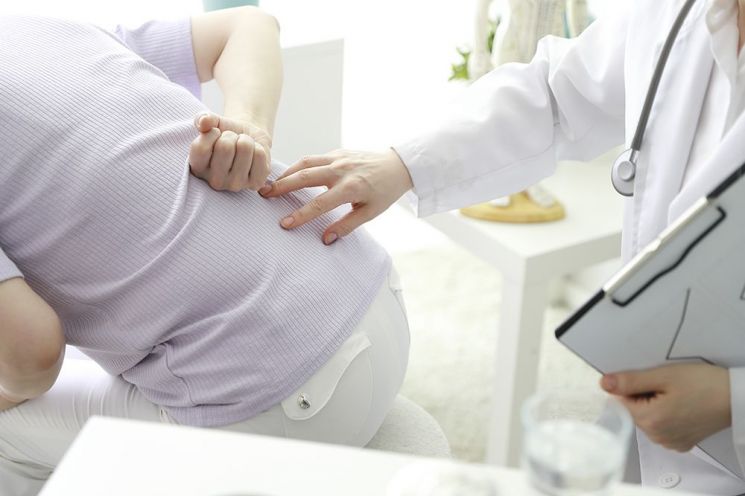
During the aging process, spinal discs lose height and moisture, resulting in reduced flexibility and increased pressure on the vertebrae. The erector muscles of the back and waist, which support the spine, also weaken, making it harder to maintain posture. In addition, prolonged slouched posture, the habit of squatting, and lack of exercise all act together to place further stress on the spinal structure, worsening kyphotic deformity.
Especially after menopause or in advanced age, osteoporosis is common and can easily cause vertebral compression fractures. As a result, the spine bends forward, further progressing kyphotic deformity. In addition, spinal stenosis, which frequently accompanies old age, is also a significant cause. To reduce pain, the elderly often bend their backs repeatedly, which leads to further muscle atrophy and can cause kyphosis to become fixed.
Senile kyphosis should not be regarded as merely a hunchbacked appearance. Pain can occur in the curved area or throughout the back, and symptoms such as impaired balance, difficulty walking, and easy fatigue even after short distances may accompany the condition.
Furthermore, when the spinal curvature is severe, it can compress the thoracic cage and abdominal organs, leading to systemic symptoms such as indigestion, loss of appetite, and shortness of breath. The risk of falls also increases, which can significantly lower the overall quality of daily life.
According to Ahn Junyoung, director of the Spine Center at Daedong Hospital (neurosurgeon), "Elderly people with hunched backs are often referred to as 'kkoburang halmeoni' (hunched grandmothers), but senile kyphosis is not simply an external change in appearance. It is a condition that can have a significant impact on quality of life due to pain and decreased physical function, so careful attention is needed."
He further emphasized, "When the spine becomes hunched, balance is lost and the risk of falls increases, which can lead to secondary complications. Therefore, early diagnosis and proactive management are extremely important."
Senile kyphosis is diagnosed through a comprehensive evaluation using X-rays, CT scans, MRI, and bone density tests to assess the degree of spinal curvature, vertebral compression fractures, spinal stenosis, and osteoporosis. Depending on the patient's condition, initial treatments may include posture correction, back and waist muscle strengthening exercises, medication, physical therapy, and the use of braces. Surgical treatment may be considered if deemed necessary by medical professionals.
The most important measure for preventing senile kyphosis is to maintain good posture in daily life. Regular exercise and stretching to strengthen the back and waist muscles are recommended, and maintaining a healthy weight is important since being overweight puts additional stress on the spine.
It is also important to consume sufficient calcium and vitamin D to prevent osteoporosis, and to undergo regular bone density and spinal checkups in order to detect and manage degenerative changes at an early stage.
© The Asia Business Daily(www.asiae.co.kr). All rights reserved.
![Clutching a Stolen Dior Bag, Saying "I Hate Being Poor but Real"... The Grotesque Con of a "Human Knockoff" [Slate]](https://cwcontent.asiae.co.kr/asiaresize/183/2026021902243444107_1771435474.jpg)















