World Meteorological Organization Warns of Heatwaves as a New Climate Reality
"Heatwaves Occurring More Frequently and Intensely Due to Climate Change"
Europe Faces 40-Degree Heatwave, Fears of Rising Death Toll
The World Meteorological Organization (WMO), an agency under the United Nations, has warned that "premature heatwaves are not temporary weather anomalies, but a new climate reality," and that "humanity must learn to live with heatwaves." According to Yonhap News, on the 1st (local time), WMO spokesperson Clare Nullis stated, "July is usually the hottest period in the Northern Hemisphere, but this year, extreme heat began at the very start of summer."

Nullis added, "While this is not unprecedented, it is unusual. Due to human-induced climate change, extreme heatwaves are occurring more frequently and more intensely. We must learn to live with heatwaves," she said.
She continued, "What will happen in the future? The current situation will either persist or worsen." However, she also noted, "It is a positive sign that the world is becoming increasingly adept at implementing early warning systems and developing response plans."
She further explained, "Currently, a strong high-pressure system over Europe is causing severe heatwaves in Western Europe. The high-pressure system is trapping hot air from North Africa over Europe, significantly affecting how we feel and act." She also pointed out, "Unusually high sea surface temperatures in the Mediterranean are another major factor exacerbating the heatwaves. This phenomenon is comparable to heatwaves on land." She went on to explain, "Extreme marine heatwaves in the Mediterranean tend to further intensify these extreme land temperatures."
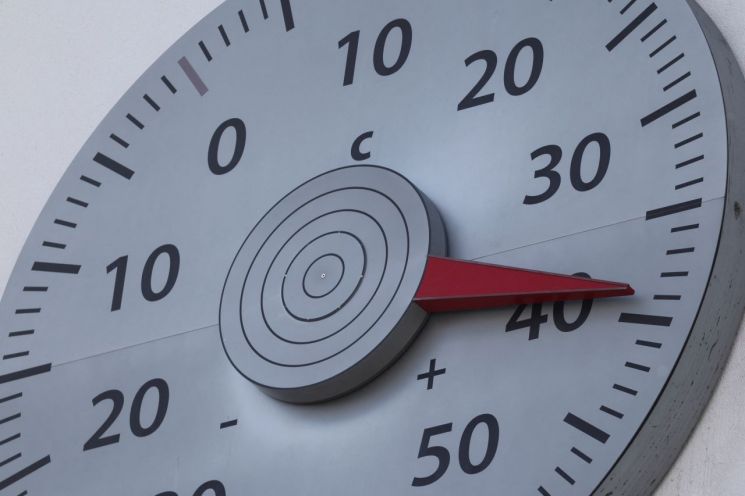 A giant thermometer installed on the wall of the United Nations Framework Convention on Climate Change (UNFCCC) headquarters in Bonn, Germany, shows a temperature of 39 degrees Celsius. Photo by Reuters Yonhap News
She also identified the urban heat island effect as a cause of heatwaves. The heat island effect refers to the phenomenon where concrete buildings and roads in city centers absorb solar heat during the day and do not cool down easily at night, causing the overall temperature of the city to be significantly higher than that of surrounding areas.
According to major foreign media outlets, on June 29, the temperature in the Portuguese city of Mora reached 46.6 degrees Celsius, setting a new all-time high for June. The previous record (45.4 degrees) set just the day before was broken within a single day. In El Granado in southern Spain, the mercury hit 46 degrees, also setting a new June record. The average temperature in Barcelona in June was 26 degrees, surpassing the previous record of 25.6 degrees set in 2003.
 As temperatures in France are expected to soar above 40 degrees Celsius, tourists are cooling off at the fountain in front of the Eiffel Tower in Paris on the 1st (local time). Photo by AFP Yonhap News
In France, as of the 1st, 16 out of 96 regions in mainland Europe were under a red heatwave alert, and 68 regions were under an orange alert. In some areas, including the capital Paris, daytime high temperatures exceeded 40 degrees Celsius. Italy also issued a 'Level 3' heatwave alert for 16 cities. This alert indicates a level of heatwave that can negatively affect not only high-risk groups such as the elderly but also healthy and active individuals.
Pierre Marcello, a statistician at the London School of Hygiene and Tropical Medicine, estimated that more than 4,500 excess deaths (the number of deaths exceeding the normal level) would occur over the four days from June 30 to July 3 due to the heatwave sweeping across Europe.
United Nations Secretary-General Antonio Guterres stated on social media, "Heatwaves are no longer extreme weather anomalies. They have now become the 'new normal,'" and urged, "We must take much stronger climate action immediately."
© The Asia Business Daily(www.asiae.co.kr). All rights reserved.



















