Declining Market Share for U.S. Auto Exporters
Worsening Conditions for Automobile and Parts Exporters
"Portfolio Diversification Needed to Counter Tariffs"
According to an analysis, if the mutual tariff suspension ends on July 9, the U.S. import market may shrink and the competitive landscape among countries could be reshaped.
According to the report "Changes in the Export Competition Structure in the U.S. Import Market after Trump's First Term and Implications," released by the Korea International Trade Association's Institute for International Trade and Commerce on July 2, the market share of major automobile exporters to the U.S.?including Korea, Mexico, Canada, Japan, and Germany?all declined compared to last year during the January to April period of this year. This is interpreted as a result of worsening export conditions for automobile and parts exporters to the U.S., as the impact of the 25% tariff on automobiles and parts has become fully apparent.
In fact, while U.S. imports from the world increased significantly during January to April this year (+19.2%, $1.2242 trillion), imports from Korea decreased (-5.0%, $41.7 billion), causing Korea's ranking in the U.S. import market to fall from 7th last year to 10th this year. Notably, there were pronounced decreases compared to the same period last year in Korea's key export items to the U.S., such as automobiles and automobile parts (-$2.43 billion), machinery (-$570 million), chemical industry products (-$420 million), and semiconductors (-$380 million).
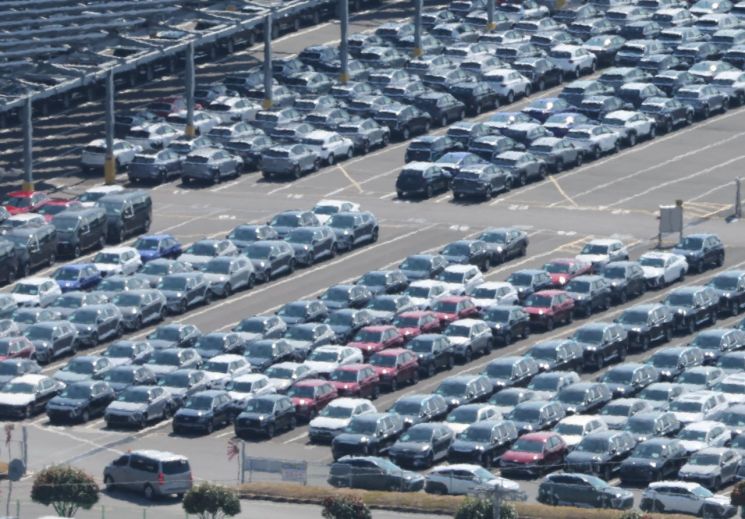 On the 2nd, finished vehicles are waiting in the storage yard next to the export loading dock at Hyundai Motor Company's Ulsan plant. Photo by Yonhap News.
The report also compared and analyzed changes in the export competition structure among major countries in the U.S. import market, using 2016 and 2024 as benchmarks?before and after the start of Trump's first term. Due to the prolonged U.S. policy of containing China and maintaining protectionism, Mexico and India have emerged as strong competitors to Korea, replacing China's shrinking presence in the U.S. import market. These countries have expanded their market share in the U.S. while simultaneously increasing their export competition index with Korea.
In the case of Mexico, following the entry into force of the USMCA (United States-Mexico-Canada Agreement) in July 2020, it has solidified its position as a production base in North America, rapidly expanding its share in automobiles, parts, and machinery. For India, this trend is attributed to the government's manufacturing promotion strategies.
Japan (export competition index 0.52) and Germany (0.41) recorded the highest export competition indices, but both countries saw their market shares in the U.S. decline. However, since their export structures to the U.S.?not only for automobiles and parts, but also for machinery and electrical/electronic products?are very similar to Korea's, the report noted that the competition index could change at any time depending on the imposition of mutual tariffs.
The report projected that if different mutual tariffs are implemented by country, the U.S. import market will shrink, and the competitive dynamics among countries will shift, especially for competing items. For China (54%), Vietnam (46%), Taiwan (32%), and India (26%), which are expected to face higher mutual tariffs than Korea (25%), competition is likely to center on machinery and electrical/electronic products. The report also added that Korea could benefit from price advantages resulting from tariffs.
However, Japan (24%) and Germany (20%) will be subject to lower tariffs than Korea, putting them at a price advantage. For automobiles and parts?the main competitive items?uniform item tariffs will be applied under Section 232 of the Trade Expansion Act, so short-term changes are expected to be limited. However, Korea's competitiveness in machinery and other sectors may weaken.
Kim Kyuwon, Senior Researcher at the Korea International Trade Association, stated, "We need to prepare in advance for a decline in exports to the U.S. due to mutual tariffs." He added, "At the corporate level, companies should diversify production bases, reduce production costs to lower the taxable base price, and expand exports to items that are difficult to produce in the U.S. or have low substitution potential."
© The Asia Business Daily(www.asiae.co.kr). All rights reserved.
![Clutching a Stolen Dior Bag, Saying "I Hate Being Poor but Real"... The Grotesque Con of a "Human Knockoff" [Slate]](https://cwcontent.asiae.co.kr/asiaresize/183/2026021902243444107_1771435474.jpg)















