Trump Intensifies Criticism of Japan for Third Day Amid Stalled Talks
Pressures Japan to Reach Deal as Reciprocal Tariff Suspension Nears Expiration
Similar Pressure on South Korea Possible Over Automobiles and Rice
Reaffirms Negative Stance on Extending Reciprocal Tariff Suspension
U.S. President Donald Trump has expressed a negative stance on the possibility of reaching a trade agreement with Japan, warning that reciprocal tariffs could be raised to as high as 35%. With the expiration of the reciprocal tariff suspension set for next week, he has voiced frustration over delayed negotiations, escalating pressure on Japan for the third consecutive day. Concerns are being raised that the impact could extend to South Korea, which, like Japan, maintains a trade surplus with the U.S. and faces demands to resolve trade barriers involving automobiles and rice, among other similar negotiation issues.
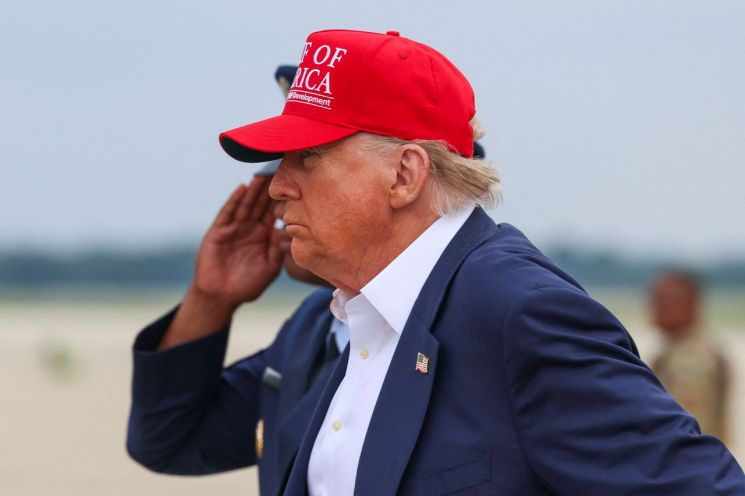
On July 1 (local time), President Trump told reporters aboard Air Force One en route from Florida to Washington, D.C., that he was "skeptical" about the possibility of the U.S. and Japan reaching a trade agreement. He stated that the country-specific reciprocal tariff rate imposed on Japan could be raised from the current 24% to between 30% and 35%.
In contrast, he took a relatively optimistic tone regarding trade negotiations with India, saying that "there is a possibility of an agreement." This stood in stark contrast to his critical stance toward Japan.
He reiterated that there are no plans to extend the reciprocal tariff suspension.
Previously, on April 9, President Trump imposed reciprocal tariffs on 57 economic entities (56 countries and the European Union (EU)), including South Korea and Japan, and applied a 90-day suspension. This measure is scheduled to end at 12:01 a.m. on July 9, and President Trump has been intensifying pressure on Japan as the deadline approaches.
President Trump has publicly criticized Japan for three consecutive days, including June 29 and 30. Over the past two days, he used his own social networking service, Truth Social, to claim, "Japan is experiencing a massive rice shortage but refuses to import our rice. I will send a letter listing the tariff rates," and "Japan does not import American cars, but the U.S. imports millions of Japanese cars. This is unfair," demanding the removal of trade barriers.
According to U.S. media reports, U.S.-Japan trade negotiations have made little progress. Japan is reportedly demanding a reduction in both the 25% tariff on automotive items and the 24% reciprocal tariff in its negotiations with the U.S. Since the automotive industry accounts for about 10% of Japan's gross domestic product (GDP), Bloomberg reported that Japan's main negotiation goal is to lower vehicle tariffs by 10 percentage points. However, Japan has been reluctant to change its stance on opening its rice market, which President Trump has criticized, due to political sensitivities such as opposition from domestic farmers. Instead, Japan is said to have proposed cooperation in the shipbuilding industry and expanded imports of U.S. semiconductors and liquefied natural gas (LNG) as alternatives.
With the expiration of the reciprocal tariff suspension imminent and no concrete trade agreement reached due to these differences in positions, President Trump has taken an even tougher stance toward Japan, where negotiations have stalled. As of 2024, the U.S. trade deficit with Japan stands at $68.5 billion, the seventh largest by country. For the U.S., a swift trade agreement with Japan could be highlighted as a political achievement.
Bloomberg reported, "As the Trump administration seeks a quick win, the risk of Japan becoming an easy target has increased," adding, "Japan, which relies on Washington for trade and security, is reluctant to confront the U.S. head-on." The report also cited experts who said, "Japan needs to take broad measures, such as removing non-tariff barriers on automobiles and lowering tariffs on agricultural products, including rice."
The issue is that South Korea's trade issues with the U.S. are also similar to those of Japan, raising concerns that President Trump's recent pressure on Japan could affect South Korea as well. The U.S. trade deficit with South Korea stands at $66 billion, the eighth largest by country after Japan. In particular, automobiles are a major export item to the U.S. for South Korea, just as they are for Japan. Given that President Trump pointed out South Korea's non-tariff barriers on rice and automobiles when announcing reciprocal tariffs in April, there is a possibility that similar issues could be raised against South Korea in the future. In addition, South Korea is also using the shipbuilding and energy sectors as negotiation cards, which creates many similarities with Japan.
South Korea had previously been somewhat shielded from U.S. pressure due to domestic political turmoil such as martial law and impeachment proceedings. However, with the launch of the Lee Jaemyung administration last month and the start of new high-level trade negotiations, there are growing concerns that U.S. pressure could intensify going forward.
© The Asia Business Daily(www.asiae.co.kr). All rights reserved.
![Clutching a Stolen Dior Bag, Saying "I Hate Being Poor but Real"... The Grotesque Con of a "Human Knockoff" [Slate]](https://cwcontent.asiae.co.kr/asiaresize/183/2026021902243444107_1771435474.jpg)















