Tie Vote in the Senate... Vance Casts Deciding Ballot
House Vote Scheduled for July 2... To Take Effect After Trump Signs
"U.S. Fiscal Deficit to Increase by $3.3 Trillion Over 10 Years"
Despite Fiscal Concerns, Response in Treasury and Dollar Markets Remains Limited
A large-scale tax cut bill, which encapsulates the core policy agenda of U.S. President Donald Trump, passed the U.S. Senate on July 1 (local time). With only a House vote remaining, if the bill is enacted, President Trump is expected to secure a major political victory and further strengthen his leadership over the political landscape. Despite concerns that the bill could expand the fiscal deficit, the market reaction was limited, with the U.S. dollar and Treasury prices only experiencing slight declines that day.

U.S. Senate Passes Bill 51-50... House Vote Scheduled for July 2
In a plenary session, the Senate passed the so-called "one big, beautiful bill" with 51 votes in favor and 50 against.
During the vote, three Republican senators broke ranks, resulting in a 50-50 tie. Vice President J.D. Vance, who also serves as President of the Senate, cast the tie-breaking vote, allowing the bill to narrowly pass.
Of the 100 seats in the Senate, Republicans hold 53. However, Senators Thom Tillis (North Carolina), Rand Paul (Kentucky), and Susan Collins (Maine) voted against the bill as previously announced. All Democratic senators opposed the bill.
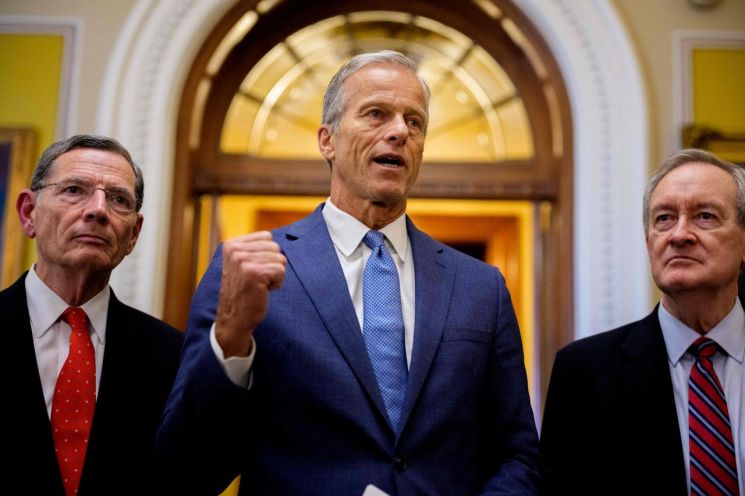
Immediately after the bill's passage, President Trump told reporters, "This is a great bill that includes provisions for everyone," adding, "I believe it will pass the House very easily. It will be easier to pass in the House than in the Senate."
This bill primarily extends major tax cut measures introduced during President Trump's first term in 2017, including reductions in individual income tax rates, a lower top corporate tax rate, and expanded standard deductions and child tax credits. It also includes provisions such as tax exemptions for tips and overtime pay, and the establishment of $1,000 savings accounts for newborns.
On the spending side, the bill increases the border security budget to curb illegal immigration. Tax credits for clean energy and electric vehicle purchases, which were introduced under former President Joe Biden, will be repealed or terminated. The bill also raises the federal debt ceiling by $5 trillion to prevent a default in August.
The bill narrowly passed the House by a single vote last month before moving to the Senate, where it faced a tumultuous process. After a procedural vote on June 28, Democrats demanded the full reading of the 940-page bill and engaged in lengthy line-by-line review. The subsequent "vote-a-rama" procedure saw 45 amendment votes, resulting in a 27-hour marathon session.
The Republican leadership conducted intensive persuasion efforts to prevent defections, and President Trump intervened directly by pressuring lawmakers who sought to block the bill, even mentioning the possibility of electoral defeat.
The bill, with some provisions amended in the Senate, has been sent back to the House, where a final vote is scheduled for July 2.
However, passage in the House is not guaranteed. The Senate's amended version would increase the fiscal deficit by about $500 billion more than the House version, raising concerns over the expansion of national debt. Controversy over proposed cuts to Medicaid (the health insurance program for low-income individuals) could also be a key variable in the House vote.
House Speaker Mike Johnson, a Republican, emphasized his commitment to swift action, stating that efforts would be made to handle the bill "quickly" by July 4. This aligns with President Trump's earlier announcement that he aims to sign the tax cut bill on Independence Day, July 4.
"U.S. Fiscal Deficit to Increase by $3.3 Trillion Over Next 10 Years"... Treasury Yields Rise Slightly

There are concerns in the market that this bill could further exacerbate the fiscal deficit. The Congressional Budget Office (CBO) projected that, based on the Senate version, the fiscal deficit will increase by $3.3 trillion by 2034. This is because government spending will decrease by $1.2 trillion, but the total amount of tax cuts will reach $4.5 trillion. However, this estimate does not take into account potential economic growth effects, such as increased consumption or expanded corporate investment resulting from the tax cuts.
Federal Reserve Chair Jerome Powell also stressed the need for prompt action to address worsening fiscal soundness. At the European Central Bank (ECB) forum that day, he warned, "The U.S. fiscal path is not sustainable," and added, "We need to address this issue as soon as possible."
Despite the passage of the tax cut bill, the market reaction has been largely limited. U.S. Treasury yields had already been rising in the morning due to strong employment data, and only saw a slight additional increase in the afternoon. The 10-year U.S. Treasury yield, a global benchmark, rose by 5 basis points (1bp=0.01 percentage point) from the previous day to 4.25%, while the 2-year yield, which is sensitive to monetary policy, increased by 6 basis points to 3.78%. So far, there has been no sharp spike in yields due to concerns over a widening fiscal deficit.
The U.S. dollar remains slightly weaker. The dollar index, which measures the dollar's value against six major currencies, fell by 0.09% from the previous day to 96.4.
© The Asia Business Daily(www.asiae.co.kr). All rights reserved.
![Clutching a Stolen Dior Bag, Saying "I Hate Being Poor but Real"... The Grotesque Con of a "Human Knockoff" [Slate]](https://cwcontent.asiae.co.kr/asiaresize/183/2026021902243444107_1771435474.jpg)


















