The World's First Customer-Participatory Research Hub Opens
Delivering Core Values of Mobility User Experience
Collecting Customer Insights and Experiences at the Open Lab
Validating New UX Concepts in the Simulation Room
When I stepped into the simulation model, the "verification bug," which replicates a real car, and selected the destination "Pangyo Techno Valley," a driving scene reflecting real-world roads appeared on the wall. As I performed actions such as turning on the indicator and engaged in virtual driving, the system collected real-time data on my interactions with the devices and the movement of my gaze toward the display.
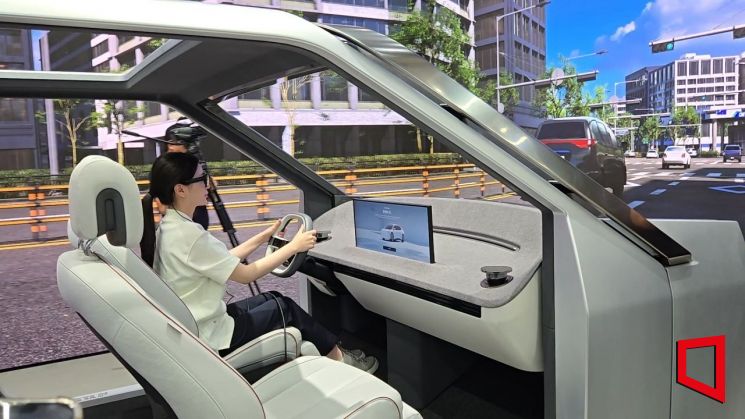 At the UX Test Zone on the first floor of Hyundai Motor Group's 'UX Studio Seoul,' a guide is seated in the verification bug, wearing a virtual reality (VR) device and experiencing the UX applied to the vehicle. Photo by Kyungjo Noh
A new space where visitors can experience Hyundai Motor Group's future mobility technologies up close has opened along Gangnam-daero in Seoul. The star of the show is "UX Studio Seoul," the world's first customer-participatory research space created by Hyundai Motor Group. Even those who are not Hyundai or Kia owners can drop by, try out the experiences, and leave feedback.
When I visited UX Studio Seoul on July 1, the space, located on the first and second floors of Hyundai Motor Group's Gangnam-daero building, featured a full-glass structure that immediately caught the attention of passersby. Upon entering, I was greeted by "Spot," the four-legged robot dog developed by Boston Dynamics, Hyundai Motor Group's U.S.-based robotics subsidiary.
The first floor, called the "Open Lab," is an area where visitors can experience exhibition content and participate in surveys. It is divided into three main zones. In the UX Test Zone, visitors can see how Hyundai and Kia's UX concepts are developed, implemented, and verified.
Here, not only are there small-scale models reflecting various UX concepts such as doors, seats, and moving consoles, but visitors can also directly operate a full-size "study bug"?an experimental model produced in advance during the vehicle development process to verify usability. Furthermore, in the verification bug, visitors can use a virtual reality (VR) device to experience the UX applied to the vehicle in an immersive way.
A Hyundai Motor Group representative explained, "Through the verification bug, we experiment to determine the optimal display height and whether lane change guidance on the navigation is more easily viewed as a carpet trajectory or as a target area box. We derive usability indicators based on functional operations and gaze dispersion, and we can validate the test results."
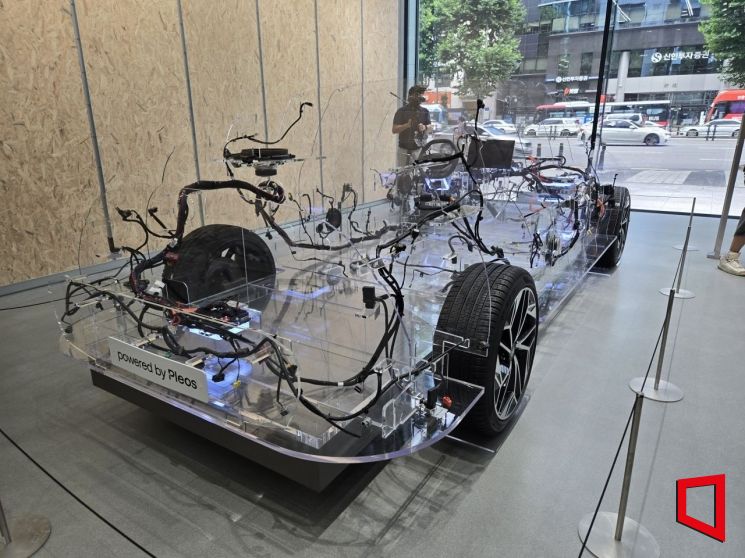 The 'Electric and Electronic (E&E) Architecture' installed in the SDV Zone on the first floor of Hyundai Motor Group's 'UX Studio Seoul'. Photo by Kyungjo Noh
To the right of the wall, the SDV (Software Defined Vehicle) Zone allows visitors to experience core hardware and software technologies. This area features the "Electric and Electronic (E&E) Architecture," which was first unveiled at the developer conference "Pleos 25" held in March.
What particularly stood out was the voice assistant "Gleo AI." As a type of Hyundai Motor Group's next-generation infotainment system, "Pleos Connect," Gleo AI went beyond simple tasks like opening and closing windows or providing basic information such as the weather. It also demonstrated emotional intelligence, such as offering comforting words for the morning commute.
After exploring the UX Archive Zone, which showcases the evolution of user experience at Hyundai and Kia, I went upstairs. The second floor, called the "Advanced Research Lab," is a restricted area where Hyundai and Kia researchers and pre-registered users conduct UX research. It consists of the UX Canvas and Feature Development Room, Simulation Room, UX Lounge, and Vehicle Exhibition Room.
A Hyundai Motor Group representative said, "On the second floor, we hold workshops to generate various ideas and conduct specialized research in areas such as autonomous driving UX and high-performance vehicle UX. The simulation room is also a dedicated research space that is not always open to the public, where we verify newly developed UX concepts in a virtual environment."
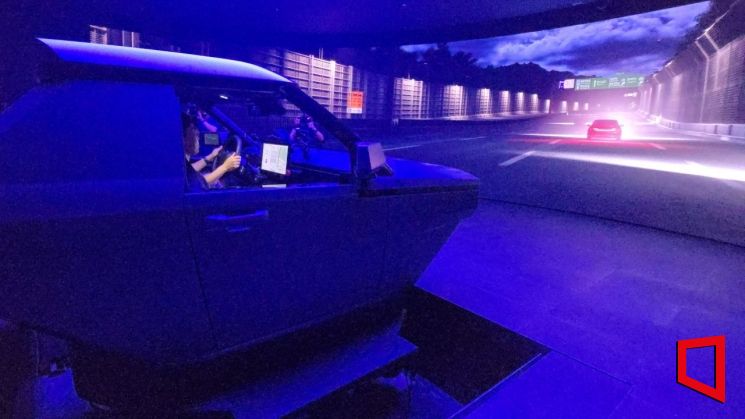 Testing a newly developed UX concept in the simulation room on the 2nd floor of Hyundai Motor Group's 'UX Studio Seoul.' Photo by Kyungjo Noh
The simulation room is equipped with a six-axis motion simulator and a large curved display with a 191-degree field of view, implemented using 730 LED modules. This setup creates an evaluation environment similar to actual driving, allowing for detailed, data-based verification of how UX concepts perform during driving and what improvements are needed.
The simulation software creates a virtual environment based on real maps of major cities around the world, including Seoul, San Francisco in the United States, and Delhi in India, making the experience even more realistic. Not only can the weather and season be changed, but the height of the steering wheel and the seat spacing also adjust according to the selected vehicle model. Driving data from the user is captured by cameras and sensors installed inside the test bug, and all data is subsequently stored in a database.
Hyundai Motor Group stated, "Next year, we plan to convert our privately operated UX Studio in Shanghai, China, into an open space. We will actively utilize accumulated user data in the UX research process and continue to develop innovative mobility experiences based on this data."
© The Asia Business Daily(www.asiae.co.kr). All rights reserved.
![Clutching a Stolen Dior Bag, Saying "I Hate Being Poor but Real"... The Grotesque Con of a "Human Knockoff" [Slate]](https://cwcontent.asiae.co.kr/asiaresize/183/2026021902243444107_1771435474.jpg)

















