Rural Development Administration Launches KOPIA Mongolia Livestock Advancement Vision
Korea Rural Community Corporation Embarks on Building Mongolia-Specific 'Smart Farming Complex'
Korean livestock technology and smart farming technology are being transferred to Mongolia. Through international agricultural cooperation, efforts are underway to establish a Mongolia-specific 'smart farming complex', while also laying the groundwork for the export of K-animal pharmaceuticals by transferring Korean livestock technology locally in Mongolia.
The Rural Development Administration announced on July 1 (local time) that it held the 'KOPIA Mongolia Livestock Advancement Vision Launch Ceremony' at the Plant Agriculture Science Institute in Darkhan, Mongolia.
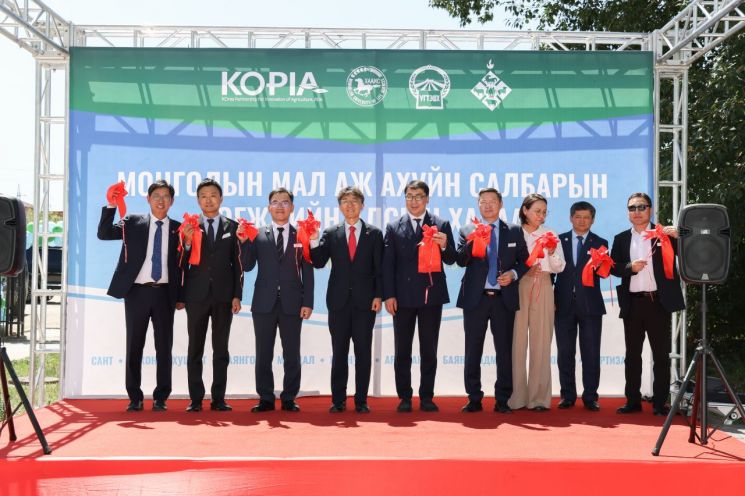
KOPIA is an international development cooperation project led by the Rural Development Administration. It is an overseas agricultural technology development project that helps partner countries improve agricultural productivity and increase smallholder farmers' incomes by developing and distributing locally tailored agricultural technologies in developing countries.
Jambalchereng, Deputy Minister of Agriculture of Mongolia, who attended the launch ceremony, stated in his congratulatory speech, "Livestock farming accounts for about 86.1% of Mongolia's total agricultural output and is a key industry, but the level of livestock technology is low. In addition, issues such as climate change and pasture degradation have placed the industry in a structural crisis. Through cooperation with the KOPIA Center, we aim to introduce modern livestock technology and create an opportunity for Mongolia's livestock industry to make a new leap forward."
During the launch ceremony, KOPIA Mongolia Center shared the results of its livestock productivity improvement pilot project, which has been underway since 2022, as well as the projects planned for this year. In addition, a memorandum of understanding (MOU) was signed to strengthen cooperation among KOPIA, ten Mongolian local governments, and the Korea Invention Promotion Association. Notably, a donation ceremony for small agricultural machinery, prepared to support productivity improvement for Mongolian farmers, was held and received positive responses from attendees. A seminar on the development direction of Mongolia's livestock industry and an export consultation meeting for K-animal pharmaceuticals were also held. Domestic animal pharmaceutical companies introduced their technologies and product efficacy, aiming to achieve tangible export results.
Lim Kisoon, Director of the National Institute of Animal Science at the Rural Development Administration, stated, "With this launch ceremony, we are entering a full-fledged phase of distributing locally tailored livestock technologies and establishing a sustainable livestock production system through the KOPIA project. We will continue to provide K-livestock technology, including disease control, livestock breeding, and animal feed, and actively support the KOPIA Mongolia project so that it can become a leading example of Korea's official development assistance."
Earlier, on June 18, Korea Rural Community Corporation began full-scale efforts to establish a smart farming complex to support Mongolia's food self-sufficiency and agricultural modernization. An official from the corporation explained, "Mongolia faces difficulties in vegetable production due to severe cold, with average winter temperatures dropping below minus 20 degrees Celsius, and relies on imports for more than 70% of its total vegetable consumption. Based on Article 36 of the 'Food Security Act,' approved by the Mongolian parliament in 2022, the Mongolian government plans to build a 270-hectare greenhouse complex over the next five years."
Korea Rural Community Corporation plans to invest approximately 6 billion KRW from last year until 2028 to establish a 9.6-hectare smart farming complex in Mongolia that enables year-round vegetable production and to provide cultivation technology support. Within the complex, state-of-the-art greenhouses will be installed, along with a 0.5-hectare open-field demonstration plot to verify vegetable production models suitable for the local climate. Based on these facilities, the corporation will operate hands-on training programs to help farmers, government officials, and students acquire smart farming technologies. These efforts are expected to not only improve the vegetable self-sufficiency rate but also foster young farmers and generate various ripple effects.
Kim Sungkyung, Director of the Global Business Division at Korea Rural Community Corporation, stated, "International agricultural cooperation programs are designed to suit the conditions of recipient countries. Through a smart farming model optimized for Mongolia's climate, we aim to establish a foundation for year-round vegetable production and contribute to securing food sovereignty."
© The Asia Business Daily(www.asiae.co.kr). All rights reserved.
![Clutching a Stolen Dior Bag, Saying "I Hate Being Poor but Real"... The Grotesque Con of a "Human Knockoff" [Slate]](https://cwcontent.asiae.co.kr/asiaresize/183/2026021902243444107_1771435474.jpg)















