Park Sunjae, National Institute of Biological Resources Researcher, Appears on SBS Radio
"It Takes Time for Population Control After Introduction of a New Species"
As lovebugs (Plecia nearctica) are proliferating throughout the Seoul metropolitan area, including Seoul and Gyeonggi Province, an expert has predicted that most of the insects will disappear by mid-July.
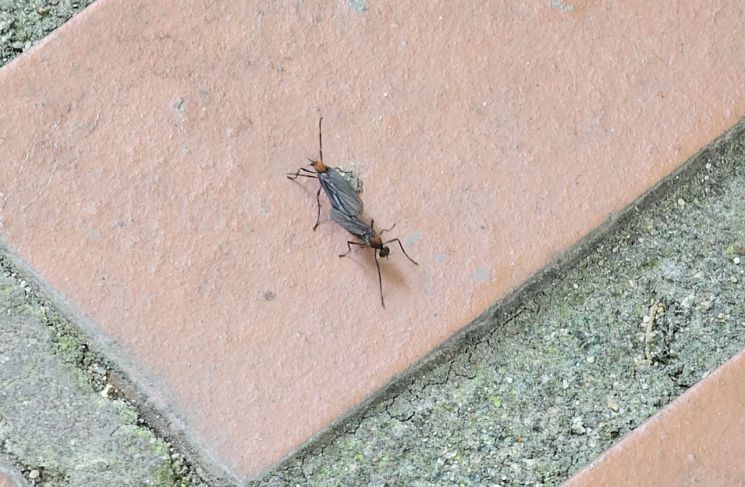 On the 20th of last month, a lovebug was sitting on a street in downtown Seoul. Photo by Yonhap News
On July 1, Park Sunjae, a researcher at the National Institute of Biological Resources, appeared on SBS Radio's 'Kim Taehyun's Political Show' and said, "If we consider the life cycle of the lovebug, reports usually begin to come in around mid-June. The adult insects live for about a week, and based on their life cycle and the current situation, we typically see that most of them disappear by mid-July."
Lovebugs were first reported in Incheon in 2015 and then appeared in large numbers in the northwestern regions, including Eunpyeong District in Seoul and Goyang in Gyeonggi Province, in 2022. Currently, they have been found in all 25 districts of Seoul and in neighboring areas of Gyeonggi Province.
Park stated, "Since the massive outbreak in the metropolitan area in 2022, it is clear that the insects have been spreading throughout Seoul and nearby areas in Gyeonggi Province. We need to continue monitoring to keep track of this trend."
He added, "When a new species is introduced, it tends to multiply rapidly at first due to the absence of natural predators, but over time, the population often becomes naturally regulated. During our field investigations, we have frequently observed magpies, sparrows, and various other birds, as well as spiders and mantises, preying on lovebugs. It will inevitably take some time for the population to be brought under control."
Regarding ways to get rid of lovebugs, Park said, "Lovebugs are attracted to light, so during periods of mass outbreaks, it is best to minimize the use of household lighting." He also recommended, "When going out, wear dark-colored clothing instead of light-colored clothes. If lovebugs enter your home, you can easily remove them by spraying water with a spray bottle and wiping them up with tissue."
In cases of mass outbreaks, such as at Gyeyangsan in Incheon, Park explained, "Since lovebugs were only recently introduced to Korea, we are continuing our research on how to respond. Starting this year, we have been developing environmentally friendly technologies to control their population. Because lovebugs are attracted to light, we are piloting the use of light-based trapping devices and attractant-based traps to lure them to specific areas, in collaboration with the Seoul Metropolitan Government and others. Once we have results, we plan to apply and operate these methods directly in the field."
© The Asia Business Daily(www.asiae.co.kr). All rights reserved.
![Clutching a Stolen Dior Bag, Saying "I Hate Being Poor but Real"... The Grotesque Con of a "Human Knockoff" [Slate]](https://cwcontent.asiae.co.kr/asiaresize/183/2026021902243444107_1771435474.jpg)















