Despite Strong Subscription Competition, Non-Priority Applications Continue
"Blind Subscription" Practices Widespread... Little Penalty for Withdrawing Contracts
Stricter Loan Regulations Likely to Increase Contract Abandonment
Cases of buyers giving up their contracts are rapidly increasing in apartment subscription sales on the outskirts of Seoul, even after recording competition ratios of dozens to one. While the high subscription competition ratios suggest strong demand, many successful applicants are not proceeding to contract, resulting in unsold units being offered through non-priority subscriptions (known as 'Jupjup'). This phenomenon appears to be driven by a combination of structural factors, including the burden of high sales prices, the widespread practice of 'blind subscriptions,' and weakened penalties for canceling subscriptions.
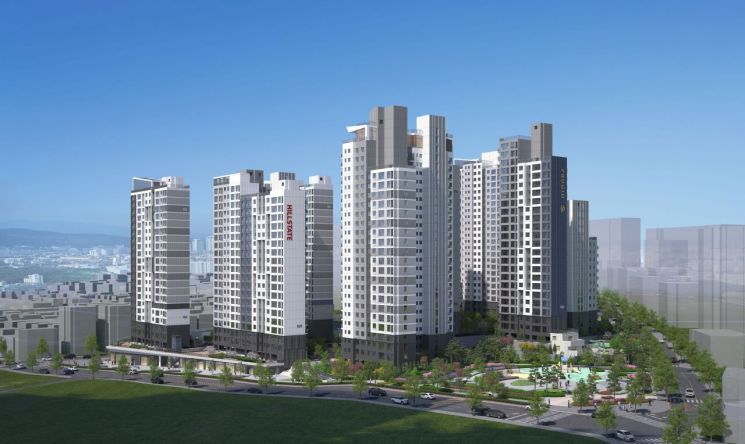
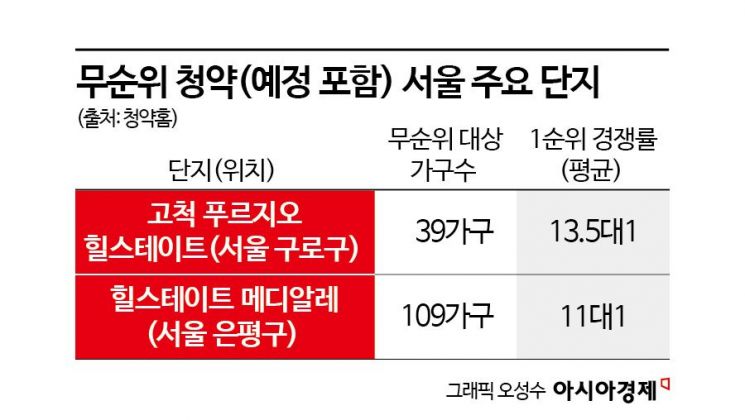
According to Korea Real Estate Board’s Cheongyak Home on July 2, 'Gocheok Prugio Hillstate' in Gocheok-dong, Guro-gu, Seoul, will conduct a non-priority subscription for 39 remaining units on July 8. By type, there are 18 units of 59㎡B, 1 unit of 59㎡D, 19 units of 84㎡A, and 1 unit of 84㎡C. The sales price for 59㎡ units ranges from 900 million to 1 billion won, while 84㎡ units are priced between 1.1 and 1.2 billion won. Households without home ownership residing in Seoul, Gyeonggi, or Incheon are eligible to apply.
This complex offered 576 units for general sale. In the subscription held in May, a total of 5,243 applicants applied for both special and general supply. The first-priority subscription recorded a maximum competition ratio of 37.3 to 1, with an average of 13.5 to 1. However, when it came time to sign contracts, many successful applicants gave up their rights. Not only did the winners, but also the standby applicants?up to five times the supply?chose not to proceed, resulting in units being offered through non-priority subscription.
Previously, 'Hillstate Mediale' in Daejo-dong, Eunpyeong-gu, Seoul, also conducted a non-priority subscription for 109 units that were abandoned by successful applicants out of 483 units offered for general sale. At the time of the main subscription, the average competition ratio was 11 to 1. This complex was developed through the redevelopment of Daejo District 1. The direct cause of contract abandonment is attributed to the high sales prices compared to nearby market prices. The price for a 59㎡ unit was set between 1 billion and 1.1 billion won, while 74㎡ units were priced in the 1.3 billion won range.
Experts point out that the surge in abandoned contracts is a consequence of the 'blind subscription' practice. In areas outside regulated zones (Seoul’s three Gangnam districts and Yongsan-gu), there are no restrictions on reapplying for subscriptions after canceling a contract. As a result, there is a prevailing attitude among younger buyers in their 20s and 30s with low subscription points to "just apply for now and think later." This is often referred to as 'Seondanghugom' (winning first, worrying later).
The lottery-based subscription system also encourages 'blind subscriptions.' It is common for applicants to give up contracts after winning in the lottery if the unit’s location or floor does not meet their preferences, or if the financial burden is too high. For units of 85㎡ or less, 60% are allocated by lottery, and for units over 85㎡, 100% are allocated by lottery. Even if a contract is canceled, applicants can simply open a new subscription account and apply elsewhere, so the penalty for canceling is considered weak.
An industry insider commented, "There are cases where the subscription competition ratio is high but the contract rate is low, while in other cases, even with a near 1-to-1 competition ratio, the contract rate is high. This means that it is difficult to judge the success of a sale based solely on the subscription competition ratio."
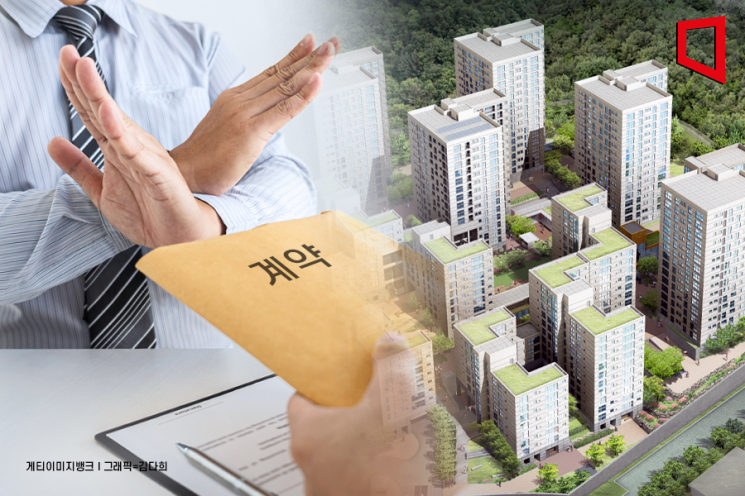
Meanwhile, there are forecasts that the number of people giving up their contracts will increase further due to the government’s loan restrictions announced on June 27. For new sales in the Seoul metropolitan area, the maximum limit for balance loans has been capped at 600 million won, making it even more difficult to secure funds for high-priced units. If buyers are unable to prepare the balance by the move-in date, they are highly likely to abandon the contract.
Park Jimin, head of Wolyong Subscription Research Institute, said, "With the new loan restrictions, complexes with sale prices exceeding 1.2 billion won are inevitably affected. The biggest impact will be on young professionals with high incomes but insufficient assets who are actual end-users."
© The Asia Business Daily(www.asiae.co.kr). All rights reserved.
![Clutching a Stolen Dior Bag, Saying "I Hate Being Poor but Real"... The Grotesque Con of a "Human Knockoff" [Slate]](https://cwcontent.asiae.co.kr/asiaresize/183/2026021902243444107_1771435474.jpg)

















