On July 1, Incheon Mayor Yoo Jungbok marked the third anniversary of the 8th popularly elected administration by presenting a vision for Incheon in 2030 and outlining his plans for city governance during the remaining year of his term.
At a press conference held that day, Mayor Yoo stated, "Over the past three years, I have focused solely on the citizens, Incheon, and the future. By resolving long-standing pending projects, we have laid the foundation for Incheon to leap forward as a world-class city. I will not be complacent with what we have achieved so far, but will make the remaining year a time of fruition and, together with the citizens, open up Incheon's future."
Incheon City plans to transform itself into a new growth hub of South Korea in the economic and industrial sectors through key projects such as designating the southern part of Ganghwa as a free economic zone, completing a bio high-tech industry cluster, creating a global aviation maintenance industry hub, establishing a future energy ecosystem centered on hydrogen and offshore wind power, renovating old industrial complexes, and building the advanced industrial complex in Gyeyang Technovalley.
In the culture and tourism sector, the city aims to foster Incheon as South Korea's culture and tourism hub by promoting projects such as the creation of K-Content Land centered on the airport economic zone, global branding of the open port area, expansion of large-scale cultural and artistic infrastructure, development of the Gyeongin Ara Waterway as a complex space for culture, tourism, and leisure sports, and revitalization of global transfer tourism through the airport and cruise terminals.
In the birth and welfare sector, the city seeks to promote generational inclusion and stability by pursuing the national adoption of Incheon-style birth policies such as the "100 Million Dream," realizing Incheon-style Empathy Welfare 3.0, expanding the local public healthcare system, and increasing support for senior jobs and social activities.
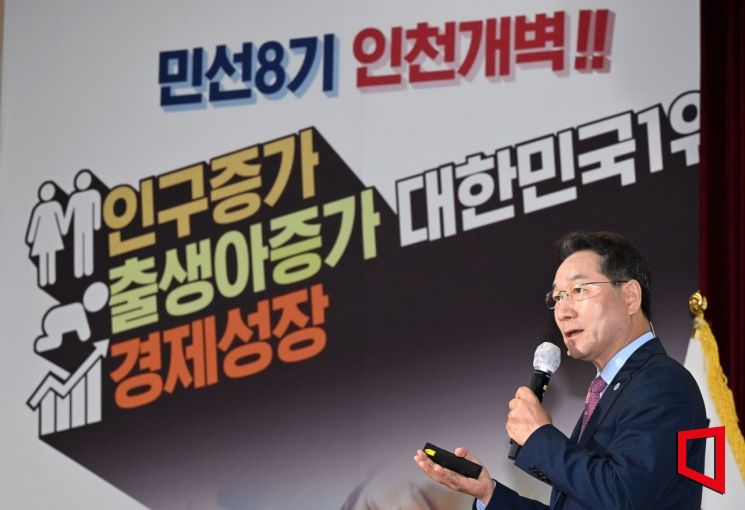 Incheon Mayor Yoo Jungbok held a press conference on the 1st to mark the third anniversary of his inauguration and explained the direction of city administration. Incheon City
In the marine and environment sector, Incheon aims to establish itself as an international marine city and a leading environmental city through projects such as the Incheon Port Future Development Project, specialized development of Incheon Treasure Island, implementation of the 2045 carbon neutrality roadmap, creation of large-scale national parks within the city, and development of alternative landfill sites for the metropolitan landfill.
In the infrastructure and transportation sector, the city is pursuing innovation in the old city center and a leap forward as a metropolitan transportation hub by completing the Jemulpo Renaissance Project, renovating aging planned cities in the old downtown, undergrounding the Gyeongin Railway and Gyeongin Expressway, expanding the metropolitan railway network centered on Incheon, and constructing the Incheon Circular Line 3.
The city plans to continuously promote strategic projects that leverage the unique characteristics and strengths of each district and county to realize the "2030 Global Top Ten City" vision and implementation strategy, while simultaneously pursuing balanced development across the entire city and strengthening global competitiveness.
Mayor Yoo stated, "I will do my utmost to bring about changes that citizens can feel and to ensure that Incheon becomes the future of South Korea through the realization of the '2030 Global Top Ten City' vision."
Mayor Yoo cited Incheon's elevated status, citizen-centered policies that lead South Korea, and the resolution of long-standing regional issues as major achievements over the past three years.
He analyzed that the "i Plus 100 Million Dream," an Incheon-style birth policy, and the "Thousand-Won Housing" initiative have contributed to maintaining the nation's highest birth rate growth and continued population increase.
Incheon recorded a nationwide highest birth rate growth of 11.6% last year, and in the first quarter of this year, the growth rate reached 14.4%, again the highest in the country. In August last year, the total resident registration population, including foreigners, exceeded 3.1 million, and from January to May of this year, the population increased by 16,039. This contrasts with population declines in 13 other metropolitan cities and provinces, including Seoul and Busan.
Clear achievements were also seen in economic indicators. Incheon's gross regional domestic product (GRDP) in 2023 was 117 trillion won, ranking second among special and metropolitan cities, and the real economic growth rate in 2023 was 4.8%, ranking first nationwide for two consecutive years.
Long-standing regional issues are also being resolved. Tolls on Yeongjong Bridge and Incheon Bridge have been eliminated, and the Bupyeong Camp Market site was returned to citizens after 84 years. The redevelopment of piers 1 and 8 in Incheon Port's inner harbor has begun in earnest with the signing of an implementation agreement with the government, and the project to underground the Gyeongin Expressway passed the preliminary feasibility study.
© The Asia Business Daily(www.asiae.co.kr). All rights reserved.

















