First Half Exports Reach $334.7 Billion, Down 0.03% Year-on-Year
ASEAN Up 3.8% and EU Up 3.9% Offset US and China Declines
Minister Ahn Dukgeun: "Full Efforts for Korea-US Negotiations"
Due to the tariff policies of the second Trump administration in the United States, exports to Korea's two largest markets, the United States and China, continued to struggle. However, increased exports to ASEAN (Association of Southeast Asian Nations) and the European Union (EU) offset the declines in the US and China, resulting in Korea's exports remaining flat in the first half of this year.
According to the "2025 First Half Export-Import Trends" released by the Ministry of Trade, Industry and Energy on July 1, export value stood at $334.7 billion, a slight decrease of 0.03% compared to the same period last year.
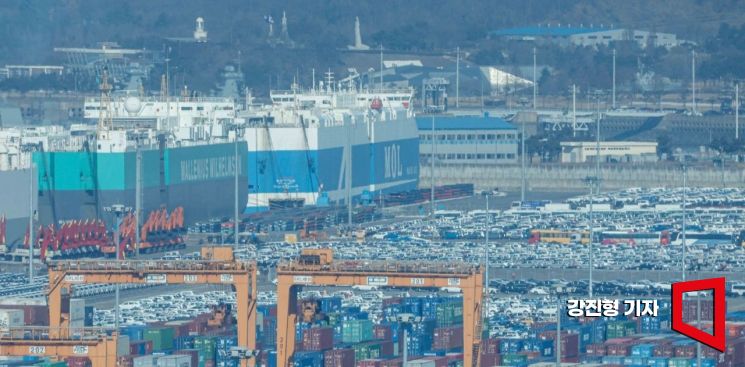
A Ministry official explained, "The export environment and conditions for Korea have not improved under Trump's tariff policies," but added, "Solid demand for semiconductors, which account for a large portion of exports, and, although the US market for automobiles is challenging, increased exports to ASEAN and the EU have compensated for this shortfall, allowing exports to remain flat in the first half."
In fact, in the first half of this year, exports increased in 5 out of the 15 major export items. Semiconductor exports reached $73.3 billion, up 11.4% year-on-year, setting a new record for the highest first-half performance. This was driven by strong demand for high value-added products such as High Bandwidth Memory (HBM) and Double Data Rate (DDR)5, as well as a rebound in fixed prices for major memory products since the beginning of the year.
Automobile exports, one of the two main export items, fell by 1.7% year-on-year to $36.4 billion. The Ministry explained that despite US tariff measures and the ramp-up of local electric vehicle production in the US, strong exports of hybrid vehicles ($8.1 billion, up 29.5%) helped limit the decline.
Exports of petroleum products ($21.5 billion, down 18.8%) and petrochemicals ($21.6 billion, down 11.4%) posted double-digit declines due to lower export prices linked to oil prices and reduced demand caused by a global economic slowdown. Steel exports, despite increased volume in the face of US tariffs, fell by 5.9% ($15.6 billion) in value due to lower unit prices.
The flat performance of Korea's exports in the first half was thanks to ASEAN and the EU. Exports to the US fell by 3.7% to $62.2 billion due to weak performance in automobiles and general machinery, the two main export items. Exports to China also dropped by 4.6% to $60.5 billion, mainly due to a decline in semiconductor exports, Korea's largest export item to China.
In contrast, exports to ASEAN ($57.6 billion) and the EU ($34.9 billion) increased by 3.8% and 3.9%, respectively, as exports of semiconductors and automobiles, the largest export items for these regions, posted double-digit growth. Exports to India also reached a record high for the first half, rising 1.6% to $9.5 billion.
Imports in the first half fell by 1.6% to $306.9 billion. Energy imports dropped by 15.3% ($59.5 billion) due to low oil prices, but non-energy imports increased by 2.4% ($247.4 billion), led by semiconductor equipment (up 27.6%). The trade surplus improved by $4.8 billion year-on-year to $27.8 billion.
In June this year, exports turned positive, reaching a record high for any June at $59.8 billion (up 4.3%). Exports increased in 6 out of the 15 major export items. Semiconductor exports, the largest export item, reached an all-time high of $14.97 billion (up 11.6%), marking four consecutive months of positive growth. Computer exports also rose for the second straight month, up 15.2% to $1.33 billion.
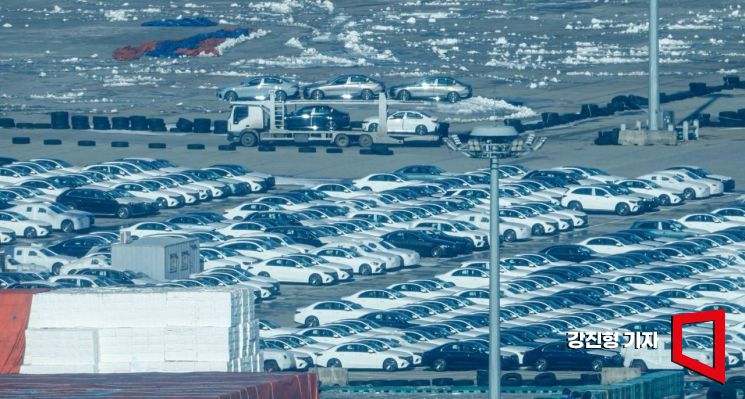
Automobile exports hit a record high for June, increasing by 2.3% to $6.3 billion. Notably, despite a decline in exports to the US, exports to the EU were strong, especially for electric vehicles, and used car exports ($670 million, up 67.9%) also surged, resulting in exports exceeding $6 billion for five consecutive months for the first time.
Bio-health exports reached a record high for June, rising 36.5% to $1.66 billion, driven by bio-pharmaceuticals ($1.11 billion, up 54.0%). Ship exports also increased for the fourth consecutive month, up 63.4% to $2.5 billion.
On the other hand, exports of petroleum products ($3.62 billion, down 2.0%) and petrochemicals ($3.36 billion, down 15.5%) continued to decline as oil prices, which determine product prices, remained weak.
Outside the 15 major export items, exports of agricultural and marine products ($1.03 billion, up 7.7%), cosmetics ($950 million, up 22.0%), and electrical equipment ($1.58 billion, up 14.8%) all reached record highs for June.
Last month, exports increased in 7 out of the 9 major regions, excluding the US and China. The two largest export markets, the US ($11.24 billion, down 0.5%) and China ($10.42 billion, down 2.7%), saw declines. Exports to ASEAN turned positive after just one month, rising 2.1% to $9.76 billion, led by semiconductors, ships, and steel products. Exports to the EU increased for the fourth consecutive month, rising 14.7% to $5.8 billion, driven by growth in automobiles, auto parts, ships, and petroleum products.
Imports in June increased by 3.3% to $50.72 billion. Energy imports ($8.55 billion) fell by 14.7%, but non-energy imports ($42.17 billion) rose by 7.9%.
Minister of Trade, Industry and Energy Ahn Dukgeun said, "Despite unprecedented global trade uncertainties this year, including US tariff measures, a slowdown in economic recovery, and the Middle East crisis, our exports in the first half maintained last year's levels. In particular, with the launch of the new government in June, exports turned positive, recording the highest June performance ever." He added, "The government will make every effort to respond to the pressing issue of Korea-US negotiations, and, depending on the outcome, will promptly prepare export support measures such as trade finance provision and the development of alternative markets to minimize negative impacts on our businesses."
© The Asia Business Daily(www.asiae.co.kr). All rights reserved.


















