Exports Hit Record High for June, Led by Semiconductors and Automobiles
Declines Continue in Shipments to United States and China
Thanks to strong performances in Korea's key export sectors, semiconductors and automobiles, exports in June increased by more than 4% year-on-year, reaching an all-time high for the month. However, exports to the two major markets, the United States and China, continued to decline.
According to the "June Export and Import Trends" announced by the Ministry of Trade, Industry and Energy on July 1, exports reached $59.8 billion, up 4.3% compared to the same period last year, marking the highest figure ever recorded for June.
The number of working days in June was 0.5 days fewer than in the same period last year. Taking this into account, average daily exports rose by 6.8% to $2.85 billion, setting a new record for the month of June.
Last month, exports increased in 6 out of the 15 main export items. Semiconductor exports, the largest export category, reached a record high of $14.97 billion (+11.6%), maintaining positive growth for the fourth consecutive month. Computer exports also rose for the second consecutive month, increasing by 15.2% to $1.33 billion.
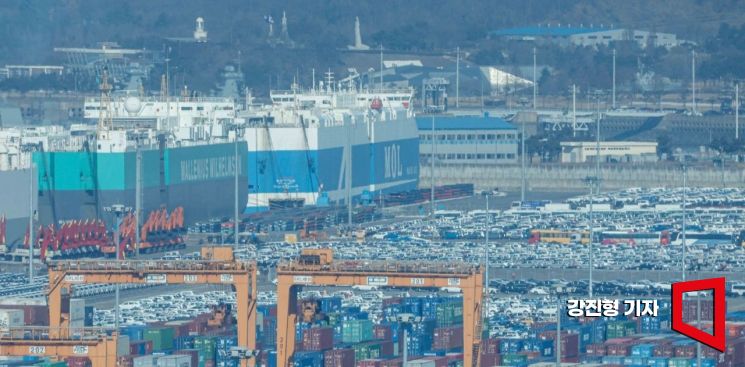
Automobile exports reached $6.3 billion, up 2.3%, setting a new record for June. Notably, despite a decline in exports to the United States, exports to the European Union (EU) remained strong, particularly for electric vehicles, while used car exports ($670 million, +67.9%) also increased significantly. As a result, automobile exports exceeded $6 billion for five consecutive months for the first time ever.
Bio-health exports rose by 36.5% to $1.66 billion, achieving a record high for June, led by bio-pharmaceuticals ($1.11 billion, +54.0%). Ship exports also increased by 63.4% to $2.5 billion, marking four consecutive months of growth.
In contrast, exports of petroleum products ($3.62 billion, -2.0%) and petrochemicals ($3.36 billion, -15.5%) continued to decline, as oil prices, which are linked to product prices, remained weak.
In addition to the 15 main export items, exports of agricultural and marine products ($1.03 billion, +7.7%), cosmetics ($950 million, +22.0%), and electrical equipment ($1.58 billion, +14.8%) all set new records for June.
In June, exports increased in 7 out of the 9 major regions, excluding the United States and China. The two largest export markets, the United States ($11.24 billion, -0.5%) and China ($10.42 billion, -2.7%), saw declines. Exports to ASEAN rebounded to positive territory after one month, increasing by 2.1% to $9.76 billion, led by semiconductors, ships, and steel products. Exports to the EU grew by 14.7% to $5.8 billion, driven by increases in automobiles, auto parts, ships, and petroleum products, marking four consecutive months of growth.
Exports to India rose by 2.3% to $1.59 billion, setting a new record for June. Exports to the Commonwealth of Independent States (CIS) increased by 18.5% to $1.1 billion, marking four consecutive months of growth. Exports to Central and South America ($2.4 billion, +3.3%), Japan ($2.5 billion, +3.0%), and the Middle East ($1.9 billion, +14.8%) also returned to positive growth.
Imports in June increased by 3.3% to $50.72 billion. Energy imports ($8.55 billion) decreased by 14.7%, while non-energy imports ($42.17 billion) increased by 7.9%.
The trade balance recorded a surplus of $9.08 billion, up $820 million from the same month last year, as exports (+$2.46 billion) grew much more than imports (+$1.63 billion). This is the largest surplus since September 2018 ($9.62 billion).
In the first half of this year, exports totaled $334.7 billion (-0.03%), remaining at the same level as the previous year. Exports to the United States fell by 3.7% to $62.2 billion due to sluggish exports of automobiles and general machinery, which are the two main export items. Meanwhile, imports increased by 0.7%, resulting in a trade surplus of $26.3 billion, which is $2.6 billion less than last year ($29.0 billion). Exports to China also decreased by 4.6% to $60.5 billion due to a decline in semiconductor exports, the largest export item. Imports in the first half reached $306.9 billion, down 1.6%. The trade balance posted a surplus of $27.8 billion, an improvement of $4.8 billion compared to last year.
Minister of Trade, Industry and Energy Ahn Dukgeun stated, "In the second half of the year, volatility in U.S. tariff policies and uncertainty regarding the pace of economic recovery are expected to persist." He added, "The government will make every effort to respond to the urgent issue of Korea-U.S. negotiations, and, depending on the outcome, will swiftly prepare export support measures, including the provision of trade finance and the identification of alternative markets, to minimize the negative impact on our companies."
© The Asia Business Daily(www.asiae.co.kr). All rights reserved.
![Clutching a Stolen Dior Bag, Saying "I Hate Being Poor but Real"... The Grotesque Con of a "Human Knockoff" [Slate]](https://cwcontent.asiae.co.kr/asiaresize/183/2026021902243444107_1771435474.jpg)















