The National Institute of Forest Science announced on July 1 that it has begun developing a new wildfire risk index that predicts wildfires caused by human-related factors, reflecting patterns of human behavior.
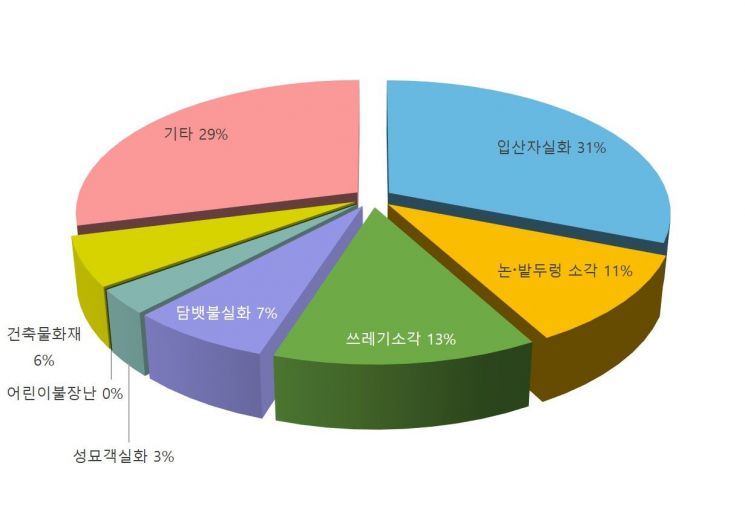
According to the institute, 99% of wildfires in South Korea from 2015 to 2024 were caused by human-related factors. The main causes include the use of fire by forest visitors, the burning of agricultural waste, the discarding of cigarette butts, careless handling of wood boiler ashes, grave visits, and welding work.
Many wildfires also result from facility fires, such as sparks from wood boiler chimneys, building fires, and fires caused by transmission lines.
In particular, this year, most large and medium-scale wildfires, including major wildfires in northern North Gyeongsang Province, are believed to have originated from human-related causes.
In response, the institute plans to use artificial intelligence (AI) to analyze human behavioral patterns and artificial factors that can trigger wildfires. It will collect and analyze a wide range of human activity data, such as the timing and regional distribution of agricultural waste burning, seasonal fluctuations in forest visitors, the distribution of households using wood boilers, and the locations of graves, and incorporate these findings into the calculation of the wildfire risk index.
Won Myungsoo, head of the Wildfire Research Division at the institute, stated, "We will work to minimize wildfire damage by improving the accuracy of wildfire risk predictions. We aim to achieve this by adding human behavioral patterns, which are the direct causes of wildfires, to the existing wildfire risk forecasting system that mainly considers environmental factors such as weather, fuel, and topography."
© The Asia Business Daily(www.asiae.co.kr). All rights reserved.
![Clutching a Stolen Dior Bag, Saying "I Hate Being Poor but Real"... The Grotesque Con of a "Human Knockoff" [Slate]](https://cwcontent.asiae.co.kr/asiaresize/183/2026021902243444107_1771435474.jpg)















