518 Companies Approved for Regulatory Exemptions in 5 Years
Total Sales Up KRW 980 Billion, 6,900 New Jobs Created
SMEs and Startups Account for 72%, Centered on Emerging Industries
The Korea Chamber of Commerce and Industry (KCCI) announced that it has approved regulatory exemptions for 518 companies over the past five years, generating significant economic effects. Based on these results, the KCCI proposed to the new administration the implementation of a "mega sandbox" at the local government level, as well as revisions to related laws and regulations.
On the 29th, the KCCI released its report, "New Growth Series: Private Regulatory Sandbox in Statistics," suggesting that "greater innovation can be achieved through a larger sandbox."
A regulatory sandbox allows innovative businesses to bypass certain regulations. The KCCI, in cooperation with the Ministry of Trade, Industry and Energy, the Ministry of Science and ICT, the Financial Services Commission, and other agencies, has supported the approval of regulatory exemptions for 518 companies over the past five years. Starting with 51 cases in 2020, the number has increased each year, reaching 112 cases last year. As of May this year, the cumulative number of approved cases stands at 518.
The KCCI explained that among the companies granted regulatory exemptions, 6,900 new jobs were created and sales increased by KRW 980 billion. In addition, the companies attracted KRW 250 billion in investment, resulting in significant economic impact. The KCCI stated, "On average, each sandbox-approved company saw employment rise by 14 people and sales increase by KRW 1.9 billion."
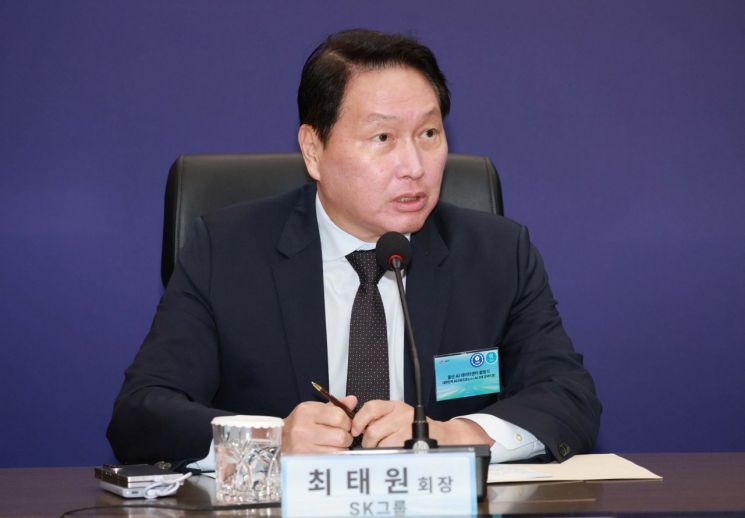 Choi Taewon, Chairman of the Korea Chamber of Commerce and Industry and SK Group, is speaking at the AI Global Cooperation Companies Meeting held at Ulsan Exhibition and Convention Center on the 20th of last month, presided over by President Lee Jae Myung. Photo by Yonhap News Presidential Office Press Photographers Group
By company size, small and medium-sized enterprises (SMEs) and startups accounted for 72% of approvals, followed by large companies (16%) and mid-sized companies (10%). By approval type, demonstration exemptions made up the largest share at 88%, followed by temporary permits (8%) and proactive interpretations (4%). By region, Seoul had 215 cases, Gyeonggi 146, Incheon 21, Chungbuk 20, Daegu 17, Chungnam 14, Gyeongbuk 14, and Busan 13, with the Seoul metropolitan area accounting for 74% of the total.
The agency with the highest number of regulatory exemption approvals was the Ministry of Food and Drug Safety. By agency, the Ministry of Food and Drug Safety approved 192 cases, the Ministry of Land, Infrastructure and Transport 102, the Ministry of Health and Welfare 66, the Ministry of Trade, Industry and Energy 55, the Ministry of Agriculture, Food and Rural Affairs 41, the Ministry of the Interior and Safety 27, and the Personal Information Protection Commission 25.
Six new industries stood out in terms of demand: climate and energy, robotics and artificial intelligence, information and communications, healthcare, the sharing economy, and companion animals.
The KCCI proposed the introduction of a "mega sandbox" at the local government level to the new administration to address the concentration in the Seoul metropolitan area and the limitations of a company-by-company approach. The aim is to foster regional innovation ecosystems by providing integrated support not only for regulatory relaxation but also for AI, workforce, and R&D infrastructure.
The KCCI emphasized the need for prompt legal and regulatory revisions for projects that have completed sandbox demonstrations. It also suggested the establishment of reward and immunity systems to encourage proactive administration by public officials and to create a public sector culture conducive to regulatory innovation.
Lee Jongmyung, Head of the Industrial Innovation Division at the KCCI, said, "Based on these innovative experiments by the public and private sectors, we must expand the scope of sandboxes, increase the scale of innovation, rationalize regulations, and achieve balanced regional development, thereby creating a solution that delivers multiple benefits at once."
The KCCI Regulatory Sandbox Support Center, established in 2020, is the only private regulatory sandbox support organization in Korea. It has provided one-stop support to companies, from consultation to regulatory exemption approval, through 1:1 customized consulting.
© The Asia Business Daily(www.asiae.co.kr). All rights reserved.
![Clutching a Stolen Dior Bag, Saying "I Hate Being Poor but Real"... The Grotesque Con of a "Human Knockoff" [Slate]](https://cwcontent.asiae.co.kr/asiaresize/183/2026021902243444107_1771435474.jpg)
















