Installation of Collectors on Baekryeonsan and Bukhansan
Eco-Friendly Pest Control Measures
On July 1, Eunpyeong District in Seoul announced that it is focusing on non-chemical, eco-friendly pest control measures to alleviate residents' discomfort caused by the mass occurrence of "lovebugs" (Plecia nearctica) during the summer.
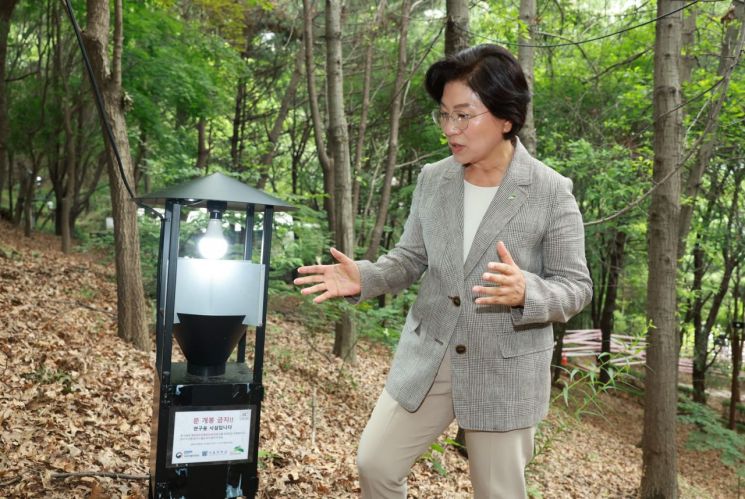 Eunpyeong District Mayor Kim Mikyung examining a light source collector installed on Baekryeonsan in Eunpyeong District. Provided by Eunpyeong District.
Although lovebugs are harmless to humans, their large swarms cause discomfort. They typically appear in large numbers from mid-June to early July for about a month before naturally disappearing.
Eunpyeong District is conducting daily water spraying pest control along the boundaries of residential areas near wooded hills, which are the main habitats. Additionally, nine light source collectors have been installed on Baekryeonsan and twelve scent lure traps on Bukhansan to strengthen eco-friendly pest control efforts.
This approach minimizes the use of insecticides to prevent ecological disruption, while also providing information to support residents' voluntary pest management. In fact, this year, the Seoul Metropolitan Government and each district are prioritizing non-chemical pest control methods such as water spraying, light traps, and other traps.
Lovebugs were first reported in China in 1934 and were first discovered in Korea in 2018 in Incheon. Regarding claims that the spread of lovebugs is linked to the creation of cypress forests, Eunpyeong District stated that there is no scientific basis for such assertions. The main causes are being analyzed as environmental factors such as climate change.
Eunpyeong District is cooperating with domestic research institutions to study the habitat characteristics and causes of lovebug outbreaks and plans to continue this collaboration to develop scientific and systematic pest control measures in the future.
Kim Mikyung, Mayor of Eunpyeong District, stated, "This eco-friendly pest control initiative is an important step that not only reduces inconvenience for residents but also serves the public interest by preserving the ecosystem. We will continue to respond proactively to pest damage caused by climate change."
© The Asia Business Daily(www.asiae.co.kr). All rights reserved.

















