S&P 500 and Nasdaq Hit Intraday Record Highs
Canada Withdraws Digital Tax, Resumes Trade Talks with U.S.
Hopes Rise for Additional Deal Before Reciprocal Tariff Suspension Expires
Focus on Congressional Passage of Tax Cut Bill This Week
June Employment Report to Be Released by Labor Department on July 3
All three major indices on the New York Stock Exchange closed higher on June 30 (local time). There is a growing sense of relief after Canada decided to withdraw its plan to impose a digital tax just two days after criticism from U.S. President Donald Trump, leading to the resumption of trade negotiations with the United States. Investors are cautiously betting on the possibility of reaching an additional trade agreement ahead of the expiration of the U.S. reciprocal tariff suspension on August 8.
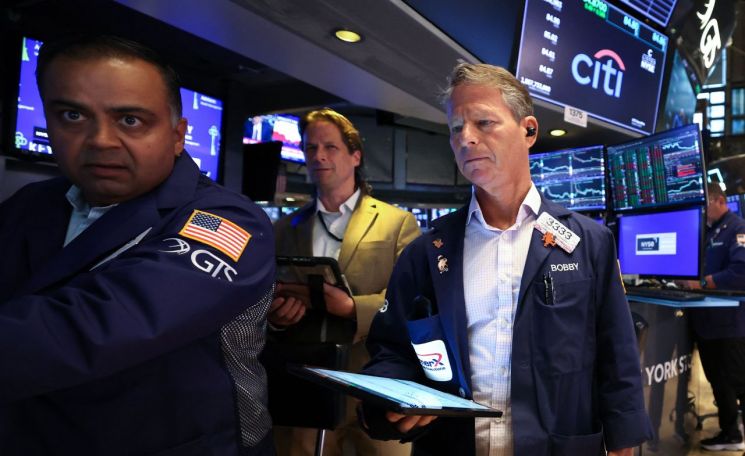
As of 9:55 a.m. on this day at the New York Stock Exchange, the Dow Jones Industrial Average, which focuses on blue-chip stocks, was up 202.15 points (0.46%) from the previous trading day, standing at 44,021.42. The S&P 500, which tracks large-cap stocks, rose 14.93 points (0.24%) to 6,188, while the tech-heavy Nasdaq gained 37.65 points (0.19%) to reach 20,311.11, setting a new intraday all-time high.
Canada canceled its plan to impose a digital tax on domestic and foreign IT companies on June 29, just one day before it was scheduled to take effect, in order to resume trade negotiations with the United States. This decision came two days after President Trump, on June 27, condemned Canada’s digital tax as a non-tariff trade barrier targeting U.S. companies, immediately suspended negotiations, and warned of tariff notifications within a week. By withdrawing the digital tax plan, Canada has secured an additional three weeks for negotiations. Previously, Canadian Prime Minister Mark Carney met with President Trump at the G7 summit held in Canada on June 16-17, where they agreed to conclude a new trade agreement within 30 days.
The market’s attention is focused on whether the U.S. will extend the reciprocal tariff suspension and on the passage of the tax cut bill in Congress. President Trump has increased pressure on U.S. trading partners by stating that there will be no extension of the reciprocal tariff suspension. In an interview with Fox News released the previous day, when asked about the possibility of extending the reciprocal tariff suspension, he said, "I don't think it will be necessary," adding, "What we will do is send letters to all countries before the 9th." Regarding tariff rates, he stated that they could be "25%, 35%, 50%, or 10%." However, since President Trump also mentioned that "an extension is possible," there is speculation in the market that some countries negotiating in good faith with the United States may still be granted an extension of the reciprocal tariff suspension. Meanwhile, Bloomberg reported that the United States is close to reaching trade agreements with several countries, including Taiwan and Indonesia, further raising expectations for additional deals.
Another key focus is whether Congress will pass the large-scale tax cut bill, which is a central part of President Trump’s economic agenda. On this day, the U.S. Senate began the "Vote-a-Rama" procedure at 9 a.m. for the so-called "one big, beautiful bill," which includes income and corporate tax cuts. This "vote marathon" allows for unlimited amendments and votes until the final vote is held. If the bill, which passed the House last month, also passes the Senate this time, it will require another House vote due to some amendments. President Trump has set a goal to complete all procedures, including signing the bill, by July 4, Independence Day. However, there are significant concerns that the tax cuts will increase the fiscal deficit, and there is considerable opposition to Medicaid (the health insurance program for low-income individuals) budget cuts, even within the Republican Party, making it difficult to be optimistic about the bill's passage. The market anticipates that if the tax cuts, which could worsen the fiscal deficit, are passed, this could undermine long-term confidence in the U.S. economy and prompt a sensitive reaction in the financial markets, such as a rise in Treasury yields.
Key economic indicators scheduled for release this week include the Labor Department’s May Job Openings and Labor Turnover Survey (JOLTs) on July 1, the ADP June private employment report on July 2, and the Labor Department’s June employment report on July 3. The market is expected to use these employment indicators to gauge the economic impact of President Trump’s tariffs and other developments.
U.S. Treasury yields are holding steady. The yield on the U.S. 10-year Treasury note, the global benchmark for bond yields, is at 4.26%, while the yield on the 2-year Treasury note, which is sensitive to monetary policy, is at 3.73%, both remaining at levels similar to the previous trading day.
By stock, Moderna is up 1.69% after announcing that its experimental flu vaccine showed positive results in late-stage clinical trials. Nvidia is down 0.66%, while Tesla is showing a 1.11% decline.
Meanwhile, the New York Stock Exchange will be closed for Independence Day on July 4. On July 3, the market will close early at 1 p.m.
© The Asia Business Daily(www.asiae.co.kr). All rights reserved.

















