Adult Lovebugs Contain Acidic Bodily Fluids
Sour Taste Causes Birds and Frogs to Avoid Them
The insect commonly known as the "lovebug," or Plecia nearctica, has been found to be unpalatable and has no natural predators. Due to its distinct sour taste, even amphibians such as frogs, which typically prey on insects, tend to avoid it.
Previously, in 2020, Carol Wyatt-Evans, a researcher at the University of Florida's School of Natural Resources and Environment, Sarasota County campus, published a detailed post on the official blog about the lovebug's ecology, reproduction, and methods of control.
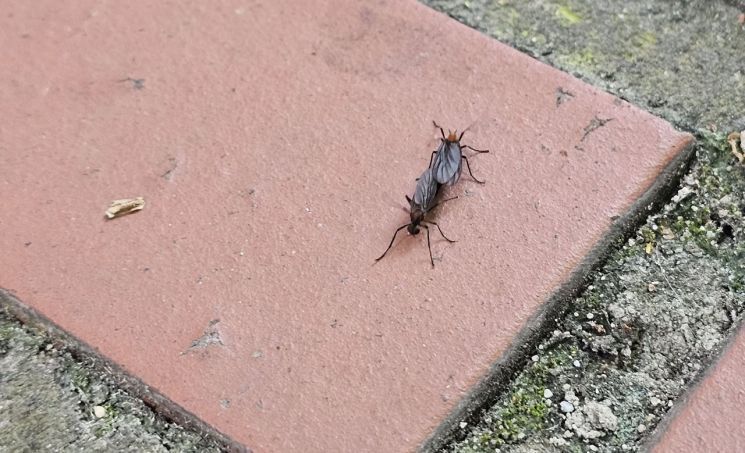
At the time, Wyatt-Evans explained, "Lovebug larvae are considered tasty by birds, spiders, and other insects, but adult lovebugs do not attract predators." The reason for this is the unique sour taste of adult lovebugs.
The source of this sourness is acidity. Lovebugs produce acidic bodily fluids, and when predators such as frogs or birds consume them, they experience an unpleasantly sour taste. As a result, predators avoid lovebugs. Consequently, adult lovebugs can focus on reproduction without the threat of natural enemies.
The acidity of lovebugs can also inadvertently cause damage to humans. Although their bodily fluids do not harm the skin, they are acidic enough to strip paint from cars. The Environmental Literacy Council, an international environmental organization, also stated, "Lovebugs have a strong sour taste and a tough exoskeleton, making them unappealing to amphibians," and described them as insects for which 'biological control' is extremely limited.
So how should lovebugs be controlled? Conventional insecticides are not effective against lovebugs. Instead, spraying them with water or physically removing them with tissues or similar items is more effective, as their wings are delicate and they are vulnerable to water. Lovebugs stuck to cars can also be removed relatively easily with water. However, Wyatt-Evans emphasized, "You should remove them within 20 minutes to prevent the acidic liquid from damaging the paint."
Meanwhile, lovebugs are not toxic, do not bite humans, and do not transmit diseases, so they are not classified as harmful pests. On the contrary, adult lovebugs assist in pollinating flowers and are considered beneficial insects. However, due to their relatively large size and tendency to cling to people, they are classified as nuisance or occasional insects.
© The Asia Business Daily(www.asiae.co.kr). All rights reserved.
![Clutching a Stolen Dior Bag, Saying "I Hate Being Poor but Real"... The Grotesque Con of a "Human Knockoff" [Slate]](https://cwcontent.asiae.co.kr/asiaresize/183/2026021902243444107_1771435474.jpg)















