Korea Disease Control and Prevention Agency Releases "2024 HIV/AIDS Reporting Status Annual Report"
67% of New Infections Are Among Young Adults in Their 20s and 30s
The number of newly reported human immunodeficiency virus (HIV) infections in South Korea decreased slightly last year compared to the previous year, according to data from domestic disease control authorities.
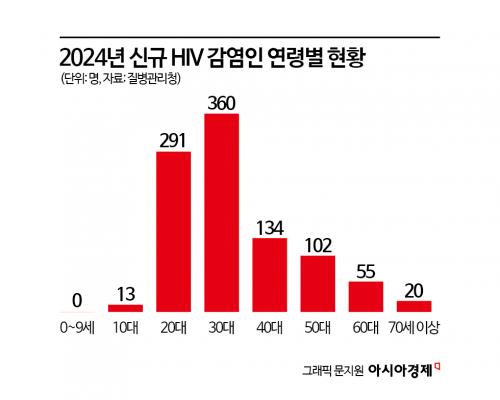
According to the "2024 HIV·AIDS (Acquired Immunodeficiency Syndrome) Reporting Status Annual Report" released by the Korea Disease Control and Prevention Agency on July 1, the number of newly reported HIV infections in the previous year was 975, a decrease of 3.0% (30 cases) from 1,005 cases in 2023.
By nationality, Korean nationals accounted for 714 cases, or 73.2% of the total, while foreigners made up 26.8% (261 cases). The proportion of foreigners among new HIV infections has been steadily increasing, from 20.9% in 2021, to 22.6% in 2022, and 25.5% in 2023.
In particular, among the 865 newly infected men, 683 were Korean nationals, accounting for 78.9%. In contrast, among the 110 newly infected women, 79 were foreigners, representing 71.8%.
By age group, those in their 30s accounted for 360 cases (36.9%), those in their 20s for 291 cases (29.8%), and those in their 40s for 134 cases (13.7%). Together, people in their 20s and 30s made up 66.8% of all new HIV infections.
HIV is the virus that causes AIDS. It survives and multiplies in the human body and is transmitted from person to person through the blood or bodily fluids of infected individuals. Not everyone infected with HIV develops AIDS; among those with HIV, only those whose immune systems have been damaged or weakened, or who develop diseases such as cancer during infection, are considered AIDS patients.
Last year, 611 cases (62.7%) of HIV infections were reported by hospitals and clinics, 281 cases (28.8%) by public health centers, and 83 cases (8.5%) by other institutions such as correctional facilities, the Military Manpower Administration, and blood centers.
According to epidemiological survey results, 215 people (30.1%) cited "voluntary testing" as their reason for testing, while 179 people (25.1%) said it was "testing to identify the cause of illness." Among 503 respondents who answered about the route of infection, 502 people (99.8%) said "sexual contact," and of these, 320 people (63.7%) said it was "same-sex sexual contact."
The number of people living with HIV in South Korea reached 17,015, an increase of 3.4% (556 people) compared to the previous year's 16,459. Among them, 3,492 (20.5%) were aged 60 or older, and the proportion of elderly people among those living with HIV continues to increase each year due to aging.
Last year, the government established the "Second AIDS Prevention and Management Plan (2024-2028)" and set a goal to reduce new infections by 50% by 2030 compared to 2023.
Ji Youngmi, Commissioner of the Korea Disease Control and Prevention Agency, stated, "To reduce HIV and AIDS, we are promoting various HIV management policies, including support for pre-exposure prophylaxis (PrEP), expansion of HIV testing, and the expansion of the 'Medical Institution Counseling Program for People Living with HIV' to support treatment retention." She also urged, "To avoid infection, people should avoid unsafe sexual contact in daily life, get tested promptly if infection is suspected, and begin treatment immediately if confirmed positive."
© The Asia Business Daily(www.asiae.co.kr). All rights reserved.
![Clutching a Stolen Dior Bag, Saying "I Hate Being Poor but Real"... The Grotesque Con of a "Human Knockoff" [Slate]](https://cwcontent.asiae.co.kr/asiaresize/183/2026021902243444107_1771435474.jpg)















