National Health Insurance Service Releases 2024 Long-Term Care Insurance Statistics
Aging Population Drives Number of Long-Term Care Beneficiaries to 1.165 Million Last Year
As the population ages rapidly, both the number of beneficiaries and the expenditure for the Long-Term Care Insurance for the Elderly continue to rise.
According to the "2024 Long-Term Care Insurance for the Elderly Statistical Yearbook" published by the National Health Insurance Service on June 30, 2024, the number of beneficiaries recognized under the long-term care insurance system reached 1,165,000 in 2024, marking a 6.1% increase compared to the previous year.
The Long-Term Care Insurance for the Elderly is a social insurance program that provides long-term care benefits, such as assistance with physical activities and household tasks, to elderly individuals who have difficulty performing daily activities alone due to old age or geriatric diseases. Individuals aged 65 or older, or those under 65 who suffer from geriatric diseases such as dementia, may apply to the National Health Insurance Service, after which an assessment committee determines both eligibility and level of care. In the previous year, 1,478,000 people applied, and 89.5% of them were approved.
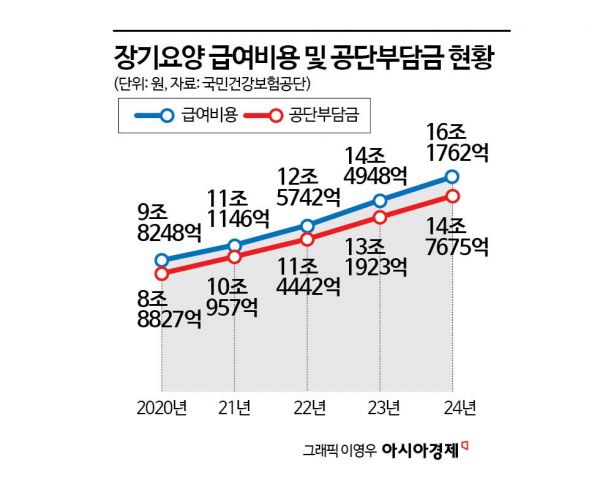
In 2024, the annual cost of long-term care benefits amounted to 16.1762 trillion won, an 11.6% increase from the previous year, surpassing 16 trillion won for the first time. The expenditure for long-term care benefits has been increasing rapidly, setting new records each year: 9.8248 trillion won in 2020, 11.1146 trillion won in 2021, 12.5742 trillion won in 2022, and 14.4948 trillion won in 2023.
As of the end of last year, the population aged 65 and over increased by 5.5% compared to a year earlier, but the growth rate of long-term care benefit expenditure (11.6%) was more than twice as fast. Of the 16.1762 trillion won, the National Health Insurance Service covered 14.7674 trillion won (91.3%), a year-on-year increase of 11.9%. The average monthly benefit expenditure per recipient was 1.5 million won, of which the insurance fund covered 1.37 million won.
By type, home-based care benefits?which provide visiting services such as nursing, bathing, and caregiving to beneficiaries who remain in their own homes?accounted for 9.2412 trillion won. Facility-based care benefits, paid to beneficiaries residing in nursing homes and similar institutions, amounted to 5.5041 trillion won.
As of the end of last year, there were a total of 29,058 long-term care institutions nationwide, an increase of 692 institutions (2.4%) from the previous year. The number of employees working in these institutions?including care workers, social workers, and nursing assistants?rose by 4.5% over the year to 704,533.
In addition, long-term care insurance premiums levied on health insurance subscribers last year totaled 10.7772 trillion won, a 3.7% increase from the previous year.
© The Asia Business Daily(www.asiae.co.kr). All rights reserved.
![Clutching a Stolen Dior Bag, Saying "I Hate Being Poor but Real"... The Grotesque Con of a "Human Knockoff" [Slate]](https://cwcontent.asiae.co.kr/asiaresize/183/2026021902243444107_1771435474.jpg)















