Establishing the New Administration's Economic Policy Direction as the First Task
Tax Reform at the End of July to Focus on Productivity Enhancement
Budget Spending Expected to Prioritize 'Performance' as the Top Goal
The prevailing interpretation behind President Lee Jaemyung's nomination of Koo Yoonchul, former Chief of the Office for Government Policy Coordination, as the candidate for Deputy Prime Minister for Economic Affairs and Minister of Economy and Finance is that he is the right person to swiftly advance the new administration's economic policies. As Koo is a seasoned bureaucrat with extensive experience in both budgeting and policymaking, he is expected to quickly fill the two-month leadership vacuum in economic affairs and lead the establishment of policies aimed at revitalizing the people's economy.
The most immediate task facing the new Deputy Prime Minister is to establish the direction of the new administration's economic policy. The first economic policy direction under the Lee Jaemyung administration is expected to focus on revitalizing the people's economy and is likely to shift from the previous administration's fiscal austerity toward an expansionary fiscal stance. The outline of the new administration's economic policy direction depends on the timing of the establishment of national policy tasks, which is currently underway at the National Policy Planning Committee. The announcement of the "Second Half Economic Policy Direction," which is usually released at the end of June, is likely to be delayed to July or August in conjunction with the establishment of national policy tasks, due to the launch of the new administration.
If Koo is appointed as the chief economic policymaker, this year's economic policy direction is expected to focus on stabilizing the people's livelihoods. On June 29, immediately after being appointed as Minister of Economy and Finance, he emphasized at a press conference held at the Korea Deposit Insurance Corporation in Jung-gu, Seoul, "I will do my utmost to stabilize the cost of living, which has become a significant burden on the people due to persistent high inflation," and added, "I will work to revitalize regional economies so that both the capital area and local regions can grow together."
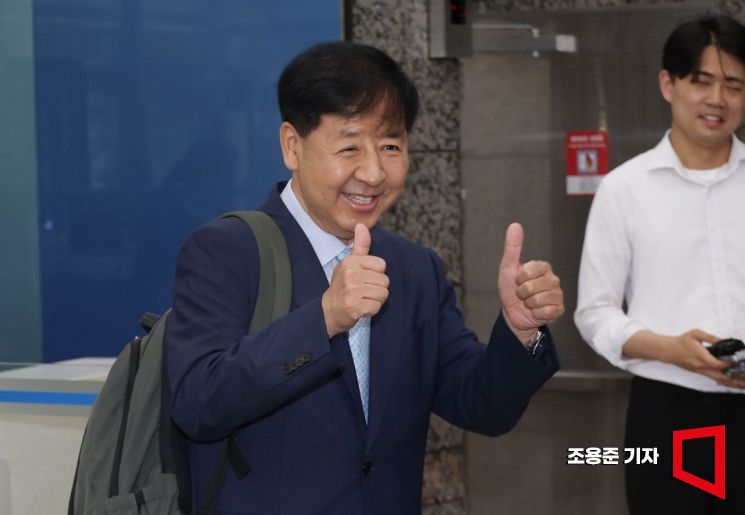 Koo Yoonchul, the nominee for Deputy Prime Minister for Economic Affairs and Minister of Economy and Finance, is arriving at the confirmation hearing preparation office set up at the Korea Deposit Insurance Corporation in Jung-gu, Seoul on June 30, 2025. Photo by Cho Yongjun
The schedule for drafting the tax law amendment is also tight. The government customarily announces its annual tax reform plan at the end of July and submits it to the National Assembly in September. Before submitting it to the National Assembly, the Ministry of Economy and Finance must convene the Tax System Advancement Committee by early August to finalize the tax reform plan. The issue is that, since the tax reform plan is also linked to the new administration's national policy tasks, it may be affected by the schedule of the National Policy Planning Committee. Koo prefers expanding the tax base through growth rather than tax increases. This is why there is speculation that the plan will include corporate-centered tax support, such as expanding R&D tax credits and investment tax credits for productivity improvement. He stated, "It is important to create a structure where companies earn profits in the global market through a super-innovative economy, which naturally increases tax revenue and leads to enhanced welfare."
Drafting next year's budget is also a major task. The budget bill must be submitted to the National Assembly by early September. Prior to that, the National Fiscal Strategy Meeting will be held between late July and early August to set the direction for medium-term fiscal management. When announcing the second supplementary budget, the Lee Jaemyung administration officially stated that it would reconsider the legal institutionalization of fiscal rules, indicating that this year's National Fiscal Strategy Meeting will focus on justifying expansionary fiscal management and restructuring. Koo prioritizes the effectiveness of the budget over the dichotomy of expansion versus austerity. He said, "If spending can foster industries and generate returns, we should spend, but unnecessary expenditures should be boldly reduced."
There is also a growing call for integrating policies and budgets to enable an AI-based economic transformation. Koo has consistently demonstrated a strong commitment to AI-driven growth strategies. He is reportedly planning to accelerate AI-related policies immediately upon his appointment as Deputy Prime Minister. It has also been reported that the Ministry of Economy and Finance recently informed the National Policy Planning Committee that it intends to seek solutions to the issues of low birth rates, population aging, and declining total factor productivity through AI.
Full-scale discussions on reorganizing the Ministry of Economy and Finance are also expected to begin in earnest. President Lee has previously stated in his campaign pledges that he intends to separate the budget function from the Ministry of Economy and Finance and integrate financial policy functions with the Financial Services Commission. Koo has also referenced the Economic Planning Board model, in which policy and budgeting operated together, in his own publications. However, Koo declined to give a direct answer on the matter, saying on the previous day, "The internal review of organizational restructuring has not yet been completed. There will be an opportunity to discuss this in the future."
© The Asia Business Daily(www.asiae.co.kr). All rights reserved.
![Clutching a Stolen Dior Bag, Saying "I Hate Being Poor but Real"... The Grotesque Con of a "Human Knockoff" [Slate]](https://cwcontent.asiae.co.kr/asiaresize/183/2026021902243444107_1771435474.jpg)















