 (From left) Professor Taeyoung Kim, Department of Environmental and Energy Engineering, Postdoctoral Researcher Jonghyun Kim.
A study has found that the billions of disposable masks used and discarded worldwide during the COVID-19 pandemic could have a serious impact on soil ecosystems.
On June 30, the Gwangju Institute of Science and Technology (GIST) announced that the research team led by Professor Taeyoung Kim from the Department of Environmental and Energy Engineering, in collaboration with the Free University of Berlin and others, has scientifically demonstrated through international joint research that discarded disposable masks can have a severe impact on soil ecosystems.
According to the research findings, microplastics and chemical additives derived from discarded masks were shown to disrupt the reproductive capacity and metabolic systems of Caenorhabditis elegans, a soil-dwelling organism.
Caenorhabditis elegans is a small organism about 1 mm in length that is widely found in soil and plays a crucial role in providing nutrients to crops and maintaining the soil ecosystem.
During the pandemic, the number of disposable masks used annually worldwide reached tens of billions, resulting in massive amounts of waste. Most masks, made from synthetic fibers such as polypropylene (PP), can release microplastics, which may potentially affect not only water quality but also soil ecosystems. However, research on this issue has been very limited.
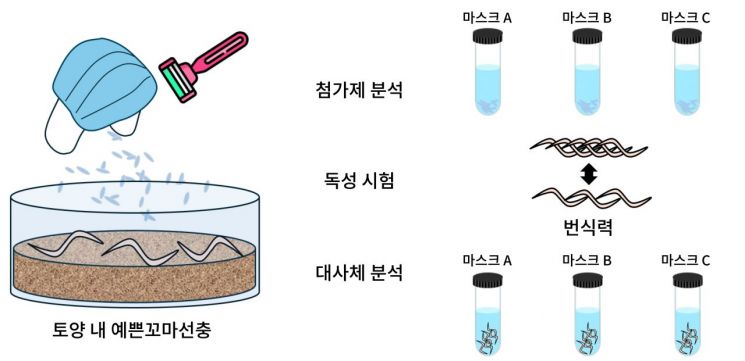
Through this study, the research team was the first to demonstrate at the molecular level that microplastics from discarded masks are not simply plastic particles, but can combine with specific chemicals added during manufacturing to cause biological toxicity.
In particular, the decline in reproductive function of soil organisms such as Caenorhabditis elegans could threaten the structural stability of the entire ecosystem, indicating the urgent need for a comprehensive assessment of the ecological risks posed by discarded masks.
The research team mixed three types of disposable masks (KF94, medical, and dust masks) and comparative polypropylene (PP) raw material with standard soil to test their effects on the reproduction and metabolism of Caenorhabditis elegans.
The experimental concentrations (the proportion of microplastics in the soil) were set at 0.1% and 0.3%. The reproductive capacity of the nematodes in each group (number of hatched larvae) was quantitatively measured. Subsequently, liquid chromatography-mass spectrometry (LC-MS) was used to precisely analyze changes in nematode metabolism and chemical additives detected in the masks.
Liquid chromatography-mass spectrometry is a precise analytical technique that separates each chemical in complex mixtures and then accurately measures the molecular weight to identify the substance.
The experiment showed that at a concentration of 0.3%, the reproductive capacity of nematodes exposed to microplastics from KF94 and dust masks decreased by 33% and 46%, respectively. In contrast, microplastics from medical masks and polypropylene (PP) raw fibers did not show significant reproductive toxicity.
Metabolomics analysis also revealed changes in the metabolic pathways of the nematodes. Microplastics from KF94 and dust masks both disrupted the polyamine biosynthesis pathway, and since different additives are presumed to have been used in each, the effects on metabolites also varied.
High-resolution mass spectrometry detected chemical additives such as phthalates in the masks, which are known endocrine disruptors that cause reproductive toxicity. The research team analyzed that these additives are highly likely to be the main cause of metabolic disruption and reduced reproductive capacity.
Professor Taeyoung Kim stated, "This study scientifically demonstrates the complex biological toxicity to soil organisms caused by microplastics released from disposable masks and the chemical additives used in mask manufacturing." He emphasized, "It is urgent to assess the long-term environmental impact of mask waste and to develop eco-friendly mask materials and disposal methods."
This research was supported by the National Research Foundation of Korea's Basic Research Program (Mid-Career Researcher Program) and was led by Professor Taeyoung Kim and Postdoctoral Researcher Jonghyun Kim from the Department of Environmental and Energy Engineering at GIST. As joint researchers, Postdoctoral Researcher Shinwoong Kim and Professor Matthias C. Rillig from the Free University of Berlin, Professor Walter R. Waldman from the Universidade Federal de Sao Carlos in Brazil, and the research team of Professor Sunghwan Kim from Kyungpook National University participated.
© The Asia Business Daily(www.asiae.co.kr). All rights reserved.
![Clutching a Stolen Dior Bag, Saying "I Hate Being Poor but Real"... The Grotesque Con of a "Human Knockoff" [Slate]](https://cwcontent.asiae.co.kr/asiaresize/183/2026021902243444107_1771435474.jpg)
















