A "cell robot" capable of autonomous movement using a cell-based system has been developed in South Korea. The cell robot is expected to serve as a foundational technology for precision drug delivery and next-generation cell-based therapies in the future.
KAIST announced on June 30 that a research team led by Professor Inseong Choi from the Department of Chemistry has developed a self-propelled cell robot that uses "urea," a metabolic byproduct, as fuel, without the need for external power sources or complex mechanical structures.
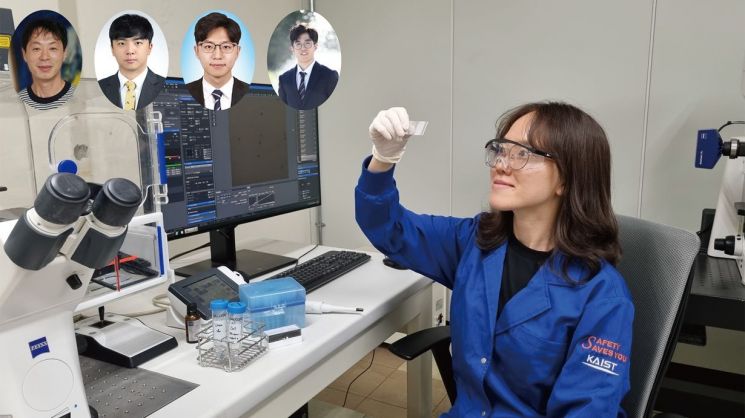 (From left) Professor Inseong Choi, Professor Hojae Lee, Integrated MS-PhD student Sangyoung Han, Integrated MS-PhD student Hyungbin Lim, Integrated MS-PhD student Nayoung Kim. Provided by KAIST
Urea is a waste product generated during the breakdown of proteins in most animals, including humans. Within living organisms, it plays a role in converting and excreting ammonia, produced during protein metabolism, into a less toxic form.
The cell robot developed by the research team can recognize direction and move autonomously. Utilizing this capability, the team designed a multifunctional platform that can transport desired substances or incorporate environmental control functions.
Previously, the research team focused on "yeast"?an organism that is easy and stable to obtain, produces ethanol as a byproduct, and can utilize substances generated by the organism itself without artificial, complex external devices.
Yeast, used in bread making and Makgeolli fermentation, produces alcohol (ethanol) as a byproduct during the metabolic process of breaking down glucose for energy. The research team developed a source technology that enables the formation of a biocompatible nano-shell on the yeast surface using the ethanol produced in this process.
The key lies in applying an enzyme system composed of alcohol oxidase (AOx) and horseradish peroxidase (HRP), which induces a cascade of enzyme reactions linked to yeast's glucose decomposition, resulting in the formation of a melanin-based nano-shell on the yeast surface.
Notably, the chemical methodology developed this time is designed to ensure that the formation of the nano-shell continues even as the yeast grows and divides, naturally generating asymmetric cell-shell structures according to changes in cell morphology.
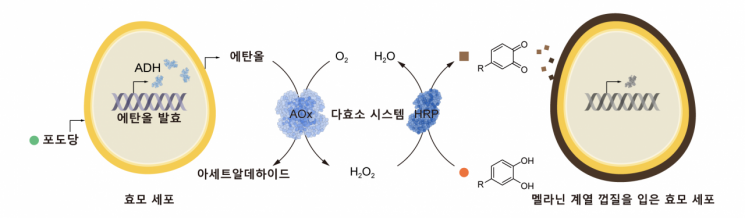 A schematic diagram illustrating the cell metabolism-linked autonomous SCNE methodology. Provided by KAIST
For example, in dividing cells, a shell may form around the entire cell, but sometimes the shell is present only on the mother cell portion and not on the daughter cell portion.
With this in mind, the research team attached urease (an enzyme that decomposes urea into ammonia and carbon dioxide) to the nano-shell surrounding the cell and observed the movement of the cell robot.
During observation, urease played a catalytic role in decomposing urea, generating the driving force that allows the cell robot to move autonomously. The team confirmed that cell robots with asymmetric structures exhibited more distinct directional self-propulsion.
The research team highlighted the advantage of the newly developed cell robot being capable of self-propulsion using only substances present around the cell.
Additionally, since the propulsion mechanism does not rely on complex external control devices such as magnets or lasers, it is much simpler. The system is also biocompatible, and various enzymes can be chemically conjugated to the nano-shell, making it possible to expand the development of cell robots that use a variety of biomaterials as fuel, according to the team.
KAIST Department of Chemistry PhD candidate Nayoung Kim (first author of the paper) said, "The self-propelled cell robot is a new concept platform with the ability to sense and respond to its environment autonomously." She added, "We expect it to play a key role in areas such as targeted cancer cell therapy and precision drug delivery systems in the future."
This research was supported by the National Research Foundation of Korea's Basic Research Program for Mid-Career Researchers. The results (paper) were published online in the international journal Science Advances on June 25.
© The Asia Business Daily(www.asiae.co.kr). All rights reserved.
![Clutching a Stolen Dior Bag, Saying "I Hate Being Poor but Real"... The Grotesque Con of a "Human Knockoff" [Slate]](https://cwcontent.asiae.co.kr/asiaresize/183/2026021902243444107_1771435474.jpg)

















