Various leading indicators related to housing supply in Seoul have shown a downward trend. According to housing statistics for May released by the Ministry of Land, Infrastructure and Transport on June 30, the number of housing construction starts in Seoul from January to May this year was 10,787 units, an 11% decrease compared to the same period last year. The number of pre-sale units for multi-family housing such as apartments was 5,612 units, down 8% over the same period.
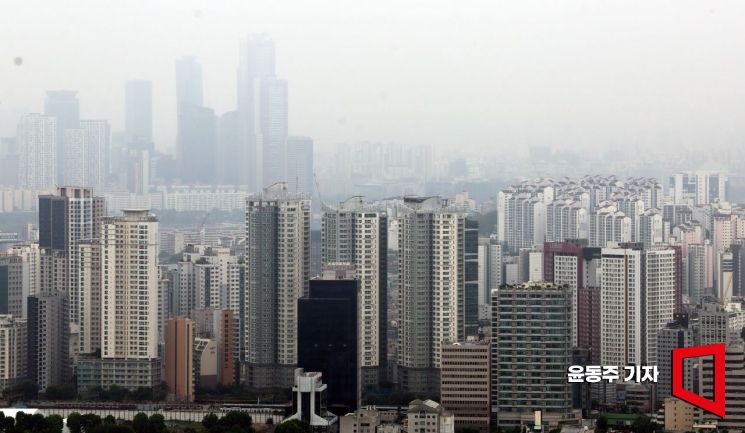
From January to May of this year, the number of housing permits issued in Seoul was 19,329 units, an increase of about 84% compared to the same period last year. However, this is mainly due to the base effect, making the increase appear larger than it is, and the actual level remains low compared to previous years. Before the COVID-19 pandemic, even in years with low activity, the annual number of housing permits in Seoul exceeded 60,000 units. The number of housing completions in Seoul was 22,440 units, a 51% increase.
Permits, construction starts, and pre-sales are considered key indicators for gauging housing supply. Typically, after developers and other project operators obtain permits, they begin construction or pre-sales, and residents move in about two to three years later. The fact that mid- to long-term supply indicators are declining means that the shortage of housing supply in Seoul is already severe, and the prospects for improvement remain slim. Increased uncertainty in the housing market due to the government's household debt measures, various domestic and international factors, and the local elections scheduled for about a year from now are also cited as negative factors.
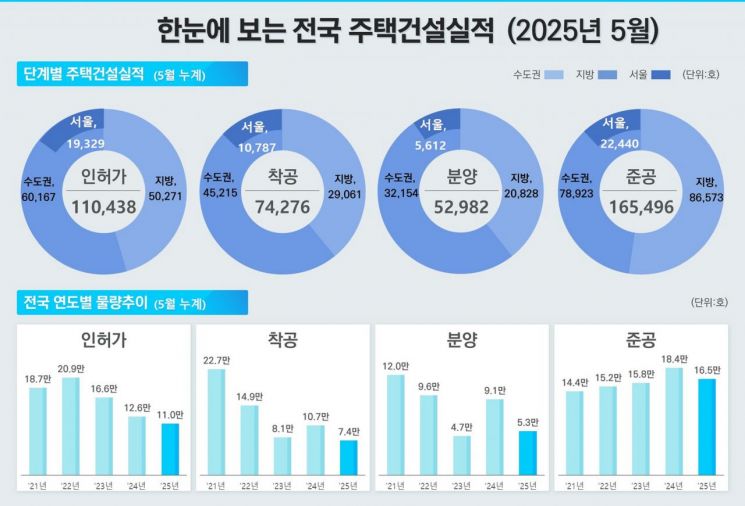 Housing construction-related statistics as of last month. Provided by the Ministry of Land, Infrastructure and Transport
As of last month, the number of housing permits issued in the Seoul metropolitan area was 8,630 units, an 11% decrease compared to the same period last year. From January to May, the figure was 60,167 units, a 17% decrease over the same period. In non-metropolitan areas, which continue to experience stagnation, the decline was even greater. Last month, housing construction starts in the metropolitan area were 8,157 units, a 9% decrease compared to the same period last year, and from January to May, the figure was 45,215 units, a 29% decrease year-on-year. However, last month's pre-sales in the metropolitan area were 9,554 units, a 12% increase over the same period.
As of last month, the number of unsold homes nationwide was 66,678 units, about a 2% decrease from the previous month. However, the number of unsold homes after completion, which is considered particularly problematic, was 27,013 units, a 2% increase over the same period. Unsold homes were counted at 15,306 units in the metropolitan area (including 4,616 units after completion) and 51,372 units in non-metropolitan areas (including 22,397 units after completion). Last month, the number of housing sales transactions was 62,703, a 4% decrease from the previous month. The number of rental transactions (including both jeonse and monthly rentals) was 252,615, an 11% increase over the same period.
© The Asia Business Daily(www.asiae.co.kr). All rights reserved.
![Clutching a Stolen Dior Bag, Saying "I Hate Being Poor but Real"... The Grotesque Con of a "Human Knockoff" [Slate]](https://cwcontent.asiae.co.kr/asiaresize/183/2026021902243444107_1771435474.jpg)
















