Speed up to 1 meter per second... Robots can get up on their own after falling
World's first humanoid robot sports games to be held in August
The world's first humanoid robot soccer tournament was held in China.
According to state-run China Central Television (CCTV) and People's Daily on the 28th, the final match of the China RoBo League 3-on-3 soccer tournament took place the previous day in the Economic and Technological Development Zone in Yizhuang, Beijing.
A total of four university teams participated in this tournament. In the final, Tsinghua University's THU Robotics Team defeated China Agricultural University's Shanhai Team by a score of 5 to 3 to claim victory. Earlier this year, the THU Robotics Team had beaten a German team 9 to 0 in the group stage final of the RoboCup (Robot World Cup) German Open. In this tournament, they advanced to the final after defeating the Beijing Information Science and Technology University team 9 to 3.
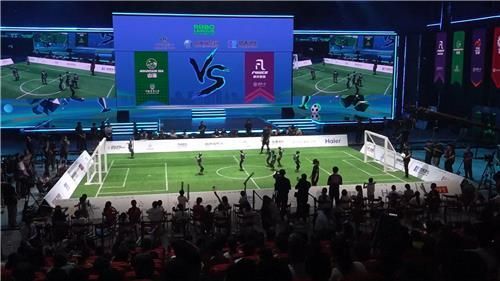 Final match of the humanoid robot soccer tournament held on the 28th in Beijing, China. Captured from China Global Television Network (CGTN) YouTube, Yonhap News Agency.
The robot players used in the tournament were T1 humanoid robots manufactured by Booster Robotics. All teams used identical hardware but developed their own artificial intelligence (AI) strategies independently to compete. The matches were conducted as fully autonomous games, with no human intervention, where robots recognized the ball and executed tactics on their own.
Dou Jing, Vice President of Shangyi Cheng Technology and Culture Group, the organizer of the tournament, stated, "This is China's first fully autonomous AI robot soccer match," adding, "It demonstrates the combination of technological innovation and industrial application, and serves as an important gateway to bringing robots into everyday life and real-world environments."
The organizing committee introduced flexible rules that did not penalize certain non-malicious collisions, taking into account that the robots still have limitations in avoiding moving obstacles, according to CCTV. Cheng Hao, founder of Booster Robotics, the official robot supplier for the tournament, explained, "Currently, the skill level of robot soccer is roughly equivalent to that of 5- to 6-year-old children, with robots able to score 1 to 2 goals per match," and noted that "progress is extremely rapid." He added, "Just a year ago, robot matches were slow-paced, required human safety assistants, and the robots were easily damaged when they fell. Now, robots can compete autonomously, reach speeds of up to 1 meter per second, and can get up by themselves after falling." He also mentioned, "In the future, mixed matches between humans and robots will be possible."
This tournament served as a rehearsal for the World Humanoid Robot Sports Games, which will be held in August in Beijing. China, which is fostering AI and robotics as national strategic industries, has showcased its technological capabilities this year through various sports events featuring humanoid robots, such as marathons and combat sports. In April, Beijing hosted the world's first humanoid robot half marathon, followed by the world's first humanoid robot combat tournament in Hangzhou, Zhejiang Province, in May.
Beijing plans to host the world's first humanoid robot sports games from August 15 to 17 at the National Stadium (known as the Bird's Nest) and the National Speed Skating Oval. The competition will feature 19 events, including floor exercise, soccer, and dance.
© The Asia Business Daily(www.asiae.co.kr). All rights reserved.
![Clutching a Stolen Dior Bag, Saying "I Hate Being Poor but Real"... The Grotesque Con of a "Human Knockoff" [Slate]](https://cwcontent.asiae.co.kr/asiaresize/183/2026021902243444107_1771435474.jpg)
















