Request for Proactive Measures on Household Debt
On June 27, the National Policy Planning Committee requested the Bank of Korea to take a forward-looking approach toward stablecoins during a business briefing. Household debt was also addressed as a key agenda item, with the committee urging the Bank of Korea to prepare proactive measures.
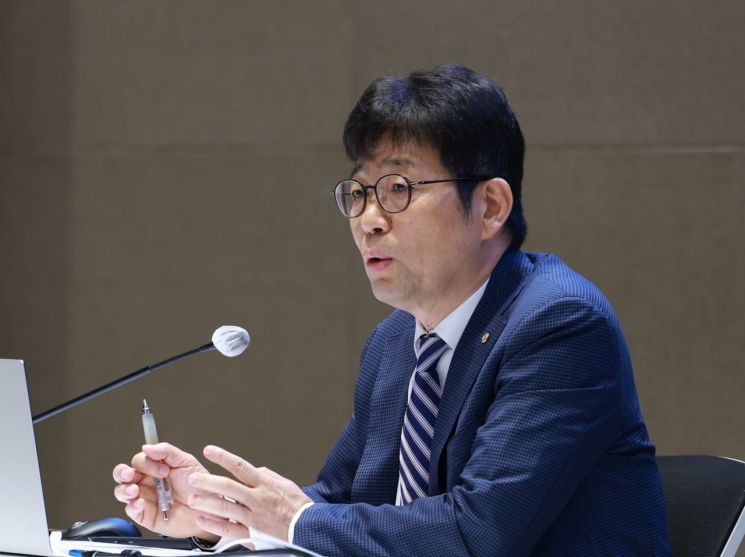
The Economic Subcommittee 1 of the National Policy Planning Committee held the business briefing from 10:30 a.m. to 12:00 p.m. at the Bank of Korea's main building in Jung-gu, Seoul. Jeong Taeho, head of Economic Subcommittee 1, along with planning and expert committee members, received the report from Yoo Sangdae, Deputy Governor of the Bank of Korea, and others.
The business briefing covered the current macroeconomic situation and policy responses, major issues facing the Bank of Korea, and mid- to long-term structural reform plans for the Korean economy.
Regarding macroeconomic issues, the committee reviewed price and financial stability, responses to economic conditions, and support for vulnerable sectors. Key topics included measures to enhance the effectiveness of monetary policy, ways to promote digital financial innovation, and the need to expand macroprudential policy tools.
In addition, the committee held broad discussions on various topics related to mid- to long-term structural reform plans aimed at mitigating the sharp decline in potential growth rates, such as addressing low birth rates and population aging, promoting the development of new industries, and reducing regional imbalances.
Committee members who received the business report requested, "While working to stabilize prices and support economic recovery, please operate monetary policy efficiently and stably, paying close attention to household debt and the conditions of the financial and foreign exchange markets."
The meeting also included discussions on the won-denominated stablecoin. In his closing remarks, Jeong Taeho, head of Economic Subcommittee 1, stated, "As we enter a period of major economic transformation, it is necessary to carefully review the establishment of a digital financial innovation ecosystem, including stablecoins, to ensure we do not fall behind, and to prepare safeguards to minimize potential side effects."
After the briefing, he told reporters, "Some committee members expressed the opinion that the Bank of Korea should also take a forward-looking stance on (won-denominated) stablecoins."
The Bank of Korea is, in principle, in favor of introducing a won-denominated stablecoin. However, it has taken a cautious approach, suggesting that if such coins affect capital flows, monetary policy could be undermined, and in the event of a coin run, financial markets could become unstable. Therefore, the Bank of Korea proposes first introducing stablecoins within the banking sector and gradually expanding to non-bank sectors.
During the business briefing, the committee also called for the preparation of active measures to manage household debt. Jeong Taeho, head of Economic Subcommittee 1, emphasized, "In a situation where overall price levels have risen since the pandemic, we must manage household debt, which poses a burden to achieving the potential growth rate target of our economy."
Meanwhile, ahead of the committee's visit for the business briefing, the Bank of Korea's labor union held a picket protest at the main building's front gate. The union argued that, in line with the new government's organizational restructuring direction, "Financial supervisory policy should be made independent from the government, with the Bank of Korea in charge of macroprudential and microprudential policies for financial institutions," and that "the Financial Supervisory Service should focus on strengthening financial market supervisory functions such as consumer protection, business practices of financial institutions, and accounting."
© The Asia Business Daily(www.asiae.co.kr). All rights reserved.
![Clutching a Stolen Dior Bag, Saying "I Hate Being Poor but Real"... The Grotesque Con of a "Human Knockoff" [Slate]](https://cwcontent.asiae.co.kr/asiaresize/183/2026021902243444107_1771435474.jpg)















