National Assembly Education Committee to Hold Bill Review Subcommittee on the 30th
Led by Representative Kang Kyungsook
"Electronic Works Excluded from Legal Definition of Textbooks
AI Textbooks to Be Classified as 'Educational Materials,' Not Official Textbooks"
A plan is being promoted to prevent the "AI Digital Textbook (AIDT)" introduced by Acting Prime Minister and Deputy Prime Minister for Social Affairs and Minister of Education Lee Juho from being used as an official textbook in schools.
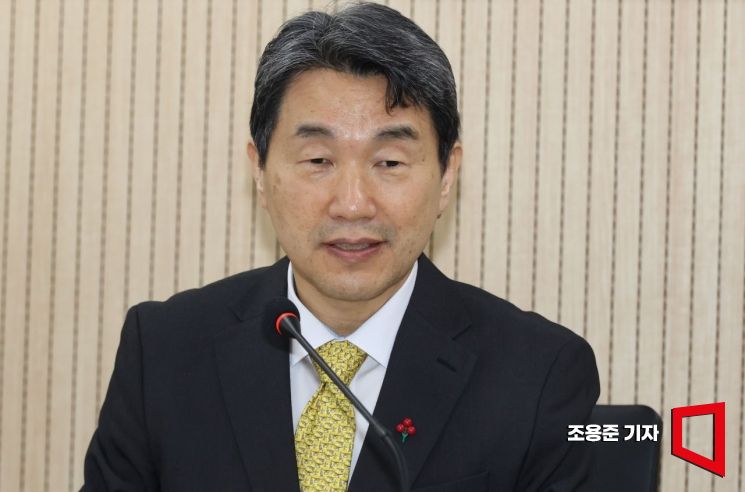 Lee Juho, Deputy Prime Minister for Social Affairs and Minister of Education, is speaking during a conversation with prospective teachers about AI digital textbooks at the "Together Chat Meeting" held on the 16th at TP Tower in Yeouido, Seoul. Photo by Jo Yongjun
The AI textbook was introduced in March this year for third and fourth graders in elementary schools, first-year students in middle schools, and first-year students in high schools nationwide, covering English, mathematics, and information subjects. However, the adoption rate in the first half of the year remained in the 30% range. Even before its introduction, the AI textbook caused confusion over whether it should be classified as a "textbook" or "teaching material," and now it is once again facing the risk of losing its status as an official textbook.
According to the education sector and other sources on the 26th, the National Assembly's Education Committee plans to hold a subcommittee meeting for bill review on the 30th to discuss related legislation concerning the status of AI textbooks. On the previous day, Kang Kyungsook, a member of the Rebuilding Korea Party, led the proposal of a partial amendment to the Elementary and Secondary Education Act, which aims to clarify the legal definition of textbooks and stipulate that the AI textbooks introduced this year should be used as "teaching materials."
Current law does not clearly define the concept or scope of textbooks. The AI textbooks promoted by the government so far have been given a legal basis not by law but by revising the administrative regulation "Regulations on Textbooks." However, since administrative regulations do not go through deliberation and resolution by the National Assembly, there are concerns about a lack of procedural legitimacy, especially in areas directly related to citizens' basic rights such as education and welfare. In this context, there has been ongoing criticism that encouraging the use of AI textbooks in schools with public funds violates the principle of statutory regulation in the education system.
The proposed amendment would directly define textbooks in the law, rather than in an enforcement decree, and stipulate that items corresponding to AI textbooks would be classified as "educational materials" rather than as official textbooks.
According to the main points of the amendment, "textbooks" would be defined as textbooks and teacher's guides for which the state holds copyright or which have been approved or recognized by the Minister of Education. Learning support software and electronic works utilizing intelligent information technology would be excluded from this definition.
In addition, "digital educational materials" could be used as supplementary materials for the curriculum, but the Minister of Education and superintendents of education would not be allowed to intervene in or exert influence over the use of these materials.
The bill also includes a supplementary provision stating that any textbooks not meeting the revised criteria would no longer be considered official textbooks once the law is enacted. Currently, 17 metropolitan and provincial offices of education nationwide have adopted AI textbooks as official textbooks, but this means their status as textbooks would be revoked in the future. However, if a school principal deems them necessary for the curriculum, they may still be used as "educational materials" after review by the school management committee.
The National Assembly's Education Committee plans to address this amendment and other AI textbook-related bills at the bill review subcommittee on the 30th. Previously, President Lee Jaemyung announced in his campaign pledges that "AI textbooks will be defined as educational materials, and schools' autonomy in choosing them will be guaranteed," signaling a complete overhaul of the AI digital textbook policy. As a result, the amendment related to AI textbooks is expected to pass without significant obstacles.
Kang Kyungsook stated, "Textbook policy must be based on statutory principles to ensure stability for students, schools, and the law," and added, "We must correct situations where someone tries to act arbitrarily or wield undue influence."
© The Asia Business Daily(www.asiae.co.kr). All rights reserved.
![Clutching a Stolen Dior Bag, Saying "I Hate Being Poor but Real"... The Grotesque Con of a "Human Knockoff" [Slate]](https://cwcontent.asiae.co.kr/asiaresize/183/2026021902243444107_1771435474.jpg)
















