"Loan Regulations Expected to Calm Panic Buying"
Park Wongap, Senior Real Estate Specialist at KB Kookmin Bank
Park Wongap, Senior Real Estate Specialist at KB Kookmin Bank, forecasted that this year's real estate market would follow a "strong first half, moderate second half" pattern. He explained that while housing prices in key areas of Seoul showed strength in the first half of the year, they may lose momentum in the second half as the government's lending regulations become more stringent.
On the 27th, during an appearance on SBS Radio's "Kim Taehyun's Political Show," Park commented on the outlook for the real estate market in the second half of the year, stating, "I expect the strong trend to subside somewhat. I see the market as 'strong first half, moderate second half.' The government is likely to introduce measures to curb demand, and there is a high possibility that certain areas of Seoul, such as Mapo and Seongdong districts, will be designated as speculative zones. Lending regulations may also be implemented. At the very least, these measures should be enough to calm panic buying."
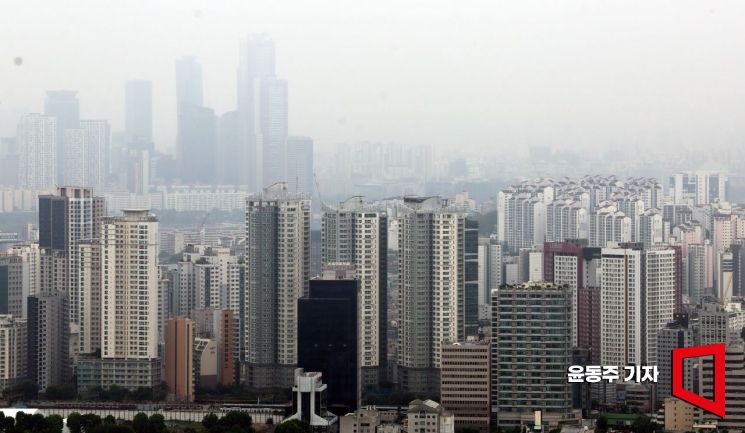 On the 27th, apartment prices in Mapo and Seongdong districts of Seoul rose at the largest rate since related statistics began to be published in 2013. The expectation that Seoul apartment prices will continue to rise is forecasted to sustain the upward trend for the time being. The photo shows a panoramic view of apartment complexes in downtown Seoul as seen from Namsan, Seoul. 2025.06.27 Photo by Dongju Yoon
He added, "If housing prices in overheated areas like Gangnam and Mayongseong (Mapo, Yongsan, and Seongdong districts) stabilize, liquidity could flow into previously sluggish provincial markets through the cyclical buying effect, where the prices of properties similar to those that have recently surged also rise."
Park noted, "Currently, apartment prices in certain areas of Seoul, such as the three Gangnam districts and Yongsan, have surpassed their previous peaks recorded during the Moon Jae-in administration. However, the rest of the metropolitan area and provincial regions remain in a slump. The defining characteristic of the current real estate market is this severe polarization."
When asked whether the sharp rise in housing prices might trigger panic buying among investors, Park responded, "The current sentiment driving up prices is rooted in anxiety over (housing) supply. We are seeing a rush of last-minute demand. There is also an expectation that housing prices will rise if a progressive administration comes to power."

However, Park pointed out, "Although there are many claims that the real estate market is strong under progressive administrations, if we look back, housing prices jumped by as much as 70% during the Roh Tae-woo administration. The expectation that housing prices rise under a progressive government is likely due to the strong impression left by the Moon Jae-in administration."
Regarding President Lee Jaemyung's campaign pledge not to control the real estate market through taxation, Park interpreted this as "an intention not to repeat the real estate policies of former Presidents Roh Moo-hyun and Moon Jae-in." However, he emphasized that to stabilize the real estate market going forward, "the government must send a clear signal regarding supply," and added, "If necessary, the option of a fourth-generation new town should be considered."
Park concluded, "The defining feature of the current real estate market is the apartment frenzy. Land, commercial properties, and single-family homes have actually been left behind, and the polarization between Seoul and the provinces is severe. A two-track strategy is needed to address the issues of Seoul and the metropolitan area, where demand is overflowing, and provincial real estate, where the unsold rate reaches 80%."
© The Asia Business Daily(www.asiae.co.kr). All rights reserved.


















