Unsettling Rise in Seoul Apartment Prices
Difficult to Acquire Without Inheritance
Concerns Over Soaring Real Estate Under Progressive Administrations
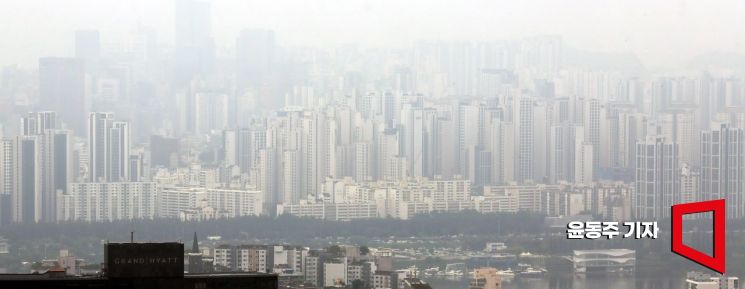 On the 27th, apartment prices in Mapo and Seongdong districts of Seoul rose at the largest rate since related statistics began to be published in 2013. The expectation that Seoul apartment prices will continue to rise is forecasted to sustain the upward trend for the time being. The photo shows a panoramic view of apartment complexes in downtown Seoul as seen from Namsan, Seoul. 2025.06.27 Photo by Dongju Yoon
My wife has been frowning and sighing for several days. When I asked her what was wrong, she said it was because of the president. To be precise, it is the soaring housing prices that are the problem. There is a saying, "There isn't even enough land to stick an awl in." That's us. We have never been able to buy real estate in our entire lives. It's not that we couldn't buy a house because we didn't earn enough money. My wife and I both had what people call good jobs and worked for decades.
The problem was that we didn't want to take on debt. Since both of us were earning, we thought that if we saved for a few years, we could buy a house without having to borrow money. To be honest, we also thought that real estate prices were so high that they would eventually fall. But that was a misjudgment. After several years of saving and cutting back, by the time we had saved up the amount we had aimed for, housing prices had risen much more than we expected.
During the last presidential election, my wife said that housing prices tend to rise when a progressive administration comes to power. At the time, I dismissed it as an overgeneralization. However, recently, the rise in housing prices has become alarming. Apartment prices in Seoul continue to climb. Last week (the third week of June), they jumped by 0.36% compared to the previous week. This is the highest increase in 6 years and 9 months since the second week of September 2018 (0.45%). The Bank of Korea has unusually issued a report warning that, at this rate, housing prices in Gangnam could rise by 30% annually. In this situation, it is hard not to recall the "progressive administration real estate price surge theory" that is circulating in the market.
For decades, whenever the Democratic Party came to power, real estate prices surged. The Citizens' Coalition for Economic Justice stated that the period when housing prices rose the most was during the Moon Jae-in administration. Over five years, the price of a 99-square-meter apartment in Seoul soared by 119%. The next highest increases were under Roh Moo-hyun (80%), Park Geun-hye (21%), Yoon Suk-yeol (1%), and Lee Myung-bak (-10%). In fact, from the perspective of a political party or candidate seeking votes, soaring housing prices are not necessarily a disadvantage. As of 2023, the proportion of households without homes was 43.6%. It could be argued that there are more people who benefit from rising housing prices.
However, every child born in the future will have no home of their own. The Citizens' Coalition for Economic Justice calculated that if a worker with the average wage (40 million won) saved every penny, it would take 32 years to buy an apartment in Seoul. For an apartment in Gangnam, it would take 80 years. Unless you inherit, it is virtually impossible. We lived in an era where you could buy a nice house through effort. If you didn't have a house, people might say you lacked judgment or didn't work hard enough.
This week, there was an article reporting that the price of a 99-square-meter apartment in Banpo One Bailey, Gangnam exceeded 7 billion won. If real estate prices rise as they did during past progressive administrations, in five years, the price of One Bailey could easily surpass 10 billion won. If that happens, Korea will become not a democratic society, but a class society. How many people can accumulate 10 billion won without inheriting from their ancestors? Apartments will take on the role that family lineage once played.
It seems that a social structure more similar to Silla's bone rank system than to the Joseon era (yangban) will take shape. For example, owners of apartments like One Bailey in Banpo would be considered "sixth rank," owners in the three Gangnam districts would be "fifth rank," and owners of major apartments in the metropolitan area would be "first rank," and so on. Instead of family lineage, apartments will determine social status. You might be able to work your way into the lower ranks, but reaching the sixth rank without relying on family ties will be as difficult as plucking a star from the sky. The amount of money required is beyond what can be achieved through effort alone.
Prices are determined by supply and demand. If supply increases, prices fall. Ultimately, the only way to lower apartment prices is to build more and release them into the market. However, you can't build apartments overnight. For the time being, supply must be increased by encouraging people to sell their apartments. If taxes are temporarily reduced when selling apartments, more people will be willing to sell. At the same time, if higher property taxes are imposed on apartment owners who have benefited greatly from price increases, more apartments will come onto the market. In the next presidential election in five years, there should no longer be talk of real estate prices soaring whenever the Democratic Party comes to power.
© The Asia Business Daily(www.asiae.co.kr). All rights reserved.
![Clutching a Stolen Dior Bag, Saying "I Hate Being Poor but Real"... The Grotesque Con of a "Human Knockoff" [Slate]](https://cwcontent.asiae.co.kr/asiaresize/183/2026021902243444107_1771435474.jpg)















