Monthly Allowance of 100,000 Won to Be Provided to Descendants Starting Next Year
429 Actual Beneficiaries... Annual Budget Set at 1,098,000,000 Won
Ordinance Established to Reevaluate the Value and Honor of the Donghak Peasant Revolution
Recently, news that Jeollabuk-do is considering providing allowances to the descendants of participants in the Donghak Peasant Revolution has sparked heated debate among netizens. In particular, some netizens have argued that if the Donghak Revolution is recognized as the foundation of the independence movement and allowances are paid to its descendants, then the families of those who sacrificed for the country during events such as the Imjin War or the Korean War (6·25 War) should also receive support payments.
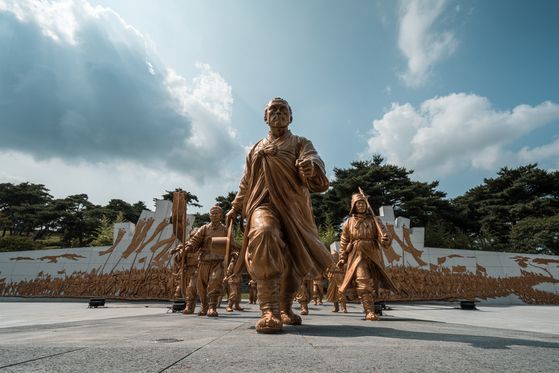 The statue procession of General Jeon Bongjun and the Donghak Peasant Army, erected in June 2022 at the Hwangtohyeon historic site in Deokcheon-myeon, Jeongeup-si, Jeollabuk-do. Jeongeup-si
Previously, Jeollabuk-do announced that it is internally reviewing the provision of allowances to the descendants of Donghak Peasant Revolution participants residing in the province starting in 2026. This is in accordance with the revised "Ordinance on Support for Donghak Peasant Revolution Commemoration Projects in Jeollabuk-do," which was amended in September last year. While the Donghak Peasant Revolution descendants' allowance may be unfamiliar to people living in the Seoul metropolitan area and elsewhere, it is not a new initiative. Since 2020, Jeongeup City has already been providing a monthly allowance of 100,000 won, with 90 people currently receiving it as of this month. However, there are opinions that paying allowances from taxpayers' money to the descendants of the Donghak Peasant Revolution, which broke out 131 years ago at the end of the Joseon Dynasty, is unreasonable.
Following this news, a variety of opinions have emerged on a local community forum in Jeollabuk-do. Some netizens criticized the policy, saying, "Does it make sense to suddenly pay monthly allowances to the descendants of Donghak peasants?" and "I'm angry that taxes are being spent recklessly." In response, others commented, "My ancestors went through the Imjin War and the Manchu Invasion of Korea, so give us support payments too," and "We should first take care of the descendants of independence fighters from the Japanese colonial period." Another netizen remarked, "Instead, use that money to properly compensate veterans of the Korean War or the Vietnam War." Among these, one netizen pointed out, "The Donghak Peasant Movement is a meaningful and memorable historical event, but it happened more than 100 years ago," adding, "If allowances are paid to the descendants of historical events from the Joseon Dynasty, then allowances should also be paid to the descendants of the Goryeo, Goguryeo, Baekje, and Silla eras."
According to Jeollabuk-do, the total number of descendants of Donghak Peasant Revolution participants in the province, including children, grandchildren, and great-grandchildren, is 915. The allowance is planned to be paid to one person per household. The actual number of beneficiaries is estimated to be about 429, and the annual project budget is expected to be approximately 1,098,000,000 won. Yeom Youngsun, the Jeollabuk-do Provincial Assembly member who sponsored the related ordinance, explained, "We hope that the value and importance of the Donghak Peasant Revolution will be re-evaluated, that participants will be recognized as independence patriots, and that this will have a positive impact on including the spirit of the Donghak Peasant Revolution in the preamble of the Constitution."
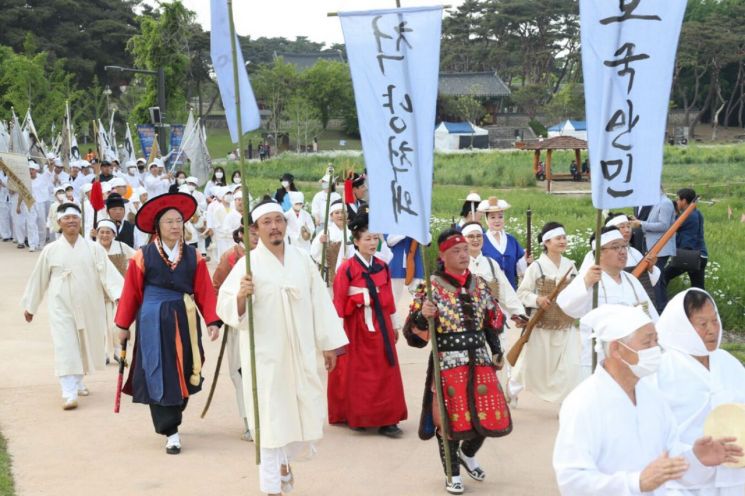 On May 11, the 58th Donghak Peasant Revolution Commemoration Ceremony was held in Jeongeup, Jeonbuk, where citizens dressed as peasant soldiers reenacted the march. Jeongeup City
Regarding the recent controversy, he stated, "Because the Donghak Peasant Revolution was the starting point of the independence movement, we reviewed the allowance from the perspective of fairness as a historical asset of Jeollabuk-do," and added, "I understand that the state has already provided benefits to generals and their descendants who participated in the Imjin War." A Jeollabuk-do official said, "Together with the 14 cities and counties in the province, we are internally reviewing the eligibility, scope, and amount of the descendants' allowance," and explained, "The spirit of the Donghak Revolution served as the foundation for the March 1st Movement, and we are also working to amend the law to recognize Donghak Revolution participants as national patriots."
Meanwhile, the Donghak Peasant Revolution was a representative anti-feudal and anti-foreign popular movement that unfolded in 1894, led by Jeon Bongjun. Farmers across the country rose up to denounce the corrupt government and greedy officials, and to resist foreign intervention. Although it ultimately failed due to military suppression, it is regarded as a historic event that had a profound impact on subsequent modern national movements, such as the Gabo Reform and the March 1st Movement.
© The Asia Business Daily(www.asiae.co.kr). All rights reserved.


















