First Revised Proposals Submitted at the 7th Minimum Wage Commission Meeting
Gap Narrows to 1,440 Won... Labor and Management Remain at Odds
As labor and management have entered into a full-fledged tug-of-war to determine next year's minimum wage, business representatives have proposed 10,060 won. This figure is 30 won higher than their initial proposal, which was at this year's level. Labor representatives have maintained their previous proposal of 11,500 won.
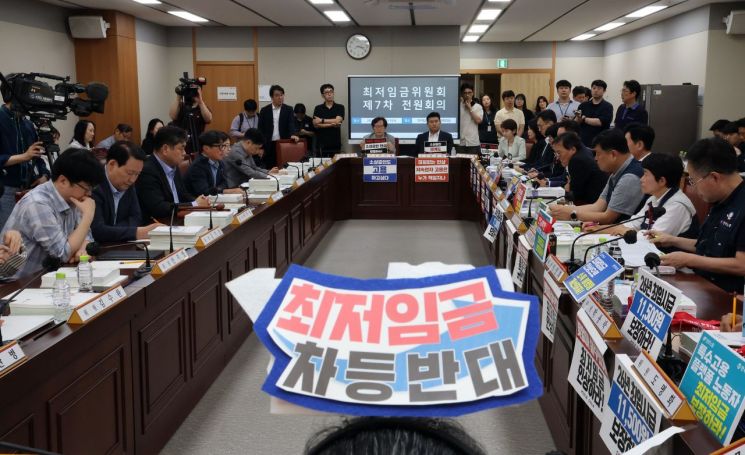 The 7th plenary meeting of the Minimum Wage Commission held at the Government Sejong Complex on the 26th. Photo by Yonhap News
The Minimum Wage Commission held its 7th plenary meeting at the Government Sejong Complex on the 26th. A total of 26 members attended the meeting, including 9 labor representatives, 9 management representatives, and 8 public interest representatives.
At the meeting, labor and management each submitted their first revised proposals for next year's minimum wage. The business side demanded 10,060 won, which is 30 won (0.3%) higher than their initial proposal. The labor side maintained their initial proposal of 11,500 won, which is a 14.7% increase from this year. As a result, the wage gap between the two sides has narrowed from 1,470 won to 1,440 won.
Although the gap has narrowed somewhat, significant differences remain between labor and management. The business side argued that, since the discussion on differentiated minimum wages by industry was scrapped at the previous plenary meeting, a single minimum wage applicable to all industries must be set. The labor side asserted that next year's minimum wage proposal reflects the current economic situation.
Ryu Kijeong, Executive Managing Director of the Korea Employers Federation, stated, "Since a single minimum wage must be set without industry differentiation, next year's level should be determined based on the most difficult business sectors." He continued, "When considering the four legal criteria for wage determination?companies' ability to pay, cost of living, wage levels of similar workers, and income distribution ratio?it is difficult to justify an increase in next year's minimum wage compared to this year."
He also emphasized, "The ability to pay among small business owners and small- and medium-sized enterprises has reached its limit." He added, "In terms of income distribution, key indicators such as the Gini coefficient, relative poverty rate, and income quintile ratio showed little improvement based on market income in 2018 and 2019, when the minimum wage was significantly increased. Therefore, it is not appropriate to further raise the minimum wage, which has a large negative ripple effect, for the purpose of income distribution."
Ryu Kiseop, Secretary-General of the Federation of Korean Trade Unions, stated, "The 11,500 won proposal is extremely reasonable and rational." He added, "As shown in the cost of living report provided for this year's minimum wage review, households of minimum wage workers with multiple members require much higher living expenses than the current minimum wage level allows."
He also said, "The initial demand from the labor representatives is about half the level of previous years," and explained, "We actively considered and reflected the sharply depressed domestic demand caused by the severe political situation last winter." He continued, "I hope this year's minimum wage decision will establish a level that reflects the intent and purpose of the Minimum Wage Act, which aims to stabilize the livelihoods of low-wage workers, as well as the living expenses of workers."
Given the remaining differences, the Minimum Wage Commission plans to narrow the gap in proposed increase rates through further negotiations. The statutory deadline for deliberating next year's minimum wage is the 29th, but it is highly likely that the review will exceed the deadline again this year.
© The Asia Business Daily(www.asiae.co.kr). All rights reserved.
![Clutching a Stolen Dior Bag, Saying "I Hate Being Poor but Real"... The Grotesque Con of a "Human Knockoff" [Slate]](https://cwcontent.asiae.co.kr/asiaresize/183/2026021902243444107_1771435474.jpg)















